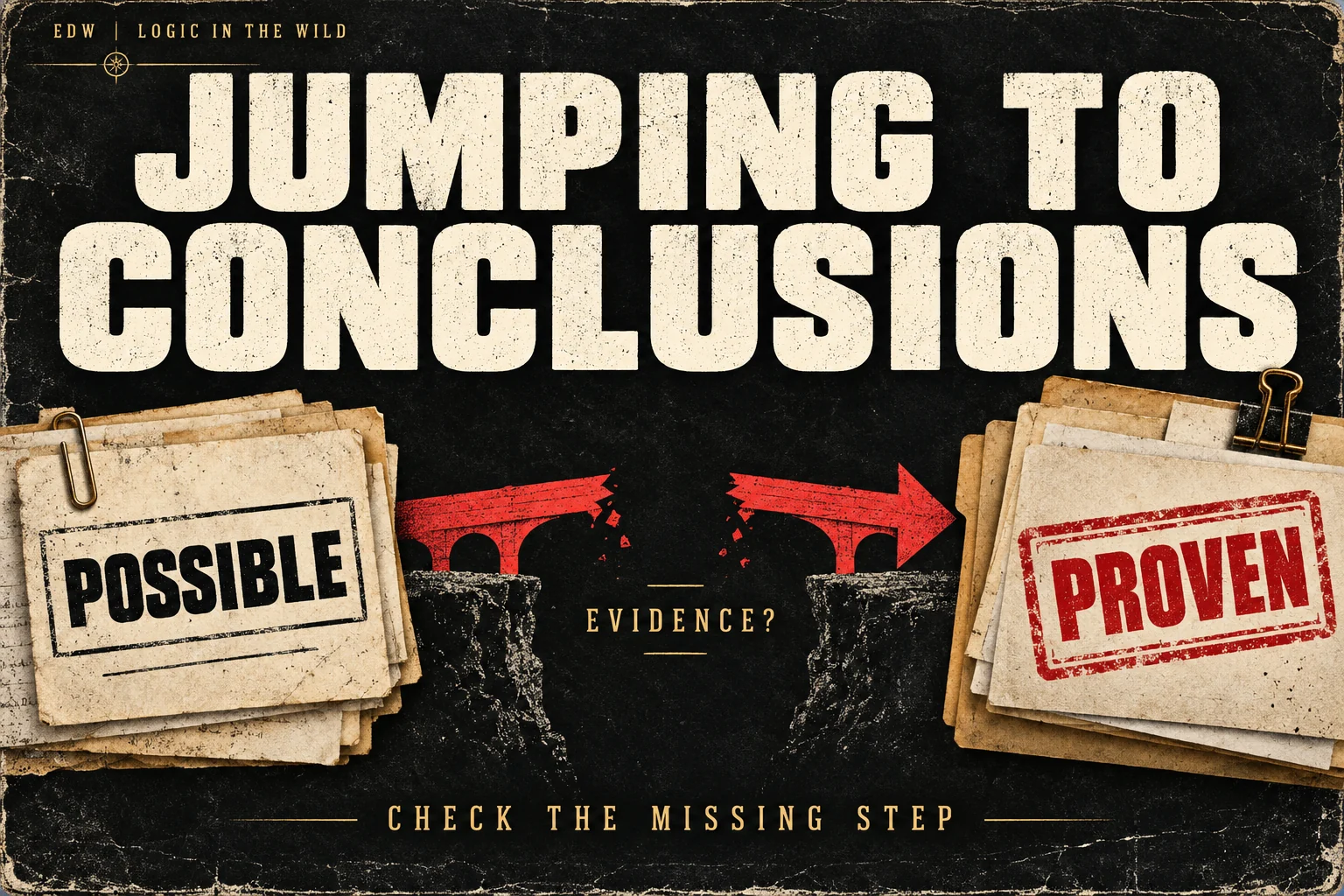
Jumping to conclusions means settling on an answer before obtaining and considering enough relevant evidence, when further checking is reasonably available. Speed alone is not the problem. A quick decision can be sensible. The problem is treating a conclusion as better established than the evidence makes it.
Imagine a package disappears from your porch. A neighbor walked past ten minutes earlier. You announce that the neighbor stole it. Their presence may justify a question. It does not eliminate a delivery mistake, another person taking the package or someone in your household bringing it inside. The doorbell recording would be a useful place to start before printing wanted posters.
Or imagine a town’s new budget could lead to a service reduction. Someone announces that the council has already decided to close the library. A possible consequence has become a settled decision. Ask for the adopted budget, meeting record and actual service plan.
These are invented teaching examples. They illustrate different missing steps: identifying the responsible person and converting a possibility into a claimed fact.
Use a simple distinction. Possible means compatible with what we know. Probable means supported strongly enough to be more likely under the relevant assessment. Established requires evidence adequate to the claim and context. Those labels are not interchangeable. The strength needed for a tentative hypothesis differs from the strength needed for a public accusation.
We still have to act under uncertainty. If water is pouring through the ceiling, you can move the furniture before completing a plumbing investigation. Proportionate precautions and provisional decisions can be justified by risk. They do not authorize inventing certainty about the cause or assigning blame.
The repair is practical: name the conclusion, identify the evidence actually supplied, ask which alternatives remain plausible, and check what could distinguish them. State the remaining uncertainty. Revise when better evidence arrives.
Hasty generalization is a related but more specific mistake: a conclusion about a larger group outruns its sample. Jumping to conclusions can instead concern one person or one event. Confirmation bias may encourage premature conclusions, but an argument alone cannot establish the speaker’s private psychology.
Finding this error does not prove the conclusion false. It shows that the route offered to it needs repair. We are checking an argument, not awarding the opposing side an automatic victory.
The linked Alaska example examines the move from possible ballot confusion to a categorical accusation. The further-reading links also connect this lesson to hasty generalization and confirmation bias.
EDW•