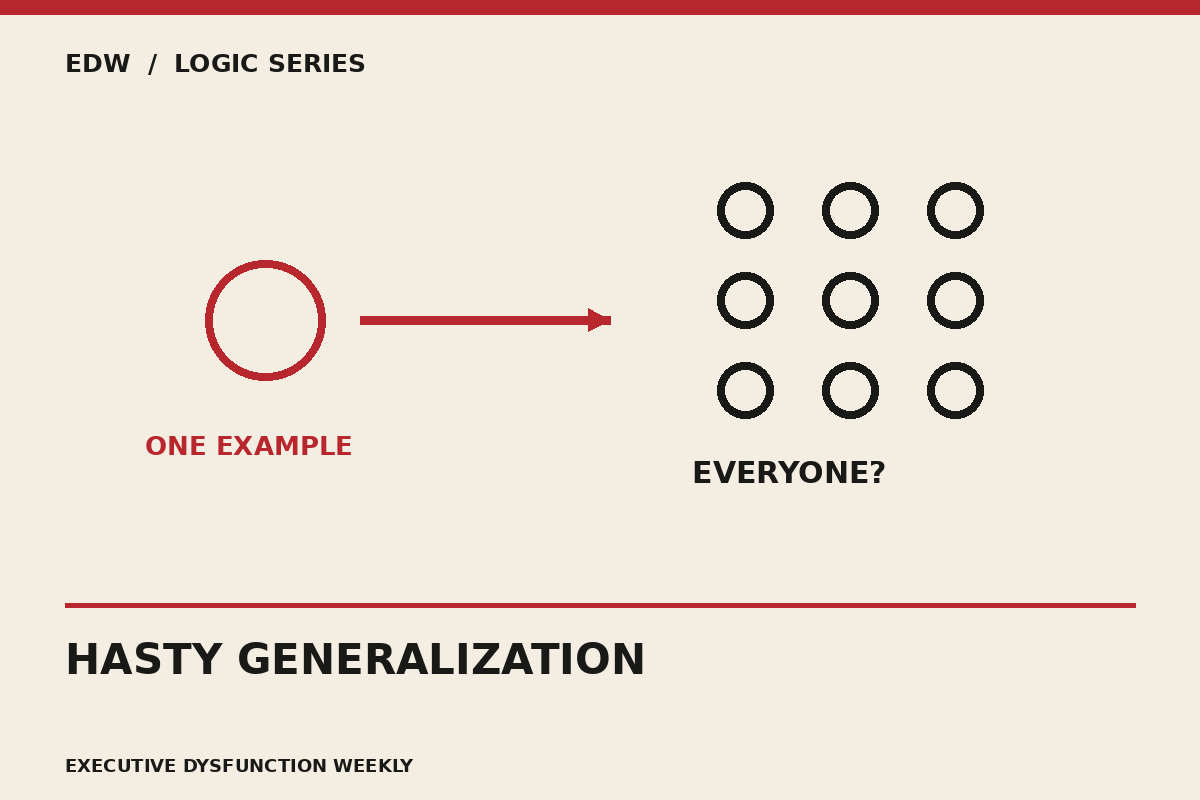
(“They all…”: the shortcut that turns disagreement into dehumanization.)
If you want to watch a conversation collapse in real time, listen for this move:
“They ALL do that.”
“That’s what THEY are.”
“Every one of them is…”
“None of them care about…”
This is the hasty generalization / overgeneralization pattern: taking a small number of examples (often the worst examples), then treating them as proof of what an entire group is like.
It’s not just sloppy logic. It’s relationship napalm.
Because the moment you do this, you’re no longer arguing about behavior or policy.
You’re arguing about someone’s identity, and you’re telling them their entire “group” is guilty.
What it is (plain English)
A hasty generalization is when you draw a big conclusion from a small, unrepresentative sample.
Example patterns:
• You meet two rude people from a group → “That group is rude.”
• You see one viral clip → “That’s how they all are.”
• You have one awful interaction → “They’re all the same.”
This shows up everywhere in politics:
• “All conservatives are ___.”
• “All liberals are ___.”
• “All cops are ___.”
• “All protesters are ___.”
• “All immigrants are ___.”
The problem is extending limited evidence to a whole group without adequate support. Words like “all” are a warning to check the evidence, not proof of a fallacy.
Why it’s toxic
1) It makes honest discussion impossible.
If I’m “already” defined as stupid/evil/corrupt because of my label, why would I keep talking?
2) It rewards the worst actors.
The worst person in a group becomes the “representative” of the entire group. Meanwhile, the quiet majority disappears.
3) It breaks your own ability to think clearly.
You start collecting examples that support your story and ignoring the ones that don’t. That’s how people get trapped in certainty.
How to spot it (fast)
Watch for absolute language:
• all / none / always / never / everyone / no one
Watch for “group as a single organism” language:
• “They want…” “They believe…” “They’re trying to…”
And watch for the emotional signature:
If the statement makes you feel righteous and furious at an entire category of people, there’s a good chance it’s overgeneralized.
How to respond calmly (without starting a fight)
Don’t say “that’s a fallacy.” That triggers ego-defense.
Try one of these instead:
1) The quantifier question (my favorite)
“When you say ‘all,’ what percent do you actually mean?”
2) The sample-size question
“What’s your sample for that: personal experience, a few posts, or data?”
3) The exception test
“Can you name one exception? If there are exceptions, then it’s not ‘all.’”
4) The behavior redirect
“Can we criticize the specific behavior without condemning an entire group?”
5) The leadership vs people distinction
“Are you talking about party leaders/media voices, or regular voters/regular people?”
6) The fairness mirror
“Would you accept that exact statement if someone said it about your group?”
How to avoid doing it yourself (the truth-seeker standard)
Before you post “they all…,” ask:
• Am I reacting to a few loud examples and treating them as the whole?
• Am I using the worst person to define everyone?
• Am I confusing ‘what some people say online’ with ‘what most people believe’?
• Would I stake my reputation on this being accurate?
If the answer is “I’m not sure,” that’s not a weakness.
That’s wisdom.
(And yes, I have this philosophy tattooed on my body: “Wisdom is the awareness of ignorance.” Not because ignorance is cute, but because awareness is where learning begins.)
A better way to speak (that people can actually hear)
Replace “they all” with:
• “Some people in X are doing Y, and I oppose Y because…”
• “The behavior I’m criticizing is…”
• “In my experience…” (and own it as experience, not universal truth)
• “Here’s what I’ve seen; do you have different evidence?”
That’s how you stay strong without turning neighbors into enemies.
24-hour challenge
For one day, do this:
• Ban “all/none/always/never” when describing groups.
• If you catch yourself typing it, replace it with:
“some” + the behavior + the reason you oppose it.
Example:
Not: “They’re all corrupt.”
Yes: “Some leaders are corrupt, and I want transparency/oversight because…”
You’ll notice something: people argue back less, and think more, because you didn’t insult their identity. You criticized something concrete.
If you want more of this series, follow Executive Dysfunction Weekly and share this post.
And tell me: what’s the most common “they all…” claim you see in your feed?
Next up (your pick): Cherry-Picking, Slippery Slope, or Moving the Goalposts.