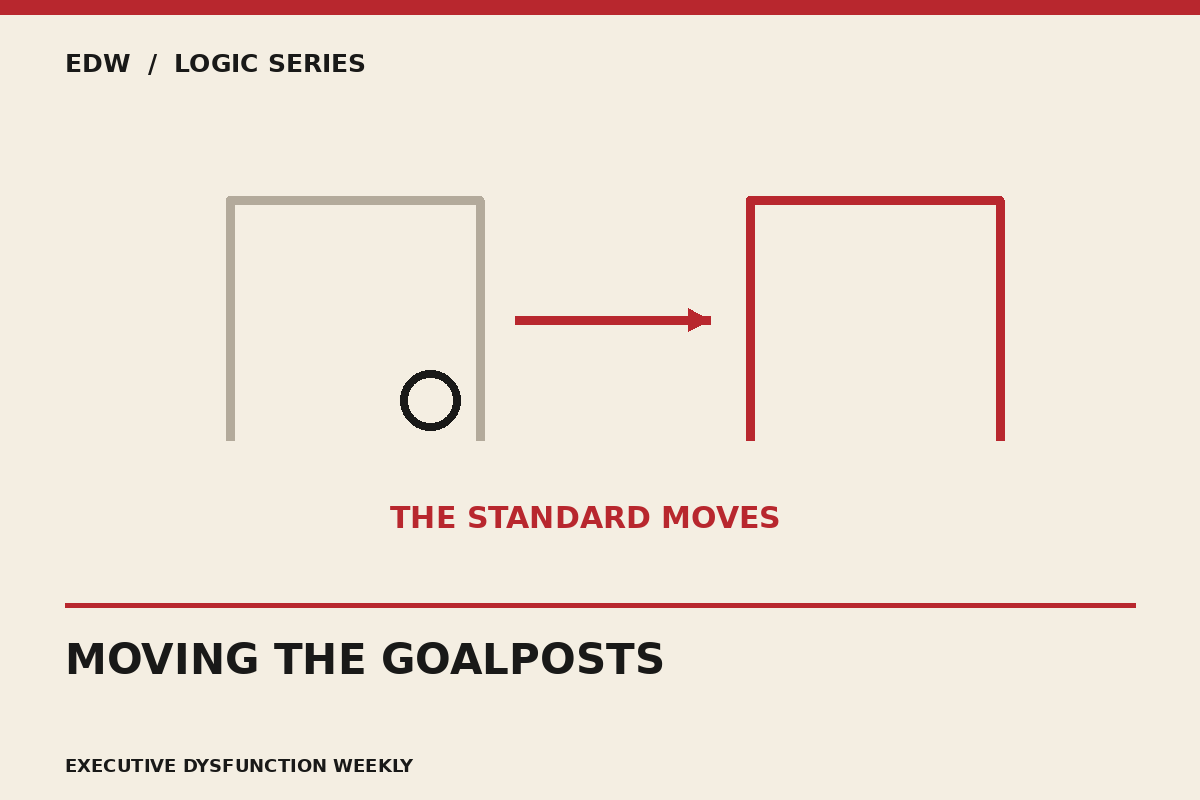
(“You proved it… so now the standard changes.”)
If you’ve ever felt like an argument is a treadmill (where you keep providing answers, links, data, examples, and context, but the “win condition” keeps shifting), there’s a name for that pattern:
Moving the goalposts.
It’s when someone changes the rules or requirements mid‑discussion in order to avoid conceding a point. Not because they learned something new and updated their view (that’s healthy), but because “being right” has become the entire mission.
And it quietly destroys relationships, because it teaches everyone involved that honesty will be punished and stubbornness will be rewarded.
What it looks like in the wild
You’ll recognize it by the rhythm:
• “Okay, but that doesn’t count.”
• “Fine, but that source is biased.”
• “Sure, but I meant something else.”
• “Even if that’s true, it doesn’t matter.”
• “That’s not what we’re talking about.”
• “Prove it again, in a different way, using different criteria.”
The goalposts move when:
1) You meet the standard they demanded…
2) And they immediately demand a higher/different standard…
3) Without acknowledging that you met the first one.
Why it’s so toxic
Moving the goalposts isn’t just “annoying.” It has three predictable outcomes:
1) It punishes good faith.
If someone does the work to engage honestly and gets met with shifting requirements, they learn: “Evidence doesn’t matter here.”
2) It makes debates infinite.
No conversation can end if the end condition is never allowed to exist.
3) It turns disagreement into identity warfare.
When conceding a point feels like “losing,” people start protecting their identity instead of pursuing truth.
How to tell the difference between “learning” and “goalpost moving”
This is important: changing your mind or refining your claim is not a sin. It’s what intelligent people do.
The difference is whether the person says something like:
• “You’re right, that evidence changes the picture. Let me update my claim.”
(That’s growth.)
Versus:
• “That doesn’t count; now prove X.”
(That’s evasion.)
A truth seeker can adjust the claim. A goalpost mover adjusts the rules to avoid admitting the claim changed.
How to respond calmly (without escalating)
Don’t accuse them of “goalpost moving.” That usually triggers defensiveness.
Instead, use one of these scripts:
1) Lock the standard BEFORE you keep working
“Fair question. Before I go pull more sources, what would count as sufficient evidence for you? One government report? Two? A court filing? A primary document?”
2) Mirror the earlier requirement
“Earlier you said you’d accept X. I provided X. Are you willing to update your claim based on that?”
3) Name the pattern without labeling the person
“I’m noticing the standard keeps changing after I meet it. If we can’t agree on what would change your mind, this turns into an endless loop.”
4) Set a boundary (this is a strength, not a retreat)
“I’m happy to keep talking if we can set clear criteria. If not, I’m going to step away, because I’m not here to perform. I’m here to learn and be accurate.”
How to avoid doing this yourself (quick self-check)
Before you type “yeah but…,” ask:
• Did they answer my actual question?
• If yes, am I about to change the standard because I don’t like where the answer leads?
• If I’m refining the claim, am I willing to say: “I was wrong / I overstated / that changes things”?
If you can’t say that sentence, you’re not debating facts; you’re defending a badge.
Mini-challenge (try this for one week)
Before you argue online, write down ONE sentence privately:
“What would change my mind on this issue?”
Then behave like a serious person: if you see that evidence, update your view in public.
That’s not weakness. That’s integrity.
EDW goal here isn’t to “win” debates.
It’s to help normal people have hard conversations without turning neighbors into enemies.
If this series is useful, follow EDW and share it with someone you trust.
And if you’ve seen goalpost moving lately, drop the cleanest example you’ve seen (no names, no doxxing), and we’ll turn it into a practice exercise.