(“I don’t believe facts. I believe my team.”)
If you’ve ever watched two people see the same video, read the same document, and walk away more convinced than ever that the OTHER person is insane, welcome to motivated reasoning.
This is the quiet engine behind most political conflict right now. Not “low IQ.” Not “evil.” Not “brainwashing” (though propaganda exists). Often it’s something more ordinary and more human:
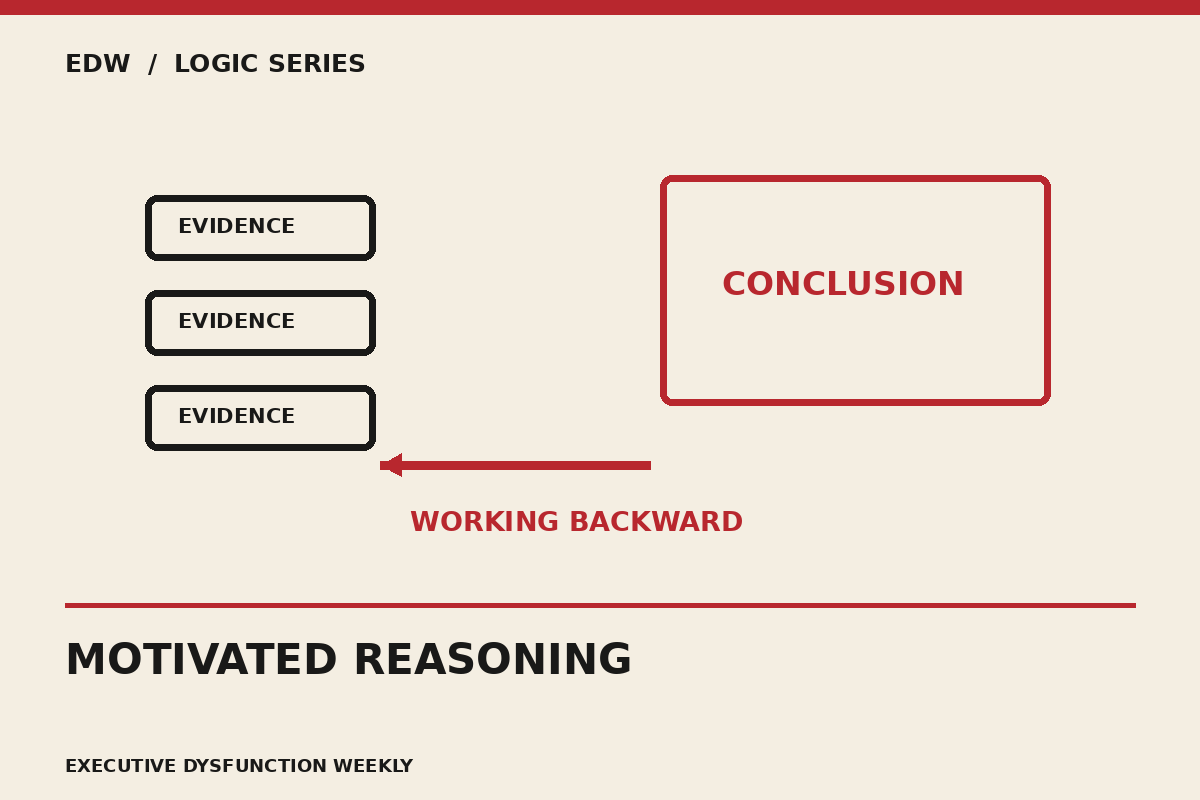
We start with a conclusion that protects our identity, and then we go shopping for reasons.
What it is
This lesson concerns directional motivated reasoning: working toward a conclusion we want, perhaps to protect our tribe, avoid embarrassment or defend a leader. Research also distinguishes accuracy goals, where the aim is to reach the right answer whatever it turns out to be.
It’s not lying.
It’s not always conscious.
It’s how smart people stay wrong with confidence.
The tell: the conclusion is fixed
With honest reasoning, you should be able to say:
“What evidence would change my mind?”
With motivated reasoning, the answer is:
“Nothing, because I already know.”
How it shows up online (common patterns)
1) “I already know what happened.”
Before facts are in, the story is locked.
2) “Any source that disagrees is fake.”
A source isn’t evaluated by accuracy, but by whether it’s friendly.
3) “That doesn’t count.”
Evidence that supports the other side is dismissed with vague skepticism; evidence that supports our side is accepted instantly.
4) “Moving goalposts.”
When one claim fails, the argument quietly shifts to a different claim.
5) “What-aboutism as escape.”
Instead of dealing with the question, we pivot to someone else’s sins to protect our team.
Why it’s happening more now
Motivated reasoning spikes when:
• identity is threatened
• fear is high
• social punishment for dissent is severe
• algorithms reward outrage
• politics is treated like religion or sports
In other words: the current environment is practically designed to trigger it.
Why it’s dangerous
Motivated reasoning doesn’t just distort opinions. It breaks relationships.
It turns disagreement into:
• betrayal
• moral contamination
• “enemy” status
And once someone is the enemy, you don’t listen; you attack.
How to recognize it in yourself (two fast self-tests)
Self-test #1: Speed
How fast did you decide?
If you decided instantly, that’s often identity, not analysis.
Self-test #2: Standards
Are you applying the same standard of proof to “your side” as “their side”?
If you demand a mountain of evidence for the other side, but accept a meme for your side, you’re not evaluating; you’re defending.
How to respond without escalating (a calm toolkit)
Don’t accuse someone of “motivated reasoning.” That’s a fight-starter.
Do this instead:
1) Ask the mind-opening question:
“What evidence would change your mind?”
If the answer is “nothing,” ask why. It is a warning that the claim may be insulated from evidence, not proof of what is happening inside someone’s head.
2) Mirror the shared value:
“I think we both want safety and fairness. The disagreement is about what the evidence shows.”
3) Separate the claim from the tribe:
“We don’t have to agree with ‘their side’ to acknowledge this specific fact.”
4) Slow it down:
“Let’s pause and verify. What’s the primary source? What’s the full video? What’s the document date?”
5) Use the swap test:
“If the parties were reversed, would you interpret this the same way?”
This is the quickest way to expose double standards without insults.
A rule that saves relationships
When you feel the urge to post “I KNOW what’s happening”, stop and replace it with:
“Here’s what we know so far, here’s what we don’t know yet, and here’s what would change my mind.”
That one habit turns tribal argument back into thinking.
EDW bottom line
Motivated reasoning is why politics now feels like a Rorschach test:
we don’t just interpret facts; we interpret threats.
The antidote isn’t “being smarter.”
It’s being brave enough to be wrong in public, and disciplined enough to use the same standards on your own team.
If you want more of this series (one mental trap at a time), share this and follow EDW.
EDW•