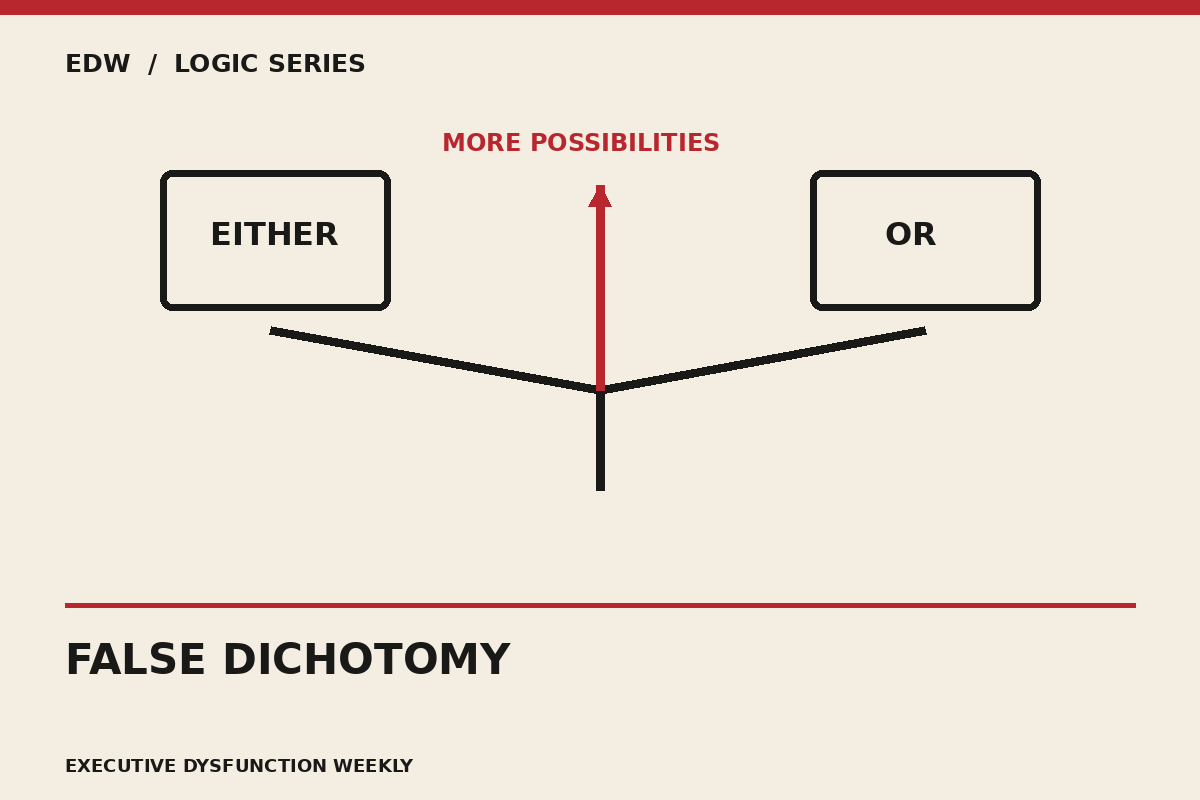
Somewhere along the line, we let our conversations get hijacked by the laziest, most destructive trick in the book:
The False Dichotomy.
The “either/or” trap.
The “pick a team or you’re the enemy” frame.
It sounds like:
- “If you criticize this tactic, you must hate that whole institution.”
- “If you support this policy goal, you must support every method used to pursue it.”
- “If you don’t agree with me 100%, you’re on the other side.”
This is the fastest way to turn neighbors into enemies. And it’s also a lie, because real life is almost never two boxes.
Here’s what research on polarization keeps finding: democracy gets stressed when we fall into “us vs them” thinking. When we stop treating each other as citizens with different priorities and start treating each other like rival tribes.
And the brutal part is that once we adopt the “two teams only” frame, we start misreading each other on purpose, or at least we become vulnerable to it. We imagine the other side is more extreme than they are. We assign motives. We fill in blanks with the worst interpretation. Researchers describe how even false polarization (exaggerated beliefs about the out-group) can become a self-fulfilling prophecy.
This is why I keep coming back to a core philosophy I literally have tattooed on my body:
“Wisdom is the awareness of ignorance.”
Not because ignorance is cute. Not because truth is optional.
Because awareness of what we don’t know is the doorway to learning and the antidote to being manipulated.
Black-and-white thinking feels powerful. It feels clean. It feels like certainty.
But it makes us easy to control.
So here’s the practice. Not for “them.” For all of us.
How to spot the false dichotomy (in them, AND in yourself)
Watch for words like:
- always / never
- everyone / no one
- only / must
- either / or (presented as the only choices)
And watch for the emotional signature:
- “If I don’t force a binary choice right now, I lose control of the conversation.”
How to respond without lighting the person on fire
Do not say: “That’s a logical fallacy.”
That’s a guaranteed ego-trigger.
Try one of these instead:
1) Name the missing options (calmly):
“I don’t think those are the only two choices. What’s a third option you’d accept?”
2) Use a both/and statement:
“I can want X and still question Y. Those aren’t mutually exclusive.”
3) Unbundle values from tactics:
“I think we share the same goal. We’re debating the method and the safeguards.”
4) Ask for the actual claim (not the tribal label):
“What specific action are you defending/criticizing? Let’s stay on that.”
The challenge (for me too)
Before we share a post, before we dunk on someone, before we block a cousin:
Ask one question:
“Am I forcing a false choice here?”
Because if we can’t hold complexity, we can’t hold a democracy.
If you want to be a strong thinker, you don’t start by proving you’re right.
You start by proving you’re honest.
And honesty begins with this sentence:
“I might be missing something.”
That’s not weakness.
That’s wisdom.