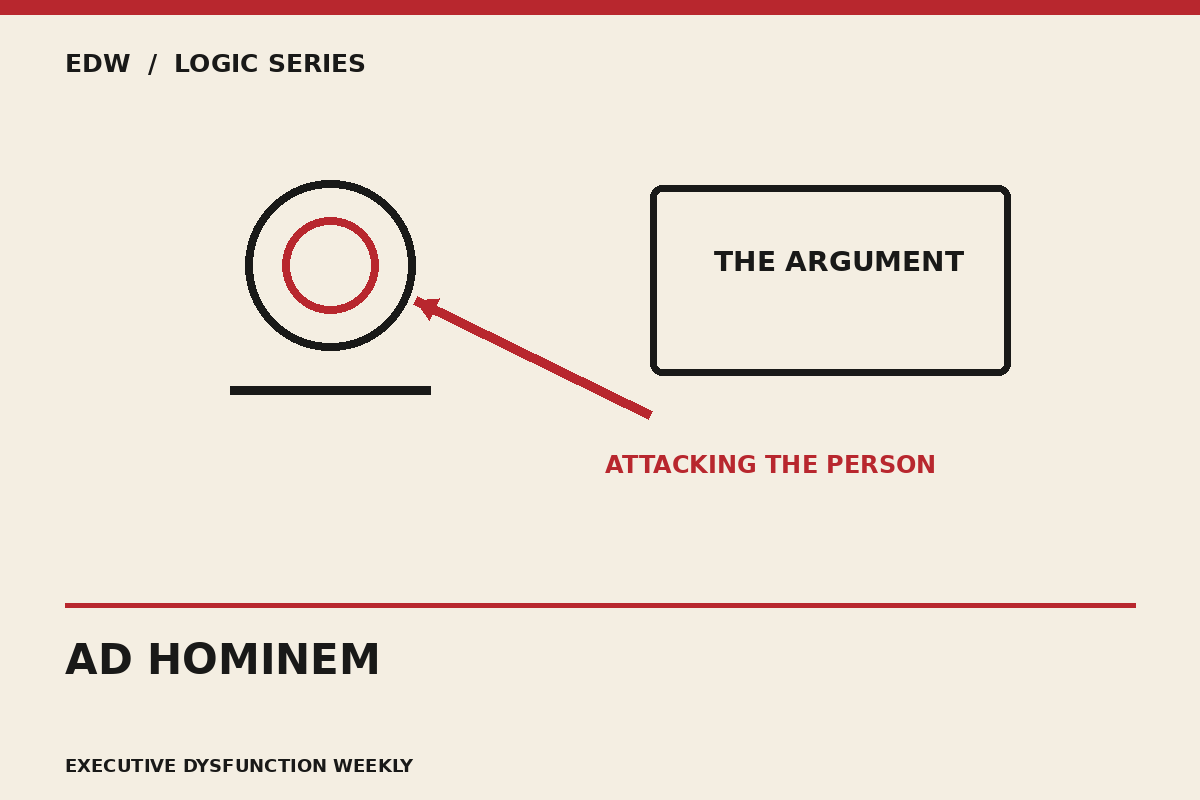
If you’ve ever walked away from a political conversation thinking, “We didn’t even talk about the issue,” there’s a good chance you just ran into one of the most common moves on the internet: the ad hominem attack.
Ad hominem means shifting from the claim to the person. In plain English: “I don’t have to deal with your point because I can discredit YOU.”
It usually looks like this:
1) You say: “Here’s my claim: X.”
2) They reply: “You’re a (idiot / snowflake / fascist / groomer / commie / racist / brainwashed / paid shill).”
3) Therefore: “X is wrong.”
Notice what’s missing? Any engagement with X.
And here’s why I’m making this the next post in my logic series: researchers analyzing thousands of replies to trending news videos on YouTube and Twitter found ad hominem attacks were the most common “objection tactic,” making up roughly 42–45% of objections across two samples. In other words: we are swimming in this.
Why it matters: ad hominem doesn’t just “hurt feelings.” It kills learning and it kills relationships.
• It shifts the goal from “find out what’s true” to “win by humiliation.”
• It turns disagreement into status combat.
• It trains people to argue like TV pundits: loud, personal, and faithless.
• It turns every topic into a Rorschach test where we stop debating facts and start guessing motives (“you only say that because you hate X / love Y”). That move is almost always unprovable and almost always inflammatory.
Research backs the social cost. A large-scale observational study of Wikipedia found that receiving toxic comments was associated with reduced editor activity and a greater risk of leaving. That is evidence of an association, not a controlled demonstration that an attack caused a particular person to withdraw. And research on online political discussion found uncivil discussants can be perceived as more dominant but less credible. That’s a perfect description of modern discourse: louder, meaner, and less trustworthy.
The ugly part: ad hominem works. Experiments have found that ad hominem attacks can shift attitudes about a claim about as much as attacks on the evidence itself. That’s one reason it spreads: it’s a shortcut for persuasion.
How to recognize it quickly
Ad hominem shows up in a few common forms:
• Abusive: “You’re stupid, so you’re wrong.”
• Circumstantial: “You only think that because you’re a Democrat/Republican.”
• Guilt by association: “People like you always…”
• Poisoning the well: “Before you listen to her, remember she’s…”
• Tu quoque (you too): “You say X, but you did Y, so X is false.”
A simple test: if the reply is mainly about the person’s character, tribe, or motives (and not the claim), you’re watching the fallacy in real time.
Important nuance: not every critique of a person is a fallacy.
If the claim depends on credibility (like testimony) or there’s a specific conflict of interest, it can be relevant to ask about it, but it still doesn’t magically disprove the claim. It changes what evidence we should demand.
How to respond without lighting the other person on fire
Do not say: “That’s a logical fallacy.” That will trigger ego-defense.
Try one of these calm redirects instead:
1) “Let’s stay on the claim. What’s your evidence that X is false?”
2) “Even if you think I’m biased, X is either true or false. Which and why?”
3) “Can you restate your objection without describing me?”
4) “If you’re alleging a conflict of interest, name it specifically and cite it. Otherwise, let’s talk about the facts.”
5) “I’m open to being wrong. What information would change your mind?”
And if it keeps going:
6) “I’m not doing personal attacks. If we can’t discuss the issue, I’m stepping away.”
If you catch yourself doing it (this is the grown-up move)
Try a repair in real time:
“Fair point. I made it personal. Let me restate: here’s what I disagree with in the claim, and here’s why.”
That one sentence can save friendships.
How to keep yourself honest (the self-check)
Before you hit “post,” ask:
• Am I attacking a claim, or a person?
• If I removed the insult, would anything intelligent remain?
• Am I trying to be right, or trying to be accurate?
I have “Wisdom is the awareness of ignorance” tattooed on my body for a reason. If we want truth, we have to be strong enough to separate someone’s worth from their viewpoint, and brave enough to interrogate the viewpoint without dehumanizing the person.
Tomorrow’s challenge: for 24 hours, refuse ad hominem, even when you’re tempted.
If someone hits you with “you’re just…,” respond with one question: “What’s the claim, and what’s the evidence?”
That’s how we start rebuilding a country where disagreement doesn’t automatically mean contempt.
Research sources: The objection-tactic percentages come from https://journals.plos.org/plosone/article?id=10.1371/journal.pone.0328550 ; the Wikipedia activity study is https://academic.oup.com/pnasnexus/article/2/12/pgad385/7457939 ; the civility experiment is https://academic.oup.com/jcmc/article/10/3/JCMC1033/4614461 ; the science-claim experiments are https://journals.plos.org/plosone/article?id=10.1371/journal.pone.0192025 .
EDW•