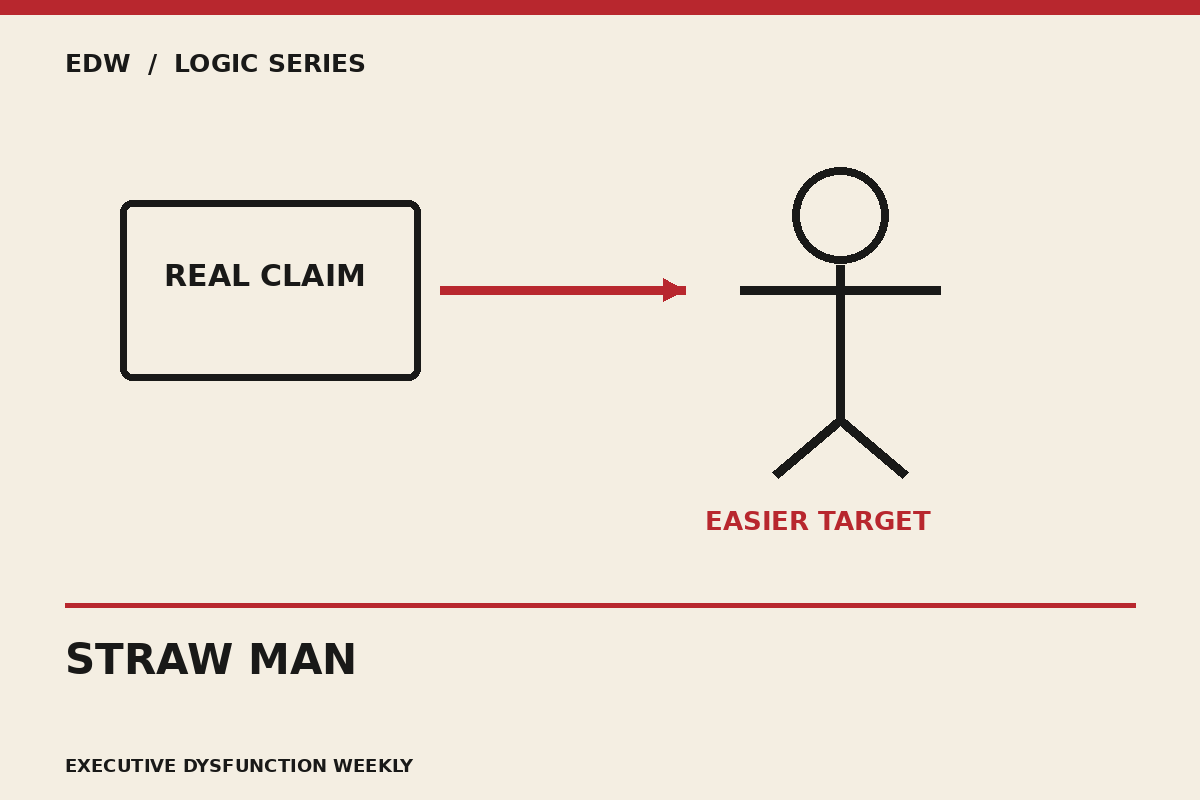
(How we turn real people into cartoons, then “win” arguments against the cartoon.)
If you’ve ever said something like:
“I’m concerned about the method, not the goal,”
…and someone replied:
“So you want open borders / you hate cops / you want kids indoctrinated / you want everyone disarmed / you want people to die…”
Congratulations. You’ve been straw-manned.
What it is (fact)
A straw man happens when someone distorts your actual position into a weaker or more extreme version (something easier to attack), then argues against that instead of what you really said.
That means the debate isn’t “heated.” It’s just off-topic, because you’re no longer discussing the same claim.
The Stanford Encyclopedia of Philosophy describes the straw man as a variation of “irrelevant conclusion” where an opponent’s view is distorted to make it easier to refute. (That’s why it feels like you’re yelling past each other, because you are.)
Why it matters (fact + evidence)
This isn’t just a “politeness” issue. It breaks reality-testing.
Research on partisan misrepresentation shows something uncomfortable: even when people are trying, they often struggle to accurately describe the other side’s actual arguments. In one study, partisans had a limited ability to simulate opponents’ perspectives and the author suggests false beliefs about partisan opponents may be pervasive. Even more interesting: political sophistication improved how people represented their own side, but not the other side, potentially making the gap worse. (Translation: being “more informed” doesn’t automatically make someone more fair.)
And here’s the part that should give us hope: the same work suggests the straw man effect is born “not out of cynicism, but out of ignorance.” That means it’s fixable with better habits.
Why it spreads online (fact + evidence)
The straw man is efficient. It’s fast. It’s emotionally satisfying. It lets you feel like you “crushed” someone without actually engaging their real point.
A psychology study of the straw man technique found it can be more persuasive when people have low motivation to elaborate (low personal relevance), and it may backfire when people are motivated to think harder. That maps perfectly onto social media: tired, scrolling brains are exactly where straw men thrive.
How to spot it (quick checklist)
You’re probably looking at a straw man when you see:
1) “So you’re saying…” followed by something you did not say.
2) Qualifiers get deleted:
“Sometimes / in this case / some” becomes “always / every / all.”
3) Your critique of a method gets rewritten as an attack on a goal:
“I disagree with this tactic” becomes “you want criminals to win.”
4) Someone uses the worst example of a group as if it represents the whole group:
“Look at THIS person” → “That’s what ALL of you are.”
5) “Some people say…” with no names, no link, no receipts:
a made-up opponent is easier to defeat than a real one.
How to respond without escalating (copy/paste scripts)
Your goal is NOT to embarrass them. Your goal is to bring the conversation back to a real claim.
Try these:
1) The reset
“Pause; that’s not what I said. My actual claim is: ____. Do you disagree with that claim?”
2) The quote test
“Can you quote the exact sentence where I said that? I want to make sure we’re responding to the same words.”
3) The accuracy agreement
“Before I answer, can you restate my position in a way I would recognize as fair? Then I’ll do yours.”
4) The one-sentence anchor
“Here’s my position in one sentence: ____. If you want to critique me, critique that.”
5) The boundary (calm, not dramatic)
“If we can’t stick to what I actually said, I’m going to step out. I’m not interested in arguing with a version of me that doesn’t exist.”
How to avoid doing it yourself (the “truth-seeker” standard)
If you care about truth more than winning, adopt this rule:
Before you criticize someone’s view, summarize it so well they’d say:
“Yes. That’s what I mean.”
This idea is captured in Rapoport’s Rules (popularized by Daniel Dennett): first re-express their position fairly, then list agreements, then mention what you learned, and only then offer criticism. It’s basically the opposite of straw-manning. It’s steelmanning.
A tiny challenge (24 hours)
For one day, replace “So you’re saying…” with:
“What I’m hearing is ____. Is that accurate?”
If they say “no,” let them correct it, then respond to the corrected version.
That single habit lowers defensiveness, increases accuracy, and forces both sides back onto shared reality.
If we can’t represent each other accurately, we can’t solve anything. We can only fight.
If you’ve got a good example of a straw man you’ve seen lately (or a moment you caught yourself doing it and corrected it), drop it below. Normalizing the correction is how we get better.
EDW•