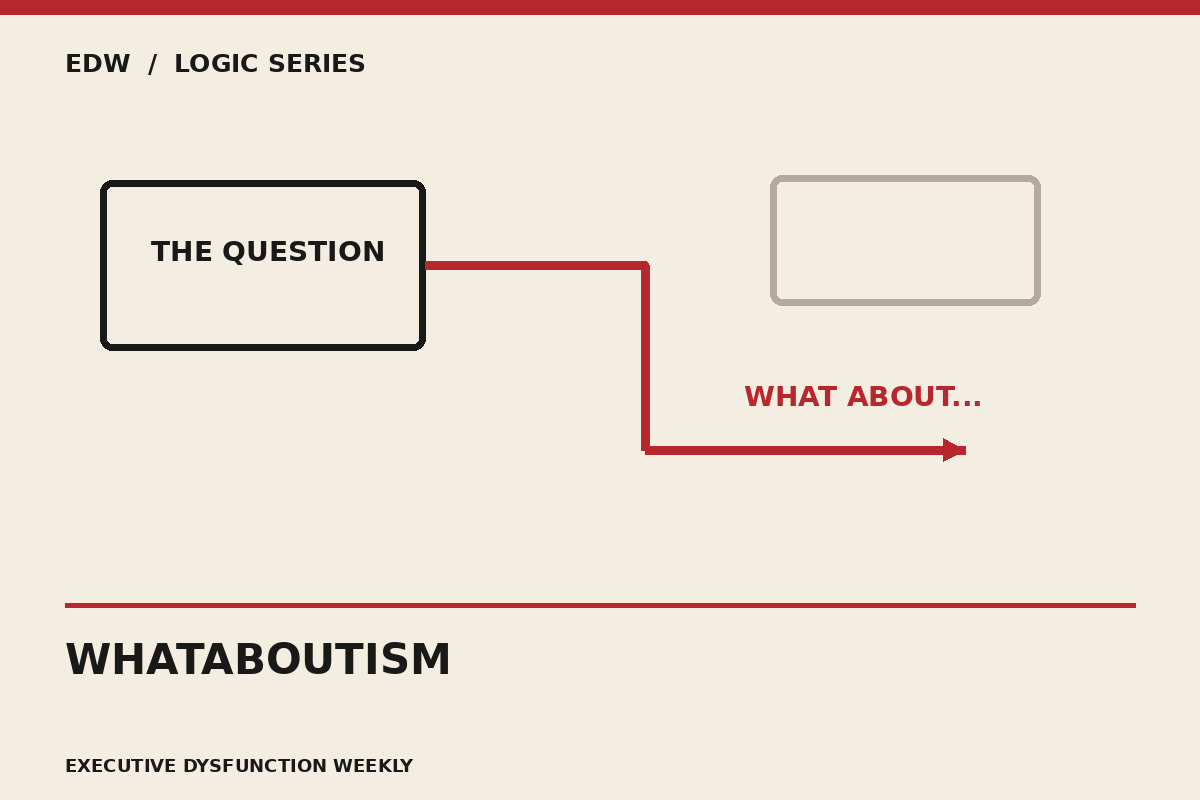
(“But what about…?”: the deflection move that turns every conversation into mush)
If you’ve ever tried to talk about ONE specific issue and the reply is instantly:
“But what about (your side / their side / some other scandal / something from 10 years ago)…?”
…you’ve met whataboutism.
What it is (simple + precise)
Whataboutism is the rhetorical practice of responding to an accusation or difficult question by making a counter‑accusation, asking a different but “related” question, or raising a different issue altogether, often to make the original issue feel less serious or to dodge accountability. (Britannica)
Merriam‑Webster puts it even more bluntly: responding to wrongdoing by claiming someone else did something similar or worse.
It often shows up as two familiar fallacies working together:
• Tu quoque (“you too” / hypocrisy attack): “You can’t criticize this because your side did it.”
• Red herring: dragging in a new issue to distract from the one on the table.
Why it’s harming us (and relationships) right now
Whataboutism doesn’t solve anything. It only does three things:
1) It destroys focus.
Instead of resolving one claim with evidence, the conversation becomes an endless hallway of side doors.
2) It kills accountability.
Even if the “what about” is true, it does not answer the original question. Two wrongs don’t make a right. (That principle is so basic it shows up even in serious legal contexts.)
3) It trains people to argue like pundits.
Cable news and political influencers love whataboutism because it feels like a dunk, it mobilizes the tribe, and it avoids the hardest part: dealing with the actual facts in front of you.
How to recognize it in 5 seconds
Ask yourself this one question:
“Did they answer the original claim, yes or no?”
If the answer is “no,” and instead they shifted to someone else’s wrongdoing or a different topic, you’re not in a debate. You’re in a deflection.
Common forms (you’ve seen all of these)
• “But what about Obama/Biden/Trump…?”
• “But what about BLM/the Capitol riot…?”
• “But what about crimes by immigrants/crimes by police…?”
• “But what about your party’s hypocrisy…?”
• “But what about the media…?”
Sometimes those topics matter. The fallacy is using them to avoid the one currently being discussed.
Important nuance: not every “what about” is a fallacy
A relevant comparison can directly address the original claim, for example by testing whether a stated rule is consistent. There is no mandatory order of discussion. The problem is using another case to evade the issue instead of answering it.
A fair version sounds like:
“First, here’s my answer to your claim. Second, I think the same principle should apply to X; do you agree?”
A whataboutist version sounds like:
“I refuse to answer your claim until we talk about X.”
One is reasoning. One is evasion.
How to respond calmly (copy/paste scripts that don’t ignite the other person)
Do NOT say “that’s a fallacy.” It triggers ego defense.
Try these instead:
1) The redirect
“That might be important, but it doesn’t answer the question I asked. Can you respond to THIS claim first: ____?”
2) The two‑track method
“I’m willing to discuss that next. Let’s do it in two lanes: 30 seconds on the original issue, then we go to your ‘what about.’ Deal?”
3) The accountability sentence
“Even if that’s true, it still doesn’t make THIS okay. Are you arguing it’s justified, or just that it’s common?”
4) The principle test
“Are we debating a principle or picking teams? If it’s a principle, state it clearly and apply it to both sides.”
5) The parking lot
“Let’s write that down as the next topic. For now, can we stay on the original point?”
6) The shared standards move (powerful)
“I’m fine holding my side accountable too. But I won’t use their wrongdoing as a reason to excuse ours. Can we agree on that?”
7) The evidence anchor
“Okay, what evidence would resolve the original claim? Let’s start there.”
8) The boundary (calm, adult)
“If we can’t discuss the topic at hand and we keep jumping sideways, I’m going to step away.”
How to avoid doing it yourself (this is the real flex)
Before you type “But what about…,” ask:
• Am I trying to clarify relevance, or am I trying to escape discomfort?
• Have I answered the original claim yet?
• Would I accept this move if the other side used it on me?
If you want to be a truth‑seeker, here’s the rule:
Answer the claim in front of you first.
Then widen the lens if it’s genuinely relevant.
A 24‑hour challenge
For one day, refuse to use whataboutism.
When you feel the urge to say “But what about them…?” replace it with:
“Yes, and. I can condemn that too. Now, back to the original claim…”
You’ll notice something fast: your conversations get clearer, shorter, and less hostile.
If you want more of this series, follow Executive Dysfunction Weekly and comment:
What’s the most common “but what about…” move you see in your feed?
Next up (if you want it): Hasty Generalization (“they all…”) or Slippery Slope (“if we allow X, then Z is inevitable”).