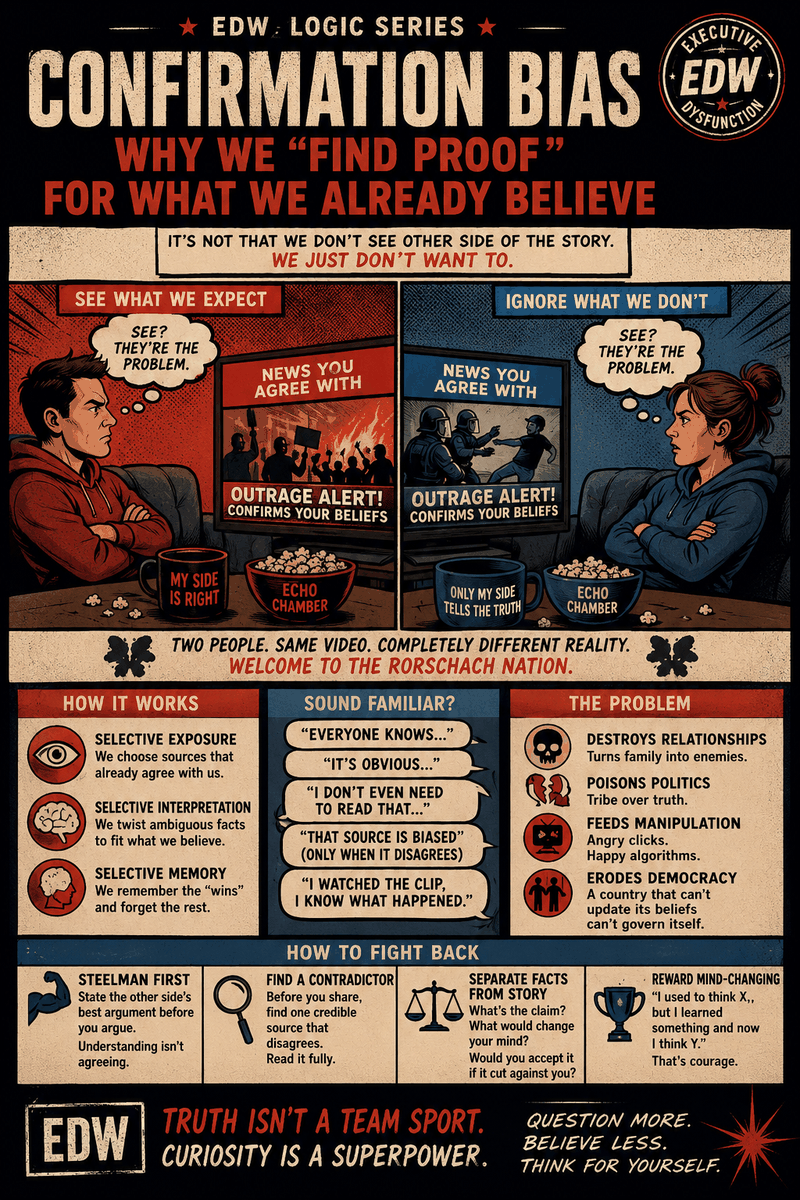
Here’s the quiet cognitive glitch that is doing more damage to relationships, politics, and even basic reality-testing than almost any other:
Confirmation bias.
It’s the tendency to notice, believe, remember, and share information that supports what we already think, while downplaying, dismissing, or never even seeing information that challenges it.
It doesn’t require bad intentions.
It doesn’t require low intelligence.
It’s a normal human shortcut, made dangerous by algorithms, tribal politics, and “news” built to keep you angry.
The simplest way to understand it
Confirmation bias isn’t “being wrong.”
It’s being selective without realizing you’re selective.
It shows up in three moves:
• Selective exposure: You choose sources that already agree with you.
• Selective interpretation: You interpret ambiguous facts in the direction you prefer.
• Selective memory: You remember the “wins” and forget the contradictions.
That’s how two people can watch the same video and walk away certain they saw opposite things.
What it sounds like in real life
You’ll recognize it because it often comes with emotional certainty:
• “Everyone knows…”
• “It’s obvious…”
• “I don’t even need to read that…”
• “That source is biased” (only when it disagrees)
• “I watched the clip, I know what happened” (even if it’s edited)
The key tell is this:
If the person has zero curiosity about disconfirming evidence, confirmation bias is driving the car.
Nonpartisan examples
Example 1: “The protest” video
• Person A (already anti-protest): Sees a clip of yelling and thinks, “See? Violent radicals.”
• Person B (already pro-protest): Sees a clip of police pushing and thinks, “See? Fascism.”
Both can be reacting to real footage, but neither is asking:
• What happened before the clip?
• What happened after?
• Is there another angle?
• Is this the full context?
Example 2: “The politician lied”
• When their politician gets caught:
“That’s out of context / the media is twisting it / everyone does it.”
• When the other side does the same thing:
“This proves they’re corrupt.”
Same behavior. Two completely different standards.
That’s confirmation bias plus tribal identity.
Example 3: “A single case becomes the whole story”
• One immigrant commits a terrible crime → “This is what they are.”
• One cop abuses power → “This is what they are.”
Both of these are forms of hasty generalization, but confirmation bias is what makes us prefer the examples that fit our story and ignore the rest.
Why it’s getting worse right now
Confirmation bias used to be a personal weakness. Now it’s a business model.
Algorithms reward content that triggers emotion, especially:
• fear
• anger
• disgust
• superiority
Those emotions make you share faster, click longer, and stay loyal.
The result is a loop:
1. You get shown more of what you already agree with
2. You feel more certain
3. You become less curious
4. You become easier to manipulate
You don’t become “informed.” You become trained.
How to spot it in yourself (the hardest part)
Here are three uncomfortable but useful self-checks:
• Do I get a little “hit” of satisfaction when I see something that proves the other side is awful?
That feeling is not truth. It’s reinforcement.
• Have I ever shared a story that turned out to be wrong because it fit my narrative?
Most people have. The question is whether you corrected it.
• Would I bet money that my favorite source has misled me before?
If you think “never,” you’re in the bias.
How to counter it without becoming a monk
You don’t need to “be neutral.” You need to be accountable.
Here are EDW’s best practical tools:
Tool 1: The “steelman” rule (30 seconds)
Before you argue, state the other side’s best version:
“I think you’re saying X, and the strongest reason for it is Y. Is that right?”
If you can’t steelman it, you don’t understand it yet.
Tool 2: The disconfirming-evidence challenge
Before you share something, look for credible evidence that could challenge your conclusion and read it in context. Weigh its quality. You do not need to manufacture an opposing side when the evidence converges.
You don’t have to convert.
You do have to test your conclusion rather than collect applause for it.
Tool 3: Separate “facts” from “story”
Ask:
• What is the claim?
• What evidence would change my mind?
• Would I accept that evidence if it cut against my side?
If the answer is “no,” you’re not debating. You’re performing loyalty.
EDW Bottom Line
Confirmation bias is the reason smart people can become impossible to talk to.
It’s why families break over politics.
It’s why we feel like we’re living in different countries.
And it’s why propaganda works, because it doesn’t need to convince you of something new. It just needs to feed what you already suspect.
The cure is not “being nicer” or “being centrist.”
The cure is curiosity under pressure.
If this helped you put language to what you’re seeing, please share it. And if you want more tools like this, follow Executive Dysfunction Weekly (EDW). We’re building a corner of the internet for people who still want truth more than tribe.
EDW•