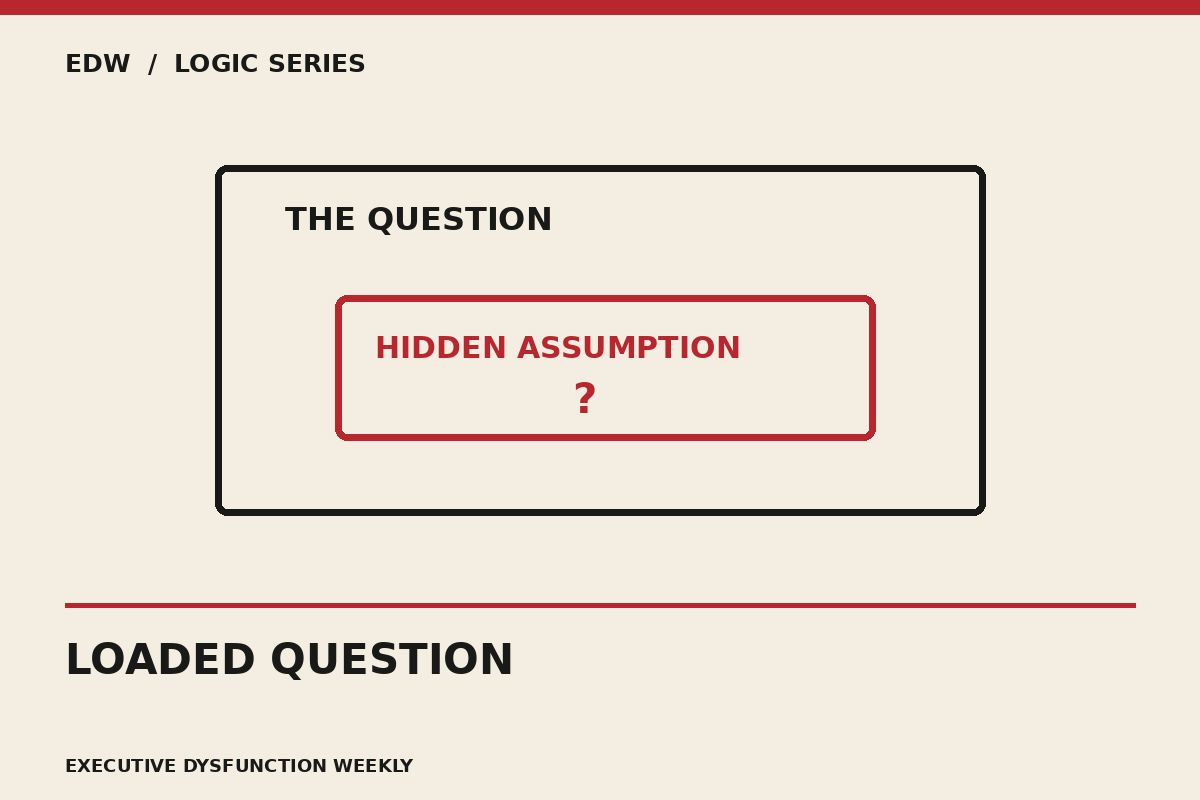
One of the most common ways people “win” arguments online isn’t by making a strong case.
It’s by asking a question that smuggles in an accusation, so if you answer it, you’ve already accepted their framing.
This is called the Loaded Question fallacy.
It’s a classic for a reason, and right now it’s everywhere: politics, policing, immigration, protests, vaccines, war, you name it.
What it is (plain English)
A loaded question smuggles in a disputed or unsupported assumption that the person answering has not accepted. A question is not fallacious simply because it relies on a premise everyone in the conversation already accepts.
The textbook example is:
“Have you stopped beating your wife?”
If you say “yes,” you admit you used to beat her.
If you say “no,” you admit you still do.
The trap is that the question forces you into a false confession unless you reject the premise.
Online, it looks less dramatic, but it’s the same logic.
How it shows up in politics (both sides)
You’ve seen these:
- “Why do you hate law enforcement?”
- “Why do you support open borders?”
- “Why are you defending criminals?”
- “Why do you want to control women?”
- “Why do you want kids sterilized?”
- “Why do you want America to fail?”
- “Why do you support genocide?”
Notice what’s happening: the “question” isn’t a request for information. It’s a verdict with a question mark.
And it’s designed to trigger your nervous system so you respond emotionally instead of logically.
Why it works (and why it destroys relationships)
Loaded questions work because they:
1) Escalate instantly (you feel accused)
2) Force a defensive posture (instead of discussion)
3) Turn complexity into a moral indictment (“answer or admit you’re evil”)
4) Reward tribal dunking (your side cheers, the other side rages)
It’s one of the fastest ways to turn neighbors into enemies.
The skill: Don’t answer the trap. Disarm the premise.
Here’s the key move:
You don’t answer a loaded question directly.
You first challenge the hidden assumption.
Think of it like this:
If the floor is fake, don’t argue about the furniture.
Copy-paste responses that actually work
1) “I reject the premise.”
“I’m not going to answer that as framed because it assumes something I don’t accept.”
2) “Ask it neutrally.”
“If you want a real answer, ask it without the accusation.”
3) “Here’s what I actually believe.”
“I support X, I oppose Y, and I’m willing to discuss specifics if we can keep it factual.”
4) “Steelman before we argue.”
“Before we debate, can you restate my position in a way I’d recognize as fair?”
That last one is powerful. Most bad-faith conversations end right there, because fairness was never the goal.
EDW example (immigration + enforcement)
Loaded question:
“Why do you want to protect illegal criminals?”
A better question:
“What enforcement methods do you think are constitutional and effective, and what accountability should exist when mistakes happen?”
Same topic. Totally different intent.
The second question invites discussion. The first invites a fight.
The self-check (for all of us)
Before you post a “question,” ask yourself:
- Am I actually curious?
- Or am I trying to pin someone into an admission?
- Would I accept this question if it were aimed at my side?
If the answer is “no,” it’s probably a loaded question.
EDW bottom line
If we want a country where people can disagree without tearing each other apart, we have to stop treating conversation like a courtroom where the verdict is already written.
Loaded questions feel satisfying because they “score points.”
But they destroy trust, and trust is what societies run on.
If you want more tools like this (calm, practical ways to argue in good faith without lighting each other on fire), please follow Executive Dysfunction Weekly (EDW) and share this post. We’re building a corner of the internet for people who still want truth more than they want a team win.
EDW•