Here’s a logic trick that is everywhere online right now, and once you see it, you can’t unsee it:
The Motte-and-Bailey Fallacy.
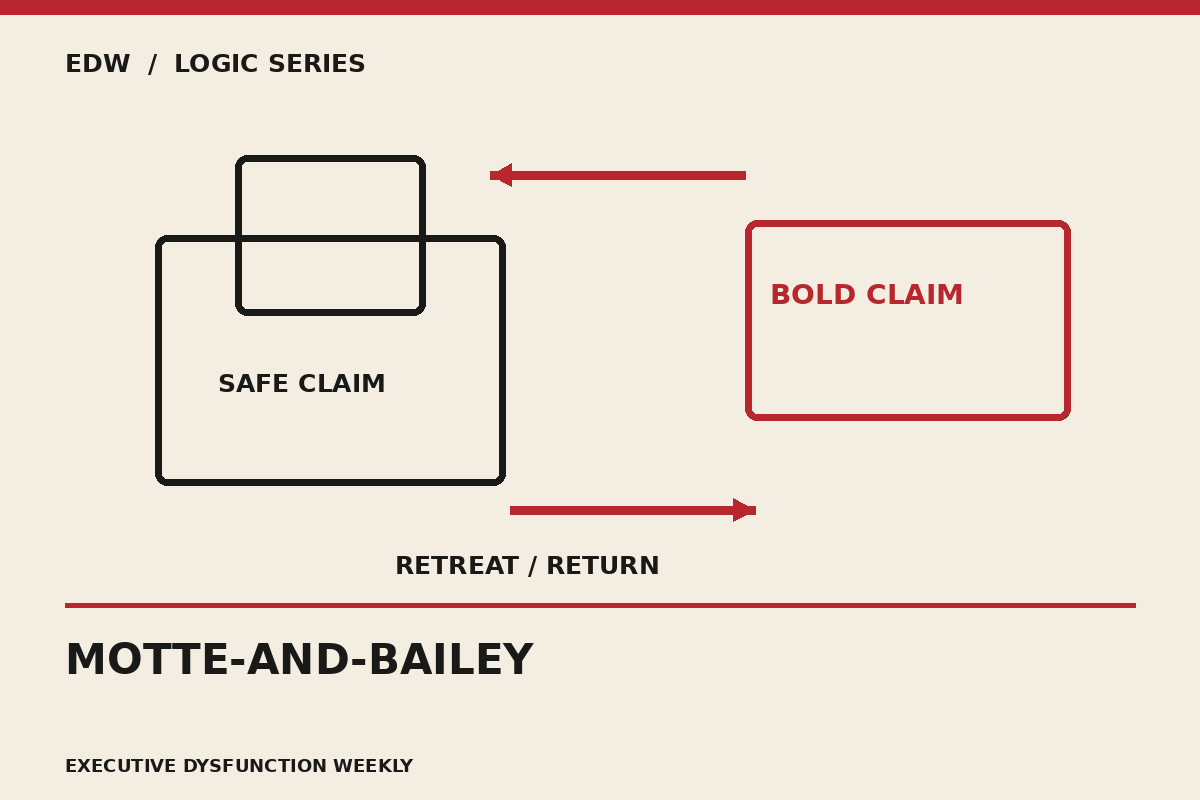
It’s when someone makes a bold, provocative claim (the bailey), then, when challenged, retreats to a smaller, safer, more reasonable claim (the motte) and acts like that was their position all along.
It’s not honest debate. It’s rhetorical bait-and-switch.
The simplest way to understand it
• The bailey = the exciting, extreme statement that rallies the crowd
• The motte = the defensible “well of course I only meant…” fallback
They bounce between them depending on pressure.
When they’re getting applause, they live in the bailey.
When they’re getting questioned, they hide in the motte.
Real-world examples (nonpartisan)
Example 1
Bailey: “Anyone who questions ICE is pro-criminal.”
Challenge: “That’s not fair, people can support enforcement and question tactics.”
Motte: “I just mean we should enforce the law.”
See the move? The motte is reasonable. But it’s not what was said.
Example 2
Bailey: “The media is the enemy of the people.”
Challenge: “That’s dangerous; free press is a core democratic institution.”
Motte: “I just mean the media is biased sometimes.”
Again: yes, bias exists. But that wasn’t the original claim.
Example 3
Bailey: “The other party is literally trying to destroy America.”
Challenge: “That’s an extreme accusation.”
Motte: “I just mean I disagree with their policies.”
If the original statement collapses into something that mild, it was never about precision. It was about heat.
Why it’s so damaging
The Motte-and-Bailey destroys conversation because it makes accountability impossible.
• If you respond to the extreme claim, they retreat and call you dramatic.
• If you respond to the mild claim, they go back to the extreme one and claim you’re dodging.
It’s a loop designed to exhaust you.
And it feeds tribalism: your side remembers the bailey, the other side is forced to argue against the motte, and everyone talks past everyone.
How to respond (calmly, effectively)
Here are three tools that work without escalating.
1) Pin the bailey politely
“I’m happy to discuss your narrower point. But earlier you said X. Do you still stand by that, or are you revising it?”
This forces clarity.
2) Ask for a precise claim
“Can you state your position in one sentence, specifically, so we’re not switching meanings midstream?”
3) Separate the two claims explicitly
“Claim A (strong) and Claim B (weaker) are different. Which one are you arguing?”
If they refuse to choose, that tells you the tactic is the point.
A self-check for all of us
Before you post, ask:
• Am I making a claim I’d defend under cross- examination?
• If challenged, would I honestly revise, or would I pretend I meant something softer?
• Am I here to clarify, or to score?
If you’re relentless about truth, you don’t need a bailey. You can stand on your motte from the start.
EDW bottom line
We can’t rebuild civic trust if we keep rewarding arguments that are designed to be unaccountable.
If you say something extreme, own it, or correct it.
If you mean something moderate, say it clearly.
That’s how adults argue. That’s how democracies survive.
If this helped you spot the pattern, share it, and follow Executive Dysfunction Weekly (EDW) for more tools that help people disagree without becoming enemies.
EDW•