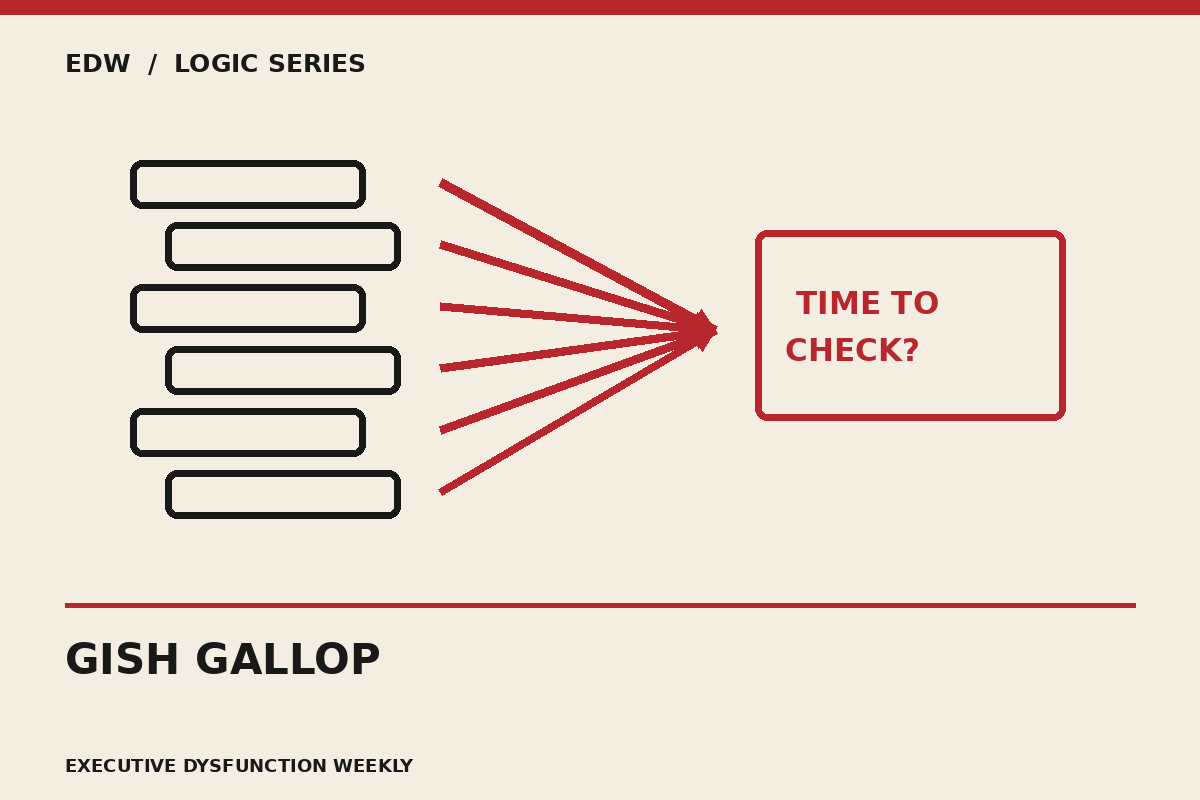
If you’ve ever walked away from an online argument feeling like you just got hit by a dump truck of talking points, you’ve met this tactic:
The Gish Gallop = a rapid flood of weak, misleading or unsupported claims that overwhelms the time available to check and answer them. The problem is not merely having many points. It is using volume in place of sound support.
This isn’t “winning with facts.” It’s winning with overload.
And here’s the uncomfortable truth: both sides do it. It’s a human problem, supercharged by algorithms.
What it looks like in the wild
You’ll recognize it instantly:
- A comment that contains 15 claims, 10 accusations, 3 links, 2 memes, and one conclusion: “Therefore you’re evil/stupid/brainwashed.”
- A list of extreme examples used to imply “the whole system is like this.”
- Rapid-fire whatabouts: “What about Clinton? What about Obama? What about Biden? What about…?”
- A post that demands you answer everything immediately, and if you don’t, you “lose.”
This is why serious conversations die online: the format rewards volume, not verification.
Why it works (psychology, not politics)
The Gish Gallop works because:
1) Attention is limited.
Most people won’t check sources. They’ll remember the feeling of certainty.
2) Refuting takes longer than asserting.
It takes 10 seconds to claim something. It can take 10 minutes to verify it. That imbalance is real.
3) It creates the illusion of dominance.
A wall of claims feels like “strength,” even when it’s mostly noise.
4) It triggers tribal instinct.
Your side sees “momentum.” The other side sees “hostility.” Everyone stops thinking.
The adult response: slow the pace, raise the standard
If your goal is truth (not dunking), here’s how to respond without escalating.
Step 1: Name the problem without insulting the person
Use this script:
“That’s a lot of claims. I’m not ignoring you; I’m trying to be accurate. Let’s do one at a time so we don’t spread misinformation.”
Step 2: Make them choose their strongest point
This is the magic move:
“Pick the single strongest claim that, if it’s wrong, would change your view. I’ll respond to that first, with sources.”
If they refuse to pick one, the conversation may remain impossible to check responsibly. That is a reason to set a boundary, not proof of what they privately want.
Step 3: Require a source before you debate
Not “Google it.” Not “everyone knows.” A source.
“What’s your best source for that specific claim? Link it and I’ll read it.”
Step 4: Agree on what would count as “evidence”
This is how you separate good faith from performance:
“If your source is wrong or doesn’t say what you claim, will you update your position?”
If the answer is no, the conversation isn’t about facts.
The EDW “One-Claim Rule” (steal this)
Here’s a simple rule I use now, because it keeps me sane:
One claim.
One source.
One standard.
If we resolve it, we move to the next claim. If we can’t agree on the standard of proof, we stop. That’s not cowardice. That’s discipline.
Quick self-check (for all of us)
Before you hit “post,” ask yourself:
- Am I listing 12 claims because I’m confident… or because I’m trying to overwhelm?
- Did I include any claim I haven’t personally verified?
- Am I posting to learn… or to win?
If you want truth, you don’t need 20 points. You need one good point that can survive scrutiny.
Why this matters right now
The Gish Gallop is one of the main ways propaganda works in a modern attention economy. Not through one perfect lie, through a flood of claims that makes people give up and pick a tribe.
And when people give up on verification, we lose the shared reality a democracy requires.
If you want more posts like this (tools for arguing in good faith without setting each other on fire), follow Executive Dysfunction Weekly (EDW). If this helped, share it and tag someone you trust on the other side. Let’s build an internet where people can disagree without becoming enemies.
EDW•