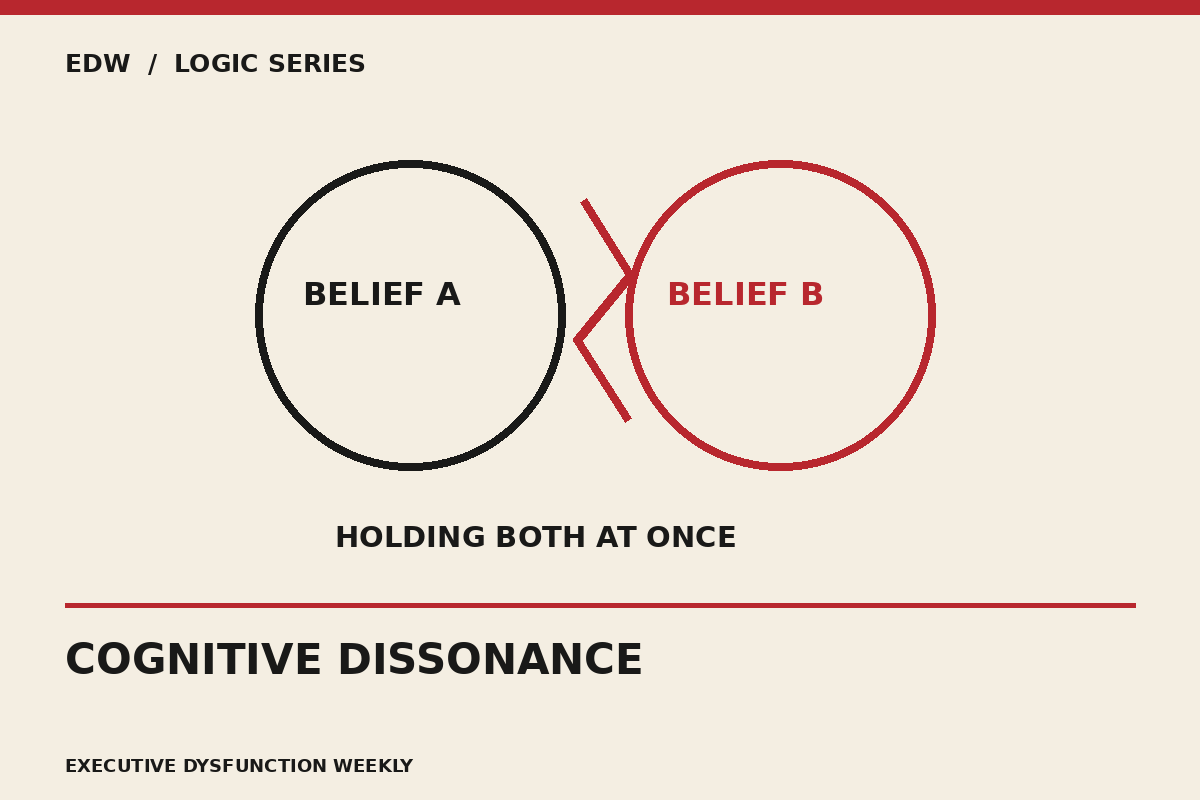
There’s a psychological phenomenon that is quietly wrecking our ability to talk to each other right now, even when we’re all staring at the same facts.
It’s called cognitive dissonance.
And once you understand it, you’ll stop assuming the other person is “stupid” or “evil” every time they double down.
One possibility is that they’re protecting their identity. The argument alone cannot tell us what someone feels.
Cognitive dissonance, in plain English
Cognitive dissonance is the discomfort you feel when two things you believe (or a belief and a fact) conflict.
Example:
- “I am a good person.”
- “Good people don’t support cruelty.”
- “But the politician I support just said something cruel.”
That mismatch creates psychological tension.
And here’s the key: people can reduce dissonance by changing a belief or behavior, adding a justification, or deciding the conflict matters less. Sometimes they reinterpret the evidence instead of changing course.
Not because they’re bad. Because dissonance is painful.
What it looks like online (and in real life)
These patterns can accompany attempts to reduce dissonance. They are clues to examine, not proof of someone’s internal state:
They switch standards mid-conversation.
- “The video proves it!” (when it helps their side)
- “You can’t trust video; it’s edited!” (when it hurts their side)
They jump to motive instead of facts.
- “You only believe that because you hate Trump.”
- “You only believe that because you’re brainwashed by MSNBC/Fox.”
They retreat into tribal identity.
- “My side would never do that.”
- “Your side always does that.”
They suddenly need “perfect certainty.”
When evidence starts piling up, they don’t say “maybe I was wrong.”
They demand impossible proof so they never have to update.
The dissonance math nobody admits
When a belief is tied to identity, the stakes aren’t “facts.”
The stakes are:
- “If I’m wrong, am I foolish?”
- “If I’m wrong, did I harm people?”
- “If I’m wrong, do I lose my community?”
- “If I’m wrong, do I have to admit I’ve been played?”
That’s why people defend contradictions like their life depends on it.
Because socially, sometimes it does.
A nonpartisan example
Right now, you can see cognitive dissonance on both sides:
On the right:
- “We back law and order.”
- But also: “When our guy attacks courts or the press, it’s fine.”
On the left:
- “We oppose authoritarian tactics.”
- But also: “When our side uses dehumanizing language, it’s justified.”
If you’re reading that and instantly feeling defensive, good.
That little flare of discomfort is a reason to pause and examine the conflict. It does not, by itself, establish cognitive dissonance.
We all have it.
How to respond without escalating
If you want to help someone think (not win a fight), these tools work better than “owning” them.
Name the conflict gently.
“I’m trying to understand how these two things fit together…”
Offer an identity-safe exit.
“It makes sense to want border enforcement and still want constitutional limits.”
Ask a “standard” question.
“What rule would you want if the other side were in power?”
That one question is a truth serum.
It shifts the conversation from tribe to principle.
Model updating.
“I used to think X. Then I saw Y. Now I think Z.”
That invites them to do the same without humiliation.
A self-check for all of us
Before you share the next clip, headline, or dunk, ask:
- If this were reversed, would I judge it the same way?
- Am I defending a principle, or defending my team?
- What evidence would actually change my mind?
- Am I “certain,” or am I scared to be wrong?
Because here’s the hard truth:
A democracy cannot survive if no one can update.
EDW bottom line
Cognitive dissonance is not a “them” problem.
It’s a human problem.
If you want to be a truth-seeker, the goal isn’t to feel right.
It’s to get it right.
If this helped you spot the pattern (in others or yourself), please share it. And if you want more evidence-first tools for arguing without becoming enemies, follow Executive Dysfunction Weekly (EDW).
EDW•