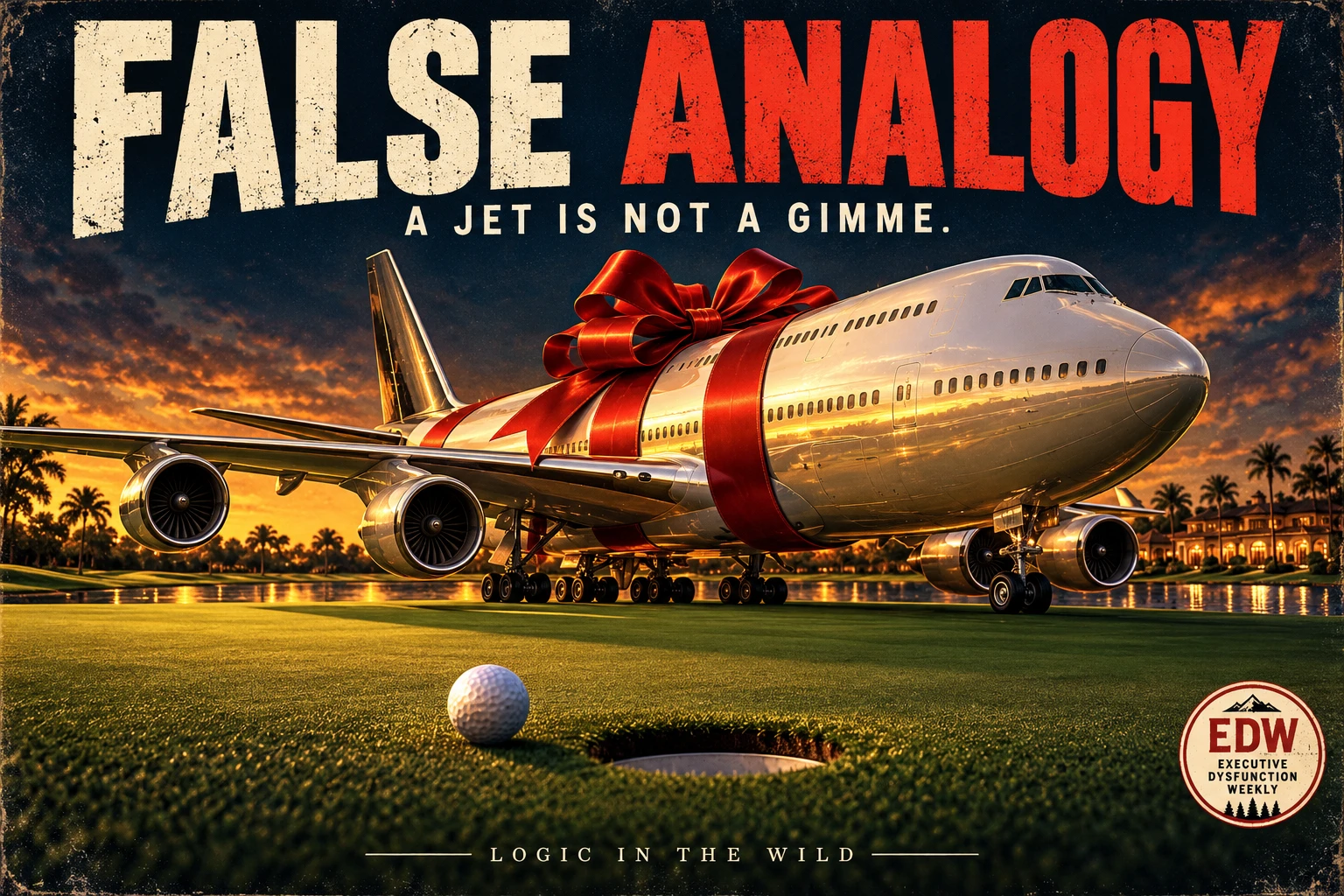
A comparison can help us understand something unfamiliar. It can also sneak a conclusion past us while we admire the resemblance.
A false analogy, also called a weak or faulty analogy, asks similarities to support more than they can. The problem is a difference that matters to the conclusion, or a resemblance too weak to support it.
Imagine a school-board candidate says: “Families can cancel subscriptions whenever they want, so a school district should be able to cancel every service overnight.” Both involve budgets. The comparison leaves out contractual obligations and the services students depend on. A household example has not established the district’s options.
Or imagine someone says: “My phone and this hospital device both have software, so they should have the same update process.” The common feature is real. Differences in safety risks and testing requirements matter to the proposed rule.
These are invented teaching examples. The test applies regardless of which party makes the argument.
Use three questions. What do the cases have in common? What conclusion is being carried from one to the other? Which difference might change that conclusion?
A good analogy identifies similarities relevant to the conclusion and survives the important differences. It usually offers support, rather than mathematical proof. More resemblance on the surface does not necessarily mean more support.
A metaphor used for a laugh is not automatically a fallacy. The issue arises when the comparison is asked to justify a conclusion it cannot support. Also, showing that one argument is weak does not establish that its conclusion is false. The speaker may have other evidence.
Read the worked example: https://executivedysfunctionweekly.com/logic-in-the-wild/2026-10-17-a-jet-is-not-a-gimme/
Sources: Stanford Encyclopedia of Philosophy, Analogy and Analogical Reasoning: https://plato.stanford.edu/entries/reasoning-analogy/
Definition and related terminology: Internet Encyclopedia of Philosophy, Fallacies, False Analogy: https://iep.utm.edu/fallacy/
EDW•