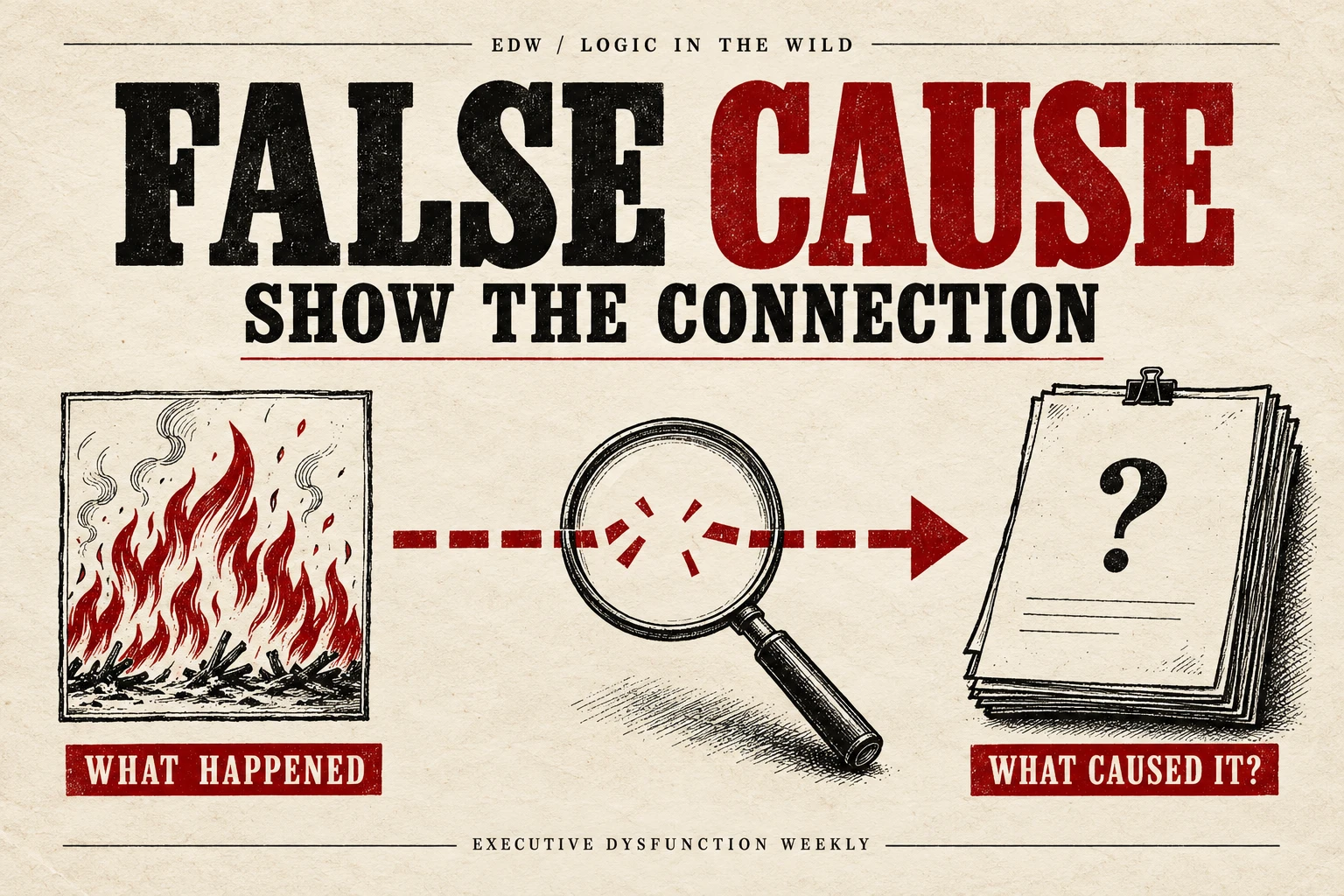
False cause is a family of reasoning errors in which an argument assigns a causal connection without adequate support. The label does not mean we have proved the proposed cause impossible. It means the argument has not done enough to establish it. That is an important difference, especially when everyone has already ordered a commemorative T-shirt.
One familiar version is post hoc reasoning: B happened after A, therefore A caused B. A new principal arrives on Monday. A pipe bursts on Tuesday. The calendar alone has not caught the principal with a wrench.
Another version treats correlation as sufficient proof of causation. Umbrella use and wet shoes rise together. That does not show umbrellas make shoes wet. Rain may help explain both. Shared causes, reversed direction and coincidence are among the alternatives an argument may need to address.
Not every false-cause argument depends on timing or a measured correlation. A speaker can point at a crisis, announce a favored explanation and skip the evidence connecting them. The crisis may be real while its proposed explanation remains unestablished.
Correlation can be useful evidence. Temporal order can matter. Neither should be dismissed just because it is not conclusive on its own. Strong causal reasoning considers the relevant mechanism, quality of observations, comparisons and plausible alternatives. Different questions require different methods; not every sound causal conclusion needs a laboratory experiment.
Try three questions: What evidence connects this proposed cause to this outcome? What else could explain the pattern? What observation would make us revise the explanation? A plausible story is a starting point for investigation, not an exemption from it.
Keep participation separate from causation. Showing that a member of a group was present at an event does not establish that the group’s identity or the policy associated with it caused the event. First establish what the person did. Then establish the causal claim. Those are separate receipts.
Worked example: A fire is not a cause-of-fire report, examining Donald Trump’s October 19, 2026 claim about France: https://executivedysfunctionweekly.com/logic-in-the-wild/2026-10-20-a-fire-is-not-a-cause-report/
Further reading: Internet Encyclopedia of Philosophy, Fallacies, especially False Cause: https://iep.utm.edu/fallacy/ ; OpenStax, Introduction to Philosophy, 5.5 Informal Fallacies: https://openstax.org/books/introduction-philosophy/pages/5-5-informal-fallacies
EDW•