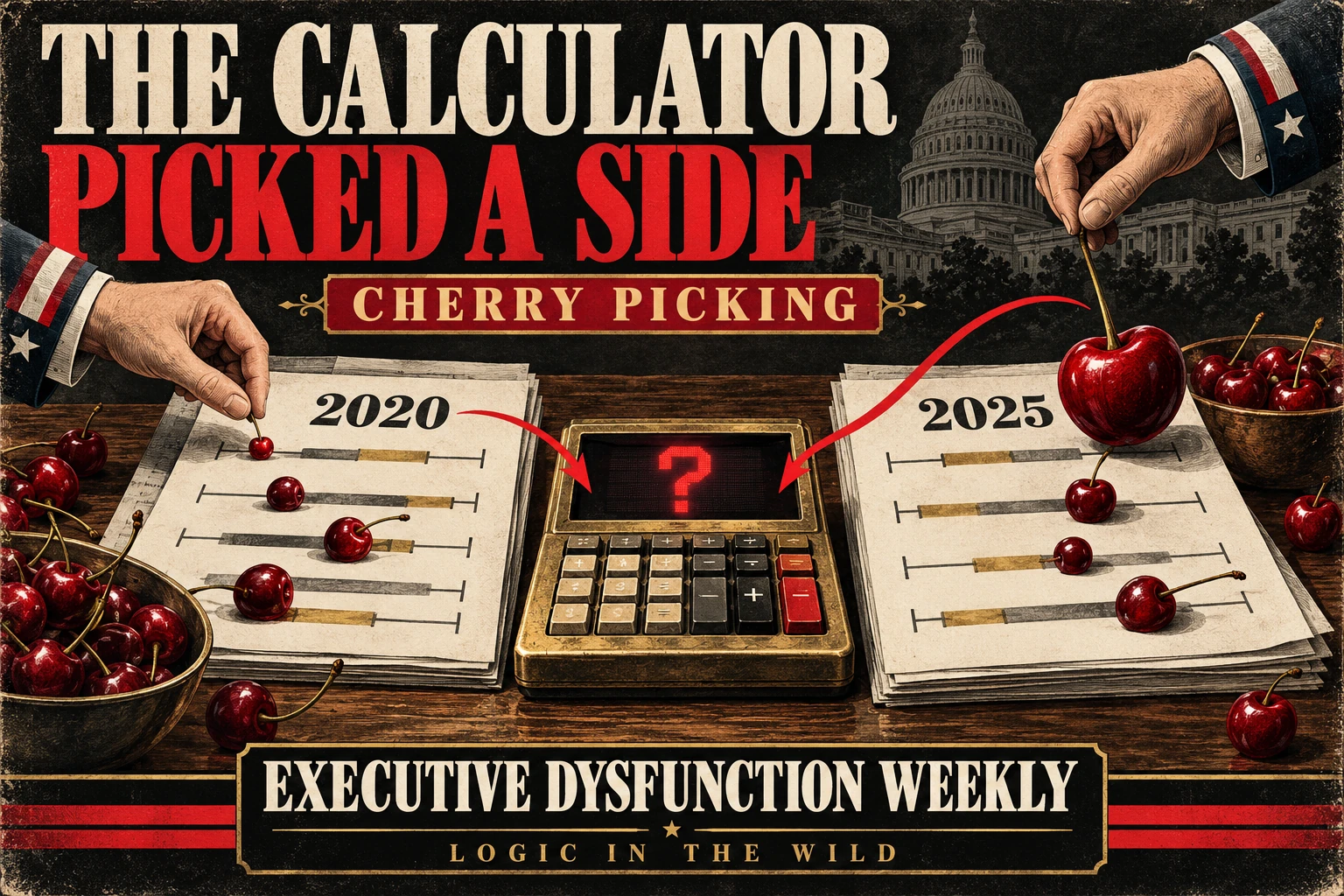
Cherry picking, also called suppressed or incomplete evidence, presents favorable evidence while omitting relevant information that could materially change the assessment. The selected facts may be true. The trouble is what the selection asks them to prove.
Imagine a project met its deadline during one excellent week. A manager shows only that week to establish that the project consistently finishes on time. Before we order the commemorative mugs, we need the other weeks.
Or imagine estimated savings range from $100 to $300 in one year and $200 to $500 in the next. Subtracting the lowest earlier estimate from the highest later estimate gives a possible $400 increase. It does not establish an observed $400 gain. The calculator performed its assignment. The assignment was the problem.
These are invented teaching examples, not reports of real people or projects.
Not every selection is cherry picking. Summaries must leave things out. The omitted information must matter to the conclusion. A clearly labeled best-case or worst-case calculation can be legitimate, as can a carefully justified sample. Explain the selection rule and preserve the uncertainty.
The repair: identify the conclusion, show the relevant comparison, state why these observations were chosen and ask whether the omitted evidence could change the result. The evidence buffet is not an all-you-can-ignore restaurant.
Keep related ideas separate. Confirmation bias concerns tendencies in seeking or evaluating evidence. Cherry picking concerns a selective evidential presentation. They can overlap, but identifying an incomplete argument does not establish the speaker’s private psychology or prove deliberate deception. An omission can be inadvertent.
Nor does finding cherry picking prove that the conclusion is false. It means the offered support is incomplete. Supply the missing evidence rather than automatically handing victory to the other side.
Worked example: The calculator picked a side, examining the endpoint selection in a WinSenate advertisement: https://executivedysfunctionweekly.com/logic-in-the-wild/2026-10-26-the-calculator-picked-a-side/
Related lesson: Confirmation Bias: https://executivedysfunctionweekly.com/logic/confirmation-bias/
Sources: Internet Encyclopedia of Philosophy, Fallacies, Suppressed Evidence: https://iep.utm.edu/fallacy/ ; Texas A&M open textbook Informed Arguments, 3.7 Logical Fallacies: https://odp.library.tamu.edu/informedarguments/chapter/logical-fallacies/
EDW•