The claim
In an October 21 Truth Social post about Alaska’s Senate race, President Donald Trump wrote, “Even 1, 2, or 3% could make the difference.” He then called the situation “CHEATING in an Election” and spoke of “holding the Democrats accountable for their Election Interference”.
The dispute concerns incumbent Republican Sen. Dan S. Sullivan and another candidate, Daniel J. Sullivan Jr. Trump attributes the second candidacy to Democrats and treats deliberate wrongdoing as established. The post’s concern about a potentially decisive margin is different from its certainty about who caused the problem.
Where the reasoning breaks
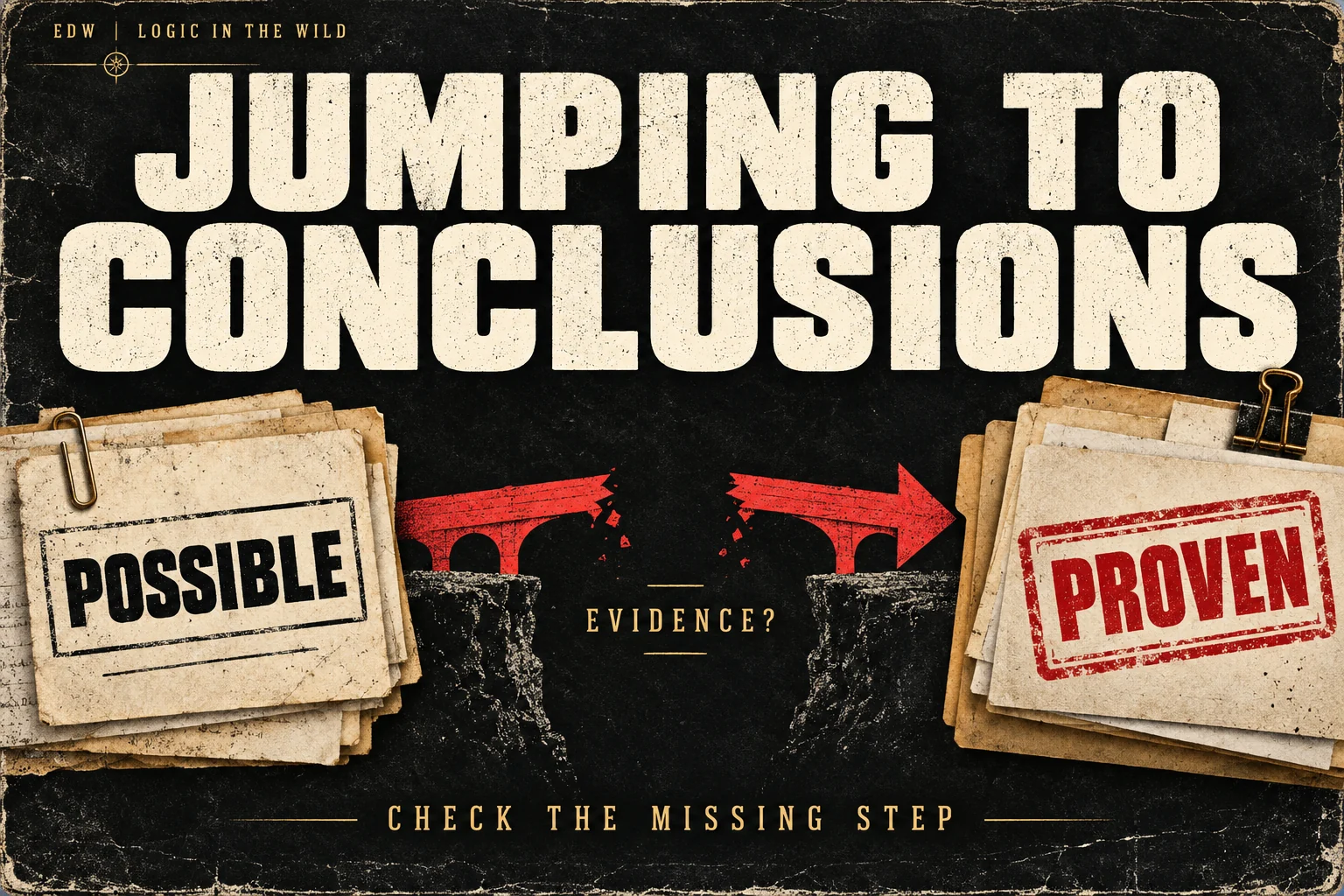
The reasoning pattern is jumping to conclusions: reaching a stronger verdict than the relevant evidence warrants. The post raises a possible electoral impact and makes a separate, categorical accusation of Democratic orchestration. Its discussion of a close margin does not establish that attribution. The evidence still has a bridge to cross before the verdict can follow.
A similar name can give us a reason to investigate. It does not settle who coordinated a candidacy, whether particular voters mistook one person for another, or how many such mistakes would change a result. Those are separate factual claims. Establishing an attempted deceptive candidacy would not require actual mistaken votes. Mistaken votes matter separately to electoral effect and the requested remedy. The argument needs evidence for each connection it asks us to accept.
This matters beyond a social-media argument. The Justice Department filed a complaint on October 22. Paragraphs 42–44 seek to prevent certification pending investigation if the incumbent loses and assigning all of the other Sullivan’s votes to him would change the ranked-choice outcome. That is a conditional request, not a demand to reverse every Republican defeat.
The filing’s hypothetical reassignment is a test of potential numerical significance. It cannot establish that those voters actually intended to support the incumbent. The requested investigation itself concerns that unresolved question. Treating every vote for another candidate as a mistaken vote would require evidence the arithmetic cannot supply.
The strongest fair reading
The strongest fair reading deserves more than a shrug about two men sharing a surname. The complaint cites the challenger’s requested shortened ballot name, recent Republican affiliation, a similar campaign website and a consultant’s Democratic connections. Those are substantive grounds for scrutiny, not merely a coincidence invented for this analysis. They remain allegations and evidence to assess, not a completed finding of party coordination.
The earlier state-court ruling also needs care. AP’s June 27 account explains that the trial judge rejected an extra good-faith eligibility requirement the election director lacked authority to impose. That ruling did not certify the candidate’s private motives as pure.
AP’s October 23 report says the ballot distinguishes the incumbent by his Republican and incumbent labels, while the challenger has no party designation. Voters can rank both candidates. These features are relevant safeguards; they do not guarantee that nobody will become confused.
Investigating a credible risk is reasonable. Announcing who is guilty before establishing the disputed links is the leap. We should avoid making the opposite leap and declaring the entire concern imaginary.
Why it matters
Keep the categories straight. The existence of two candidates is a factual matter. Coordination, intent and actual mistaken votes are disputed empirical questions. Whether a court should grant the requested remedy is a legal question this article does not decide. Whether the risk warrants investigation is a judgment that can be argued without pretending the investigation is finished.
The limited conclusion here is about the support for Trump’s categorical accusation. It does not prove that every suspicion is false, resolve the litigation or reveal his private motives. A weak inference can land on a true conclusion by accident. It is still a lousy way to get there.
Ask what evidence would distinguish deliberate confusion from a legitimate vote for a different candidate. Ask whether the same standard would apply if the party labels were reversed. Then match the confidence of the claim to the strength of the answer.
Check the missing step before ordering the guilty stamp.