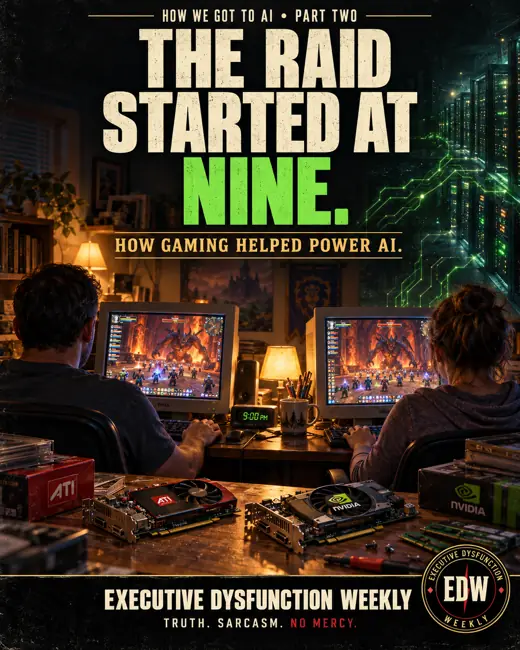
In the late 1990s, a computer warehouse opened across the street from where I worked in Las Vegas.
They sold computer parts on pallets.
Whole fucking pallets of video cards.
For a computer nerd, it was Toys R Us for adults. Times ten. I had never seen that much computer hardware in one place.
I was working for The Good Guys at the WOW! Superstore on Sahara Avenue. We shared the place with Tower Records. Our electronics side closed at midnight. Tower stayed open all night.
It was an awesome place to work. Music, electronics, Las Vegas. I was in my late twenties, surrounded by stuff I loved, and I have enough stories from that store to keep us here all morning.
But put a warehouse full of computer parts across the street, and you knew where I was going.
Through work, I had free subscriptions to computer magazines. I read everything. Then I went on the internet and read some more. If I was going to buy a video card, I wanted to know what the hell I was buying.
I was the fucking nerd. The king of all nerds.
At least I thought I was.
Choosing the card was serious business. Different companies, different promises, different results depending on what you wanted to play. You could spend hours researching and still be standing there trying to decide.
3dfx. ATI. NVIDIA.
Which one worked best with your machine? Which one gave you the most for your money? Which one would actually make the game you cared about better?
I went with a 3dfx Voodoo card. This was the Hexen II era, around 1997.
You could change one part inside your computer and change the whole experience on the screen. That fascinated me. I had loved computers since I was a kid, and now I could keep making mine do more.
NVIDIA was still a young company. It had been founded in 1993, released its first product, NV1, in 1995, and brought out RIVA 128 in 1997. Eventually, I would switch toward NVIDIA cards. At the time, it was another company I was reading about while trying to make a difficult purchase.
Nobody standing in that warehouse knew how this would all turn out.
We wanted better games. The companies wanted us to buy their cards. The competition was happening right there in front of us, in boxes we could pick up and compare.
Windows 95 had arrived in August 1995. Windows 98 would follow in June 1998. The computer industry kept giving us more things to learn, more things to buy, and more things to get working together.
I started at Best Buy in 1998. Between The Good Guys and Best Buy, I went to COMDEX and CES every year for about six years.
For somebody like me, those shows were incredible. I was sitting in the audience watching Bill Gates give a keynote. The people building this stuff were onstage showing us where they thought it could go.
Then I went back to selling it.
Onstage, you got the big vision. In the store, somebody needed to know whether the computer they could afford would do what they wanted.
At home, Nicole and I had a very specific requirement.
EverQuest launched on March 16, 1999, and we started playing soon afterward.
We had one computer.
We both wanted it.
So we used timers.
If you played early EverQuest, you already know how well that was going to work.
Your time was up. Somebody else wanted to play. You had died somewhere, and getting your body back had suddenly become the most important thing in your life.
“I’ve got to get my body!”
The timer did not give a fuck about your corpse.
Nicole wanted to play. I wanted to play. We could either keep taking turns or get another computer so we could play together.
Best Buy had good prices on open-box computers. I bought an IBM and upgraded the graphics so it could run the game.
Now we could both play.
That was the whole point. I wanted to be in the game with my wife. The hardware made it possible.
I still love that about computers. You want to do something. Your machine can’t quite do it. You learn what you need, make a change, and suddenly you can.
Now I’m sitting here talking to AI, asking questions, learning things, and making images I had carried around in my imagination. I’ve been waiting for something like this since I was a kid watching Star Trek.
I love this shit.
And I want to understand how we got here.
AI research was already decades old when I was shopping for that Voodoo card. The Dartmouth workshop happened in 1956, before I was born. Researchers had been working on machine intelligence long before NVIDIA existed.
But the graphics hardware became an important part of what happened next.
In 2012, the researchers behind the neural network we now call AlexNet trained it using two NVIDIA GTX 580 graphics processors. Their work produced a major advance in computer image recognition.
Two graphics cards.
The kind of hardware we had been arguing about, shopping for, and installing so our games would run better was helping researchers teach a computer to recognize what was in a picture.
Back in Vegas, I wanted Hexen II to look better. A couple of years later, I wanted to play EverQuest with Nicole.
Now I want to know how that hardware helped make it possible to sit here and talk to a machine.
Follow the graphics card.
EDW•