In 2013, after years of researching graphics cards and building better computers, we bought Xboxes.
Three of them.
Whatever happened to the technology, I was still buying everything more than once.
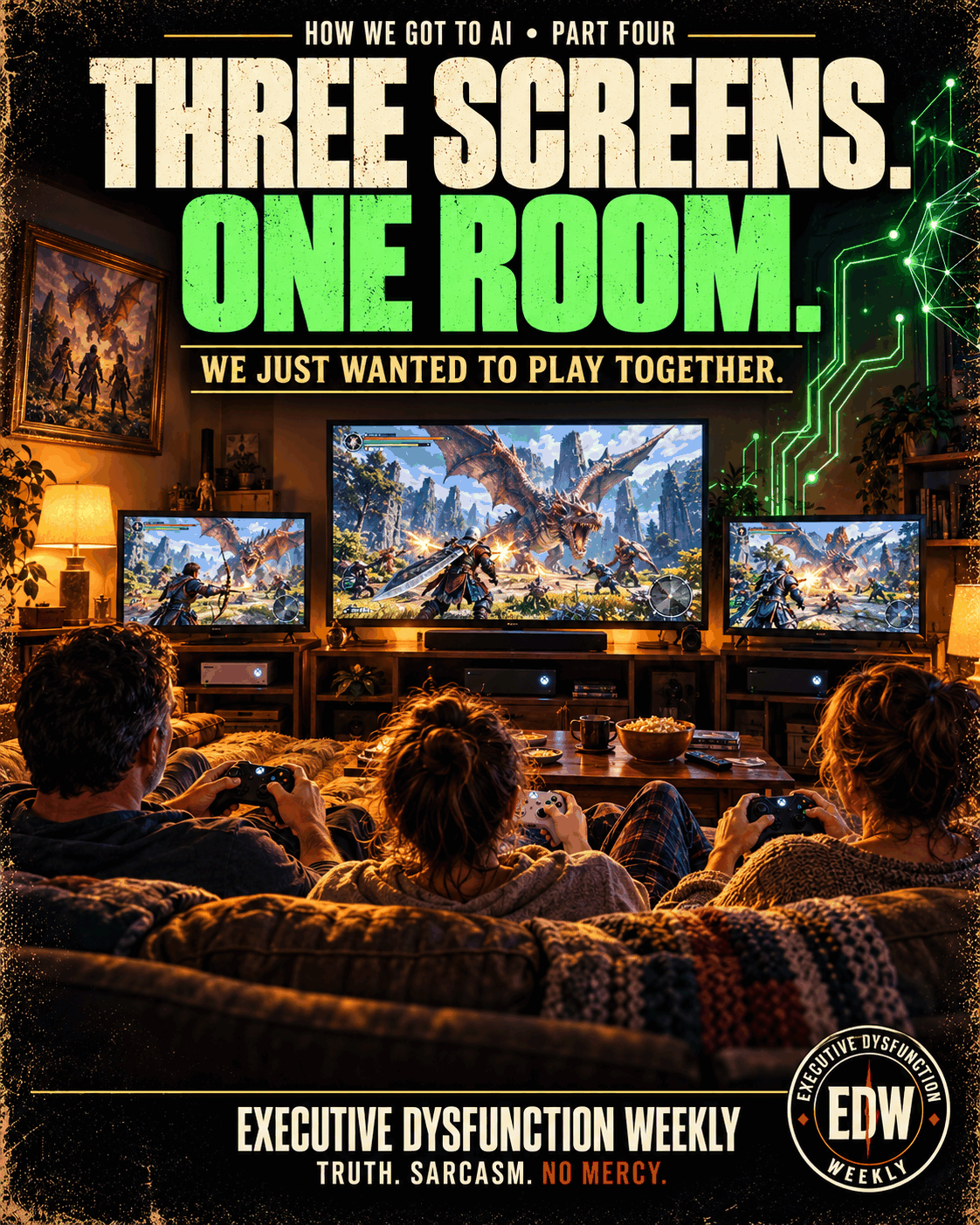
We built the room around a 75-inch Sony on the main wall, a 37-inch television on either side, and a long couch across the back. Nicole, Alyssa, and I could each have a screen and play together.
I loved getting all of it to work. The network, the sound system, the music, the games. We even watched television through the Xbox. We took the entertainment we'd spread across two rooms and put it into one comfortable room where we could enjoy it together.
We put a lot of years into that room.
Minecraft. Borderlands 2, 3, and 4. Tiny Tina. All those expansions. We loved that whole world.
Golf With Your Friends, talking trash. Gang Beasts and Human: Fall Flat, which were fucking hilarious. So much laughing. So much family time.
We played Monster Hunter: World together for a while, too. Alyssa did an oil painting for us with the characters we played and the monsters we slayed.
Our daughter made a painting out of us playing a video game together.
I love that.
Back in our EverQuest days, a second computer had meant Nicole and I could stop taking turns. Now there were three of us. Alyssa was growing up, and we were all growing together through these games.
That was what all those machines gave us.
Xbox One launched on November 22, 2013. Eight CPU cores, eight gigabytes of memory, and a custom AMD chip handling processing and graphics. The original U.S. package, including Kinect, cost about $500.
By then, the consoles had enough power to give us the experience we wanted at a price that made sense. There were faster PCs, of course. I had spent years figuring out how to build them. Buying three complete machines and getting on with playing sounded pretty fucking good.
AMD supplied the custom chips for both Xbox One and PlayStation 4. Its Graphics and Visual Solutions revenue rose 55 percent in 2013, primarily because of those semi-custom chip sales.
I had moved from comparing ATI and NVIDIA cards to buying Xboxes, and AMD was still getting my money. It was getting money from the PlayStation crowd, too.
We could argue about which console was better while the same company sold chips for both.
Meanwhile, Google acquired the neural-network company founded by Geoffrey Hinton, Alex Krizhevsky, and Ilya Sutskever in March 2013. Those were the three researchers behind AlexNet. In December, Yann LeCun joined Facebook to lead its AI research effort.
The companies with enormous computing systems were hiring the people who could put them to work on AI.
Minecraft reached Xbox One in September 2014. While we were busy finding things to build together, researchers were getting better tools for their work, too.
Google released TensorFlow as open-source software in November 2015. PyTorch, developed at Facebook with collaborators, followed in early 2017. These frameworks supplied reusable software for building and training learning systems. Researchers could spend more time trying an idea because somebody else had already written much of the underlying machinery.
People outside those companies could use the tools, improve them, and build on them. That sharing mattered.
OpenAI announced itself in December 2015 as a nonprofit research company, with a stated goal of developing AI that benefited humanity broadly. Its research director was Ilya Sutskever.
There was that name again. AlexNet, Google, now OpenAI.
In March 2016, Google DeepMind's AlphaGo defeated Go champion Lee Sedol four games to one. The system combined neural networks with search. It learned from human games and then played against versions of itself. This was a system trained specifically for Go, and it had beaten one of the world's best players.
The next month, NVIDIA announced the DGX-1, a computer built for deep learning with eight Tesla P100 GPUs and the software to run them together.
The company whose graphics cards I had bought for games was now selling whole computers for AI research.
Xbox One X arrived on November 7, 2017, at $499. It had an eight-core AMD processor running at 2.3 gigahertz, twelve gigabytes of faster GDDR5 memory, and graphics rated at six teraflops.
A teraflop measures a trillion floating-point calculations per second. What you see in a game also depends on the rest of the hardware and how the developers use it. Still, these were capable machines for the money, especially when you were buying for a whole family.
That same year, a team at Google published “Attention Is All You Need.” The paper introduced the Transformer, a neural-network design using attention mechanisms to work with relationships within sequences of information. The researchers demonstrated it through language translation. Their design also allowed more of the training work to happen in parallel.
There's the connection to those graphics processors again. Lots of calculations happening at once, with software getting better at putting that capacity to work. This time, the work included language.
Then AI came back into gaming.
In 2018, NVIDIA introduced DLSS, using deep learning to help produce game graphics. Gaming hardware had helped make the AI research possible, and AI was now helping improve the pictures in games.
I love how that came around.
In July 2019, Microsoft announced a billion-dollar investment in OpenAI and a partnership to build computing infrastructure for more advanced AI systems.
The company selling us Xboxes was also financing AI research and supplying the computers behind it.
In May 2020, Microsoft announced an Azure supercomputer built for OpenAI with 10,000 GPUs.
Ten thousand.
I had spent enough time connecting computers at home and running a server for a medical practice to appreciate how much work that meant. The processors needed fast connections so they could exchange information and work together. Somebody had to build it, power it, cool it, and keep it running.
The companies with money, engineers, and data centers had a huge advantage. A researcher could read a published paper and have an idea. Paying for an experiment at that scale was another matter.
In May 2020, OpenAI published its GPT-3 research. The largest model had 175 billion parameters, the numerical values adjusted during training. It could perform a range of language tasks from instructions or examples supplied in text.
Its training material included web pages, books, and Wikipedia. It learned patterns by predicting what came next in text.
Those words had authors.
The people who wrote them belong in this story along with the people who designed the processors and paid for the computers. Their work helped give these systems something to learn from.
Other researchers were using AI for different problems. In November 2020, DeepMind's AlphaFold achieved a major breakthrough in predicting the three-dimensional structures of proteins, helping scientists investigate how those proteins function.
After eleven years working in ophthalmology, I care about what better scientific tools might make possible. That's part of why this technology interests me so much. There are a lot of things I'd like to see us figure out.
Xbox Series X launched on November 10, 2020, at $499. Sixteen gigabytes of GDDR6 memory, a newer eight-core AMD Zen 2 processor, graphics rated at twelve teraflops, and a fast solid-state drive. More processing power, better graphics, and faster access to what the machine had stored.
We kept upgrading through those generations.
One of the later purchases still makes me laugh. Nicole and I had separate accounts and a Best Buy membership that gave us a chance to buy during one of their sales windows. We were both refreshing, trying to get an order through.
We each got one.
The employee came out with the consoles and wanted to know how we'd possibly managed to get two.
Two separate accounts. Both of us refreshing. We got them.
We managed another through Walmart with its membership arrangement, too.
Buying the fucking things had become a project.
I was still following people who built PCs, and they were losing their minds over component prices. I was happy to be out of that upgrade cycle.
The shortages around 2020 and 2021 had several causes. NVIDIA's reporting described pandemic-era demand, supply constraints, and cryptocurrency mining as a source of demand for gaming GPUs.
People wanted the same kind of equipment for different reasons. I wanted to play games with my family. Somebody else wanted to mine cryptocurrency. Researchers wanted to train learning systems. Businesses wanted computing power they could sell to other businesses.
The budgets involved were getting a long way from what I could spend on a graphics card.
In 2022, releases including DALL·E 2 and Stable Diffusion brought image generation to more people. You could describe an image in words and have a system generate it.
On November 30, 2022, OpenAI released ChatGPT as a public research preview.
You could ask a question, read the answer, and ask another question.
Human trainers had written example conversations and ranked responses to help shape how the system answered. Even at launch, OpenAI warned that it could produce convincing answers that were wrong. People had helped teach it how to respond, and people still needed to check its work.
For its fiscal year ending in January 2024, NVIDIA reported $47.5 billion in data-center revenue, compared with $10.4 billion from gaming. Data-center revenue had more than tripled in a year as demand for AI computing grew.
Think about where we started. Graphics cards sitting on pallets, people like me buying them because we wanted our games to look better. Now the company was selling computing equipment to customers spending billions.
At home, I could finally talk to the computer.
I grew up watching Star Trek. I've been waiting for this my whole fucking life.
I love asking questions, working through an idea, and seeing an image I've been trying to describe finally take shape. I've spent two years working on a book cover. Make a choice, look at the result, change something, try again.
The choices are mine. So is the responsibility for what I put out there. I have to check the information, recognize the mistakes, and decide whether the result says what I mean.
I still get excited about the next Xbox, too. Microsoft has announced Project Helix, a console being designed to play Xbox and PC games. I'm curious about what that could mean for Steam games, and I'm waiting to see what support actually ships.
More games. More ways to connect. After all these years, that still gets my attention.
Alyssa is in college now. She's a fine artist, and we have some real disagreements about AI.
I love what I can do with it. She's building her life around making art. We bring different experiences to the conversation, and it matters to both of us.
I want to understand what this means for the work she loves. Who gets asked before their work becomes training material? Who gets paid? What happens to the value we place on the people who make things?
Those questions deserve answers. The companies making money from this have a responsibility to the people whose work helped make it possible.
We've spent this series following the parts, the people, and the money. We've also kept running into the same tribes. ATI and NVIDIA. Xbox and PlayStation. People picking a side and getting ready to defend it.
Now we're doing it with AI.
Once we've picked our team, it's easy to start preparing an answer while the other person is still talking. I want to hear my daughter. I want her to understand why this means so much to me, too.
I want the scientific discoveries. I want people to have more ways to create. I want artists to have a say in what happens to their work and a chance to make a living doing it.
When I think about art in our family, I think about that Monster Hunter painting.
Our characters. The monsters we slayed. All that time together, and what Alyssa made from it.
That's part of this story, too.
I built a room with three screens because I wanted us together.
I still do.
EDW•