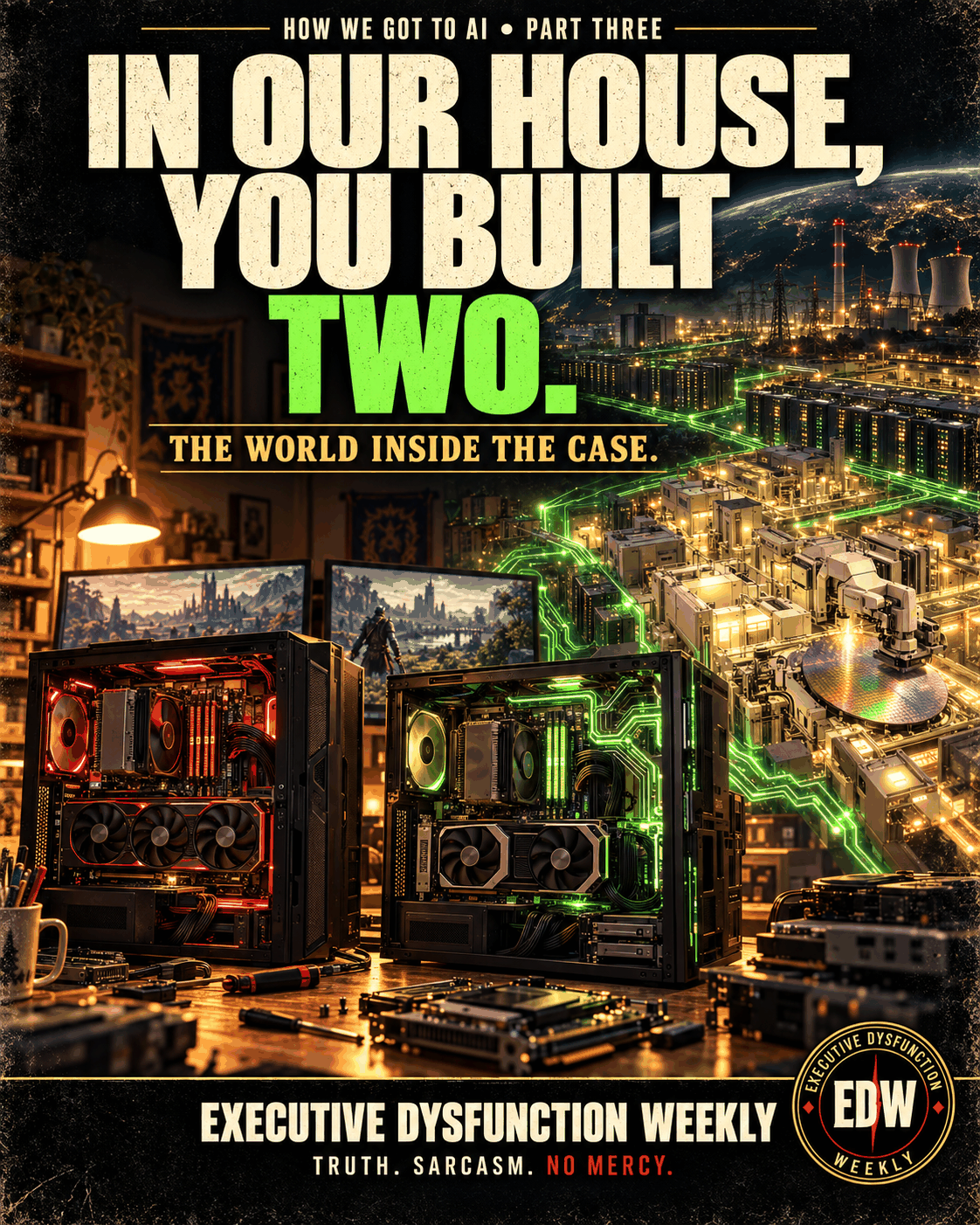
In our house, you built two.
That was something you had to remember when you started pricing the perfect computer. The motherboard you wanted. The processor. Plenty of memory. A power supply you trusted to run everything you were putting inside the case.
Then you did the math again for Nicole.
The open-box IBM from Part One, “The Future Was Sitting on a Pallet,” had solved our EverQuest sharing problem. By the raids in Part Two, “The Raid Started at Nine,” keeping both computers capable was part of the household budget.
If we were going to do this together, we both needed computers that could do it.
For well over a decade, I kept researching, comparing, buying, and upgrading graphics cards. As our circumstances improved, I put more money into the machines around them. I wanted to choose the components myself.
I wanted top-of-the-line shit.
I knew how to build it. I worked hard. This was something Nicole and I enjoyed. Why the hell couldn’t we have the computers we wanted?
Eventually, there was a third computer for our daughter.
You can see where this is going.
At one point, I had three monitors and two graphics cards working together. I switched between ATI and NVIDIA over the years, depending on what made sense when I was buying. I wanted the game across those screens, and I wanted the machine to handle it.
Then I would see somebody else’s setup with six monitors.
That was helpful information for a man already inclined to justify another upgrade.
I was learning along the way. System memory and graphics memory did different jobs. I watched the cards’ memory grow, read about what the games needed, and tried to decide whether the next purchase would make enough difference to justify the money.
That was my view of the industry: the next thing I wanted my computer to do.
Part Two followed the graphics card into research that helped make modern AI possible. This time, I want to look inside the box a little differently.
Who had to do what before I could bring those parts home?
My computer knowledge was a big reason I got the administrator job at the eye center. I was also the IT guy.
We were moving from paper charts to electronic records. I built a server for the practice. The years I had spent learning about computers were now helping me earn the money I spent on better computers at home.
At work, the consequences were different. Staff needed access to records. Patients needed care. The systems had to function when people depended on them.
I understood the pleasure of getting a game to run well. I was learning the responsibility of keeping a business running.
Businesses everywhere were making their own decisions about what computing was worth paying for. Microsoft’s Server & Tools revenue grew 12 percent in fiscal 2012, with the company pointing to purchases of SQL Server and System Center.
After all my complaining about Windows in Part Two, here was Microsoft again, making money from work that needed doing.
NVIDIA’s accounts show another side of the same economy. In its fiscal year ending in January 2012, it recorded roughly $4 billion in revenue and spent just over $1 billion on research and development. More than five thousand employees worked in R&D.
A quarter of revenue going into research and development. Engineers being paid to work on products nobody could buy yet.
Gamers were part of the customer base supporting that effort, alongside professional users and other markets. Our upgrades helped sustain a business that was developing the next generation while selling the current one.
I knew what the card cost me.
I was beginning to understand what it took to make another one worth buying.
Then I reached a question I hadn’t spent nearly enough time asking.
Who actually made this thing?
NVIDIA designed its chips. Outside manufacturers produced them. Its 2012 annual report named Taiwan Semiconductor Manufacturing Company (TSMC) as a wafer supplier, with other contractors handling assembly, testing, and packaging.
TSMC’s business was manufacturing chips designed by its customers. That let those customers develop products without having to own the factories that fabricated the chips.
And there, in TSMC’s 2005 annual report, were two familiar customers.
ATI. NVIDIA.
Remember the graphics-card tribes from Part Two? The arguments over which brand deserved your loyalty?
We were fighting about which team had the better graphics card. A company in Taiwan was making chips for both of them.
That is fucking hilarious.
The designs and performance still differed. Those buying decisions mattered. But our arguments had made the brands enormous and a manufacturer both depended on practically invisible to me.
I stopped while we were working on this article.
How the hell did I not know about TSMC?
I had built computers. I had built a server for a medical practice. I could compare parts and explain why I wanted one over another. Yet here was a company behind those choices that I had barely understood.
Following it took me somewhere I hadn’t expected.
In 1976, Taiwan’s Industrial Technology Research Institute signed a technology-transfer agreement with RCA. Nineteen engineers went to the United States for training. In 1987, ITRI transferred facilities, equipment, technology, and people to the new TSMC. Taiwan’s government, Philips, and private investors helped establish the company.
Public investment. Private capital. People crossing an ocean to learn, then bringing that knowledge home.
Taiwan was changing politically, too. Martial law ended in 1987, the year TSMC was founded. Its first direct presidential election followed in 1996.
While this industry was growing, people there were building a democracy. Taiwan deserves to be understood as a place where people live, with a history and a future of their own.
Its emergence as a center of advanced chip production also gave the rest of the world an enormous economic stake in its security. The conflict across the Taiwan Strait had already drawn in the United States during the 1950s. Chips raised the stakes of a struggle that long predated them.
I had started with a graphics-card box. Now I was seeing a connection to the news that had been there all along.
Even TSMC was only part of the answer.
Its factories needed materials and equipment from other businesses. Its 2012 report listed wafer suppliers with manufacturing sites across North America, Asia, and Europe.
Someone had to make the machines that made the chips.
ASML, in the Netherlands, supplied lithography equipment used to create the patterns for integrated circuits. In 2012, Intel, TSMC, and Samsung agreed to contribute a combined €1.38 billion over five years toward its next-generation lithography research.
Companies with competing interests were helping finance equipment they would need to move forward.
I was comparing the parts on sale. They were paying to develop the tools for parts that couldn’t yet be made that way.
The financing crossed borders, too. In 2009, AMD contributed manufacturing operations, including facilities in Dresden, Germany, to the venture that became GlobalFoundries. Its partner, the Advanced Technology Investment Company, was owned by Abu Dhabi’s government.
An American chip company. Factories in Germany. Capital from Abu Dhabi.
Try fitting that on a team jersey.
And all that investment came with uncertainty. AMD reported $5.42 billion in revenue in 2012 and a net loss of approximately $1.18 billion.
You could sell billions of dollars’ worth of products and still lose more than a billion dollars.
Looking backward from AI makes it tempting to arrange this history as if everyone knew the destination. They were making expensive decisions about an uncertain future. Some paid off. Some hurt.
The machine on my desk contained the results.
Meanwhile, that machine kept connecting me to computers somewhere else.
A game with friends. A business system. A photograph. A video. A search.
Behind those ordinary activities, companies were learning to operate computing at a scale I never had to manage at the eye center.
In 2011, Facebook opened its first dedicated data center in Prineville, Oregon. Through the Open Compute Project, it shared designs for servers, power supplies, racks, and the building itself. AMD, Dell, HP, and Intel were among the companies that helped develop the technology.
The names from the parts list were showing up behind the services, too.
Advertising supplied another stream of money. Facebook earned roughly $4.28 billion from it in 2012. Keeping people connected was a business, and running that business required physical equipment.
Amazon offered another way to pay for computing. Its 2006 launch of the EC2 beta let customers rent capacity over the internet and pay for what they used.
A developer could try an idea without first buying and setting up every server. The machines still had to exist. Someone still had to house them, power them, and keep them running.
I had built a server. I knew those responsibilities didn’t disappear because the customer stopped seeing the box.
And I knew another problem that followed you as you added more hardware.
Could you power it? Could you get the heat out?
I had asked those questions about the case at my desk. More powerful graphics cards. More things I wanted to do. The power supply and cooling had to keep up with the machine I was building.
Look ahead from those early data centers, and the same questions become matters for utilities, transmission lines, and entire communities.
The International Energy Agency estimated that data centers used about 1.5 percent of the world’s electricity in 2024. That covers all their workloads, not just AI. Cooling alone can account for roughly 7 percent of electricity use in efficient hyperscale facilities and more than 30 percent in less-efficient enterprise facilities.
You need electricity to do the computing. You need more to keep the equipment cool enough to continue.
It feels like the whole fucking planet is becoming a giant PC.
The comparison has limits, but the practical problem is familiar. Concentrate enough demand in one place and a local grid can struggle, even when the worldwide percentage looks small.
At home, I could shop for a bigger power supply. At this scale, somebody has to build the infrastructure.
Who gets the benefit? Who gets the bill?
There were costs before the machines were switched on, too. TSMC’s 2012 reporting already covered electricity, water, pollution control, and waste management in manufacturing.
The people operating those factories belong in this story alongside the people giving the keynote presentations. So do the communities supplying the resources and the workers handling what gets left behind.
I loved what these computers let my family do. Learning how they were made gives me more people to appreciate and more responsibilities to think about.
There were also people being supported to work on ideas whose usefulness might take years to emerge.
Canada’s Natural Sciences and Engineering Research Council began funding Geoffrey Hinton’s neural-network research in 1986.
That meant time to think, experiment, fail, and try again. Someone had to pay for those years before there was a breakthrough to celebrate.
ImageNet, the image collection behind the research we met in Part Two, credits support from universities, the U.S. National Science Foundation, and companies including Google and NVIDIA.
Its images came from the web. Human workers labeled them through Amazon’s Mechanical Turk service, as the AlexNet paper explains.
People whose names weren’t on the graphics-card box were helping make the experiment possible, too.
Then I reached a detail in that paper that brought me straight back to my own machines.
The researchers’ GTX 580 cards had three gigabytes of memory each. The network was too large to fit on one, so they divided it across two GPUs.
After all those years comparing graphics memory, I recognized the constraint immediately. There was something they wanted the computer to do, and they had to find a way to fit it onto the available hardware.
Their research and software made that possible. My gaming setup wasn’t doing the same work. But I understood why that memory limit mattered.
And I could finally see more of what stood behind those two cards: engineers, factories, suppliers, customers, investors, public research, and the people who had labeled the images.
AlexNet’s 2012 breakthrough brought those efforts together with the researchers’ own ideas and years of work.
I used to look at my setup and see the parts I had chosen.
I could tell you why I wanted them. What I had upgraded. What I hoped to buy next.
Now I can see people and places I hadn’t known to look for.
Engineers learning in another country. Workers in a factory. Researchers with enough support to keep going. Companies competing for customers while depending on the same supplier.
The tribes gave us a simpler story. Following the parts gave me a better one.
And it still comes back to our house.
I wanted a better computer. Nicole needed one, too. Eventually, our daughter needed her own. We wanted machines that would let us spend time together doing something we enjoyed.
Multiply those decisions across households and businesses, and you begin to see the market that helped sustain the industry. Add the research, the public investment, and the work stretching across borders, and you can see how much had to come together before those GPUs reached a laboratory.
Then researchers showed what else they could do.
The companies supplying the hardware (and the companies already operating enormous amounts of it) had another reason to invest.
That is where Part Four of How We Got to AI begins.
At my desk, I had been planning the next upgrade.
I hadn’t understood how much of the world was already inside the case.
EDW•