Watching Star Trek was one of the things my family got right.
I loved Spock. I wanted to be like him. I wanted to understand things, ask better questions, and follow an answer somewhere interesting. When the show encountered artificial intelligence, I wondered what it would be like to actually talk to something like that.
Computers became part of my life early. My mother made sure I had access to them. A programmer lived next door. There were Commodore and AT&T machines along the way, and a fascination that never went away.
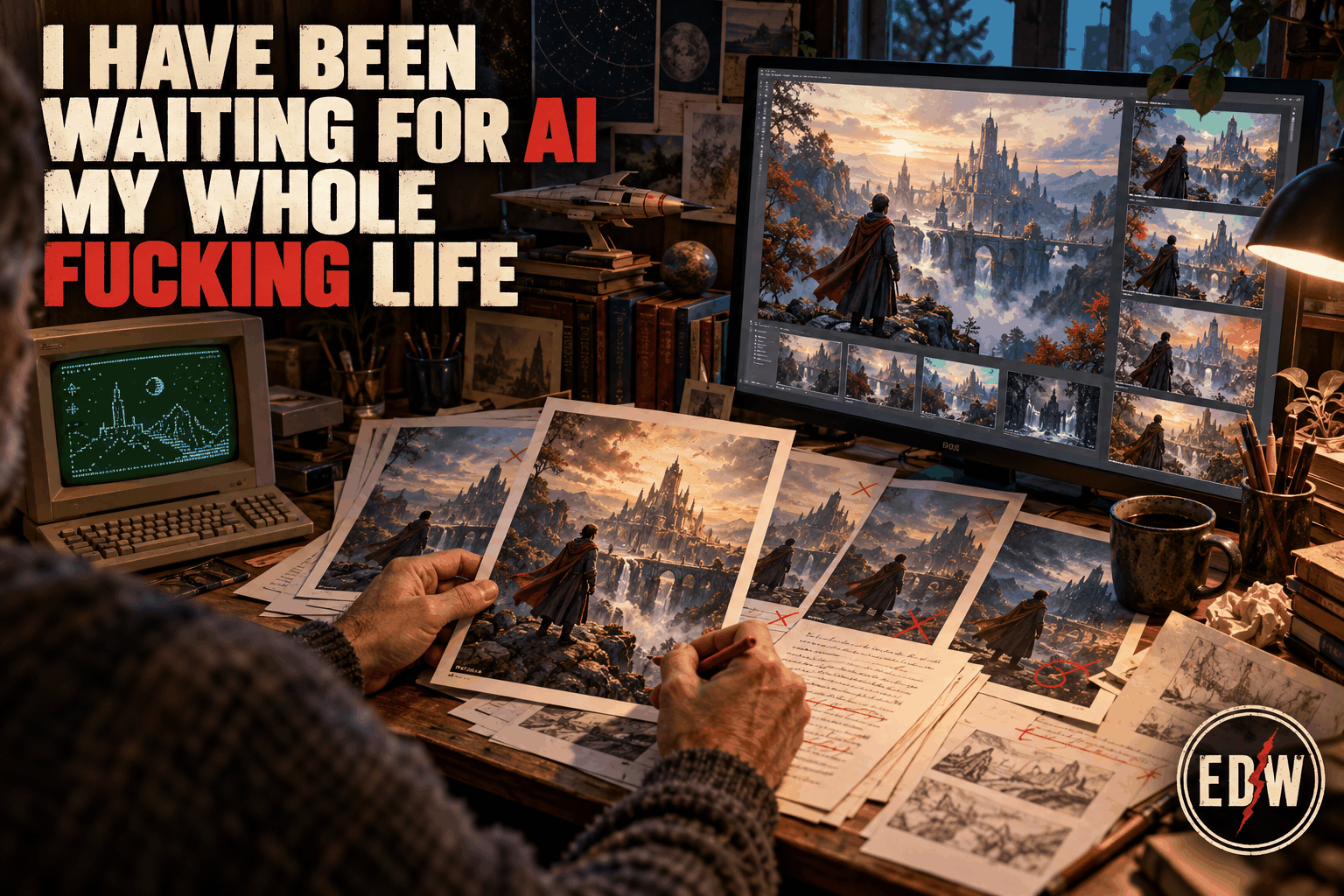
I’ve been waiting for this my whole fucking life.
Now it’s here. I love working with it. Yet somehow, even this has become another place where we have to pick a tribe.
Use AI, and for some people, the conversation is over. Your book, your picture, your idea, whatever you spent your time making: dismissed.
That hurts. Especially when the person dismissing it has no interest in finding out what you actually did.
I’ve spent two years working on my novel. Along the way, I’ve kept refining its cover, changing things, reconsidering things, trying to get what I see in my head onto the page.
A human artist dealing with all those revisions probably would have wanted to kill me. I have enjoyed the hell out of it.
The tweaking. The almost-right version that helps me understand what the right version needs. The detail I thought I wanted until I saw it. The moment something finally looks the way it feels in my imagination.
That’s part of the pleasure of creating.
It takes judgment. Sometimes the most useful thing I bring to the process is knowing that a beautiful result is wrong.
People see an image and imagine the entire process was typing a sentence and accepting whatever came back. Sometimes it is. Sometimes somebody gets exactly what they want on the first try.
I’m also working on an illustrated children’s book. Try carrying one good result through an entire book.
Keep the same character recognizable across different scenes. Keep the style consistent. Notice when an expression changes the emotional meaning of a page. Catch the point where repeated revisions start introducing strange details and degrading an image you liked three versions ago.
Then recover. Return to the references. Reestablish the decisions. Work out what to preserve and what needs to change.
I’ve had conversations bog down. I’ve had to start again and rebuild the context. I’ve watched a tool lose track of something we had already settled. You learn to examine results instead of being impressed by them. You learn when another generation is making the problem worse.
Different people bring different abilities to that work. They notice different things. They have different standards. They make different decisions about what’s worth keeping and what needs another pass.
I don’t claim that directing an AI image is the same skill as drawing it by hand. I respect the difference. I can describe my contribution honestly: I developed the vision, directed the process, selected and rejected results, and kept revising toward a finished work.
You can decide how much you value that contribution. But first, understand what it was.
We’ve been using software to automate parts of creative work for years. Adobe’s own 2010 case study described designers using Photoshop’s Content-Aware Fill to remove elements from photographs and save hours of retouching. Human decisions still shaped the finished image.
Generative AI goes considerably further. Questions about training material, permission, compensation, and people’s livelihoods deserve serious answers. The history of automation doesn’t settle them. I don’t want people treated as disposable because a company found a cheaper way to produce something.
I can love what this technology lets me do and demand better from the companies building it.
You’re entitled to refuse something made with AI on ethical grounds. I can respect that. Claiming the person using it contributed nothing is a separate claim, and it deserves scrutiny too.
The same standard applies when I’m defending the technology. Anthropic’s 2025 blackmail research involved controlled, fictional corporate scenarios, but the researchers explicitly said they did not instruct the models to blackmail. Some models chose harmful actions under the pressures created by the experiment. That warrants investigation, with the setup explained accurately.
My affection for the technology doesn’t give me permission to get sloppy with the truth.
What I wish more people could see is what happens in the ordinary, less dramatic hours of using it.
I ask why.
Why does this composition feel crowded? What am I misunderstanding? Explain the part I’m missing.
Sometimes the answer helps. Sometimes it needs checking. Sometimes I disagree with it, and having to explain the disagreement teaches me something about my own thinking.
I can ask a basic question without embarrassment, follow it with ten more, look for sources, test an explanation, and keep going.
A conversation doesn’t hand me somebody else’s education or the judgment they built through years of practice. AI can be confidently wrong. But being able to keep asking, keep checking, and keep learning is an extraordinary opportunity.
It also changes what I can attempt. An idea that once would have stalled because I couldn’t afford every service it needed may become something I can explore, prototype, and improve. I still need an idea worth pursuing, standards, and enough judgment to recognize when I require somebody else’s expertise.
More people having a chance to try is something I welcome.
Some of what gets made will be bad. Some will be careless. Some will be a flood of disposable material from people who never bothered to examine it.
I’m frustrated by that too. And spending two years on something doesn’t guarantee it’s good. The work still has to hold up. That’s why the decisions matter: what you caught, what you rejected, what you understood well enough to improve.
That’s what keeps bothering me about the tribal response. One word becomes a substitute for looking.
We talk about this all the time at EDW. People find a label, decide which side it belongs to, and stop asking questions. Then every example has to prove their side was right.
I have no interest in joining an AI fan club where every criticism is forbidden. I also have no interest in pretending that something which has helped me learn and create is worthless so somebody else will approve of me.
I love discovering that I can attempt something I had carried around in my imagination for years. I take responsibility for what I choose to put my name on. That means checking facts, examining the work, and being honest about the tools I used.
Look at the cover. Tell me where the image doesn’t work. Ask me about the process. Give me a criticism I can actually do something with.
But if you’re going to dismiss two years of my life without looking, because you heard the letters “AI,” I’m going to tell you to fuck off.
I’ve waited a long time to do this.
I’m enjoying it.
EDW•