In Augsburg, Germany, there is a housing community where the annual base rent is €0.88. [1]
Eighty-eight euro cents. For the year.
It’s called the Fuggerei. Jakob Fugger established it in 1521, and it still houses people in need today. It serves Catholic Augsburg residents in financial need, and the obligations include three daily prayers. Residents pay utilities and other housing charges separately. [18] [1]
I started this research wanting to know where the oldest fortunes came from and whether any of the money was still around. I wasn’t expecting a housing project founded more than 250 years before the United States existed.
Then I learned what helps pay for it.
Forests. The Fugger foundations own forests. During the seventeenth century, the foundations shifted from financial investments toward owning estates. Forestry later became a principal source of income. [2] [3]
People made decisions about that wealth centuries ago. Those decisions are still helping pay somebody’s housing costs.
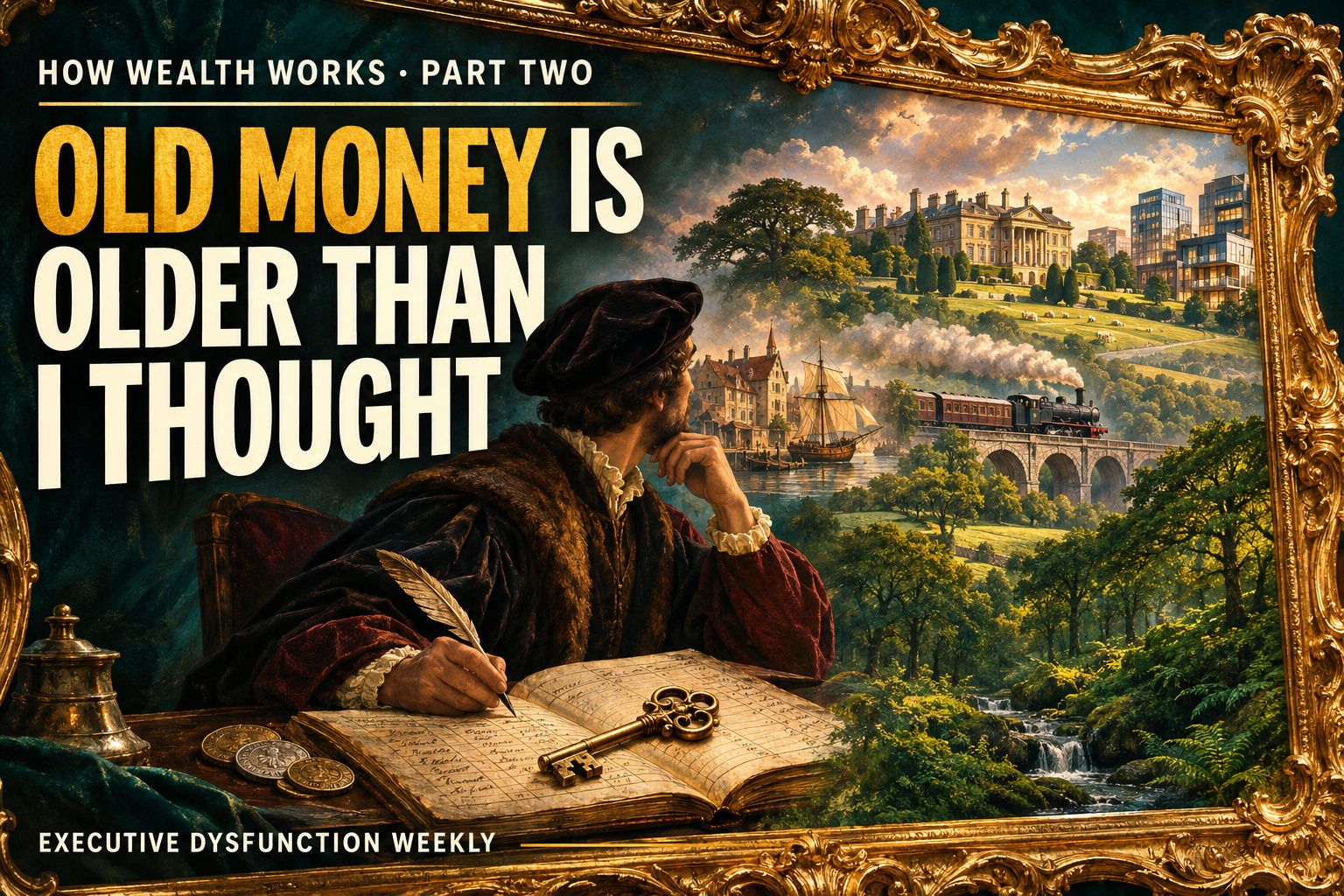
The Fugger story starts with a weaver. Hans Fugger arrived in Augsburg in 1367. Over the following generations, the family’s textile business expanded into trade, mining, and finance. Jakob Fugger, known as Jakob the Rich, became a lender to rulers. [4]
In 1519, Jakob supplied roughly two-thirds of the money used to bribe the electors into choosing the future Emperor Charles V, according to the Swiss National Museum. [16]
I knew money and political power had a long relationship. I hadn’t pictured a banker financing the selection of an emperor.
The lending also helped the business obtain valuable mining rights. Commerce, access to natural resources, and proximity to power grew together. [5]
Those royal loans also caused trouble. The Spanish crown’s failure to pay its debts caused losses. The family gradually pulled back from businesses and bought more land. In 1658, it decided to dissolve the old firm. [5]
The company ended. The foundations survived.
This is what I hadn’t understood about old wealth. You have to follow what it became. A trading profit can buy land. The land can produce income. A foundation can hold that property after the founder, the company, and the political world they knew are gone.
The charitable assets belong to the foundations, which are separate legal entities. They aren’t a private spending account for everyone with the surname Fugger. [6]
But they show how long the effects of ownership can last. They also show that wealth preserved across generations can support something useful. The assets and the rules governing them determine who benefits.
So who has the oldest fortune?
I wanted a name. What I found was a problem with the question.
An ancient surname doesn’t establish an unbroken fortune. A family might lose its estates, acquire new ones through marriage, sell a business, or rebuild after a disaster. A company can keep its name after the founding family loses control. To trace the wealth, you need the ownership records.
The Liechtenstein family gives us an unusually long trail. Its name appears in twelfth-century records, and its documented property history reaches back to a grant of land in 1249. These are examples with surviving records, not a ranking of every fortune on Earth. [7]
The family expanded its holdings after the Battle of White Mountain in 1620. Karl I of Liechtenstein supported the victorious emperor and bought estates confiscated from defeated rebels at low prices. [7] [20]
Someone loses a political and military struggle. Their property is seized. Someone on the winning side acquires it. Future generations inherit the result.
The family also made arrangements to keep part of its fortune together. In 1606, three brothers agreed that a portion would be indivisible and could not be sold off. The firstborn male in the ruling line would have its use. [7]
They were trying to keep future inheritances from splitting those assets into smaller and smaller pieces.
In 1945, the family’s estates in Czechoslovakia were expropriated without compensation. The family sold important works of art in the decades that followed, including a Leonardo da Vinci painting in 1967. [8]
The painting was Ginevra de’ Benci, now at the National Gallery of Art in Washington. To bring it to America, conservator Mario Modestini packed it in a specially fitted suitcase and booked it a first-class airline seat under “Mrs. Modestini.” [17]
Imagine having to sell the Leonardo to help recover from a financial catastrophe.
That is a real loss. It is also an extraordinary kind of reserve to have.
Today the family’s holdings include the LGT financial group, property, agriculture, and forestry. LGT also manages other people’s money; those clients’ assets are not the family’s personal fortune. [9]
The documented story includes acquisition, protection, confiscation, sales, and rebuilding. Nine hundred years of a name does not mean nine hundred years of the same untouched pile of money.
Then there are the Vanderbilts.
This is the story people reach for when they want to show that even an enormous fortune can disappear. There is plenty of extravagance to work with.
Cornelius Vanderbilt built his fortune in shipping and railroads. When he died in 1877, it was estimated at about $100 million, with most going to his son William Henry. William died eight years later with a fortune estimated at about $200 million. Those are dollars of their time. [10]
The inheritance then spread among William’s eight children, with the largest portions going to two sons. The National Park Service’s historical account describes a generation whose spending dissipated much of the fortune. Mansions, yachts, and elaborate social lives were part of the story. [10]
A mansion is an asset. It is also something you have to heat, maintain, staff, insure, and repair. Owning something expensive doesn’t guarantee that it earns enough to support the life built around it.
But the ending needs more care than “the Vanderbilts blew it all.”
Frederick Vanderbilt was shy enough that Franklin D. Roosevelt told a story about him ducking into bushes to avoid a servant, only to find the servant had ducked into the same bushes to avoid him. [11]
Frederick also increased his inheritance and died in 1938 with a fortune worth tens of millions of dollars. According to the National Park Service, more than half of his estate went to estate and inheritance taxes. [11]
Biltmore, the enormous North Carolina estate built by George Vanderbilt, remains a family business operated by George’s descendants. [12]
The loss of a single dominant family empire is not the same thing as every descendant becoming poor.
It also helps to separate what people mean when they say money disappeared. Spending transfers money to someone else. Dividing an inheritance spreads ownership among more people. Taxes transfer resources to the public. A collapsing investment can lose market value without an equivalent pile of cash appearing in somebody else’s account.
Those are different events. Calling them all “losing the fortune” hides what happened.
For a different kind of ending, look at Mitsui in Japan.
Its commercial roots include a kimono business opened by Mitsui Takatoshi in Edo in 1673. The family’s archive describes the appeal of selling for cash at fixed prices in a trade where customers often needed connections and bargaining knowledge. A clearer, more accessible way to shop helped build a successful business. [13] [14]
I want that in this story, too. People did build fortunes by finding better ways to do things. Understanding wealth means looking at the useful work as well as the privileges and coercion. Sometimes they appear in the same history.
By the twentieth century, Mitsui had become a huge family-controlled business group, or zaibatsu. After Japan’s defeat in World War II, the Allied occupation pushed to dismantle those groups. Mitsui’s holding company was dissolved in 1946. [15]
Shares held by companies and family members were transferred to a liquidation commission for sale. The former owners received compensation in government bonds. A separate capital levy also took a large share of the family’s taxable wealth. The Mitsui archive describes the severing of the family’s ownership and management ties to the affiliated companies. [15] [19]
A familiar corporate name could survive those changes. The family’s old control could not. [15]
This was a defeat, an occupation, and an extraordinary restructuring. It was also a demonstration that even an entrenched ownership system could be changed.
That is worth remembering when wealth starts to look permanent. Some fortunes weaken through spending or bad business decisions. Others are transformed by war, taxes, or changes in who is legally allowed to own and control the assets. There is more than one way for a fortune to end.
When I began, I pictured old wealth as something that had somehow been kept safe.
Now I keep thinking about how much had to happen around it.
Workers mined the metals. People ran the railroads, managed the forests, built the houses, and kept the businesses operating. Owners and managers made decisions, committed resources, and sometimes took enormous risks. Laws determined who held the property, who could inherit it, and who could lose it.
The family histories focus on the owners. The history of how those assets kept producing value includes a lot more people.
The surviving dynasties are also the ones easiest to notice. We have to look for the failures, too, or we start treating the survivors as proof that wealth always lasts.
What gets me is the length of the head start.
Most of us are trying to leave our kids something. Some families have spent centuries arranging for their kids to begin with assets, income, and choices already in place.
We talked in Part One about what it means to be able to afford a risk. This is what it can look like when that advantage survives the person who first acquired it.
You can work your ass off and build something worthwhile. I believe that. I also think we ought to understand how differently the same effort can pay off when one person is starting with a paycheck and another is starting with generations of ownership.
The next thing I want to understand is how that ownership gets handed forward. What keeps the assets together? What allows the income to keep flowing? And what do the trusts, loans, and tax rules actually do?
Because the founder eventually dies. The bills keep coming. Somehow, in some families, so does the money.
EDW•