For Maryanne Gunshefski, born Maryanne Tyleski (1941–1995). Mother of George, Linda and Jaimee.
In 1980, I came home from Catholic school and explained to my mother why she should vote for Ronald Reagan.
I was twelve. Apparently, I had the economy figured out.
My history teacher, Mr. Gore, had explained what I remember as trickle-down economics. We’d asked who he was voting for, and he told us Reagan. His explanation made sense to me.
I liked him. He was young, had a mustache, and the girls in class thought he was good-looking. He told us about his girlfriends helping him decorate the classroom on weekends. I was having a hard time at school, and he was kind to me. He liked me. I loved his class.
So I brought my new expertise home.
Holy shit, was my mother angry.
She wanted to go to the school. I begged her to leave it alone. I was afraid he would hate me afterward. Here was a teacher I liked, a class I looked forward to, and I needed her to understand that.
She listened. She never went to complain to him. She protected something that mattered to me, even while she was furious.
Then we talked.
She explained why she thought the economics were wrong. Then she told me about the experiences behind her politics, including a train ride to Louisiana.
My parents had started young. My father joined the Air Force to support his family. He thought he might be drafted anyway and wanted to choose his branch. He was stationed in Louisiana, and around 1961, my mother traveled down to join him.
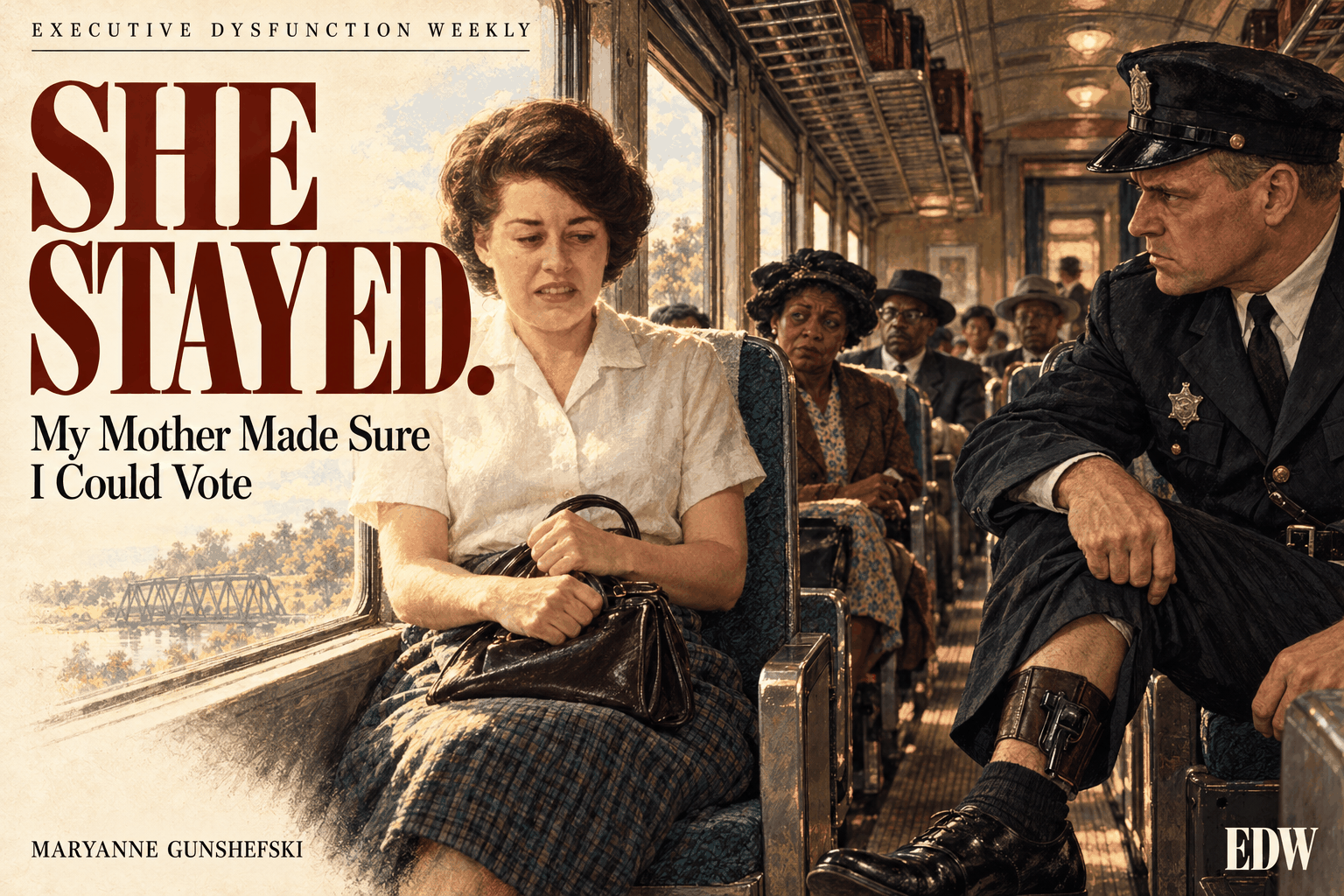
After changing trains, she picked a car with plenty of empty seats. The other passengers were Black. She was from Bayonne, New Jersey. She knew Black people. She sat down, talked to the people around her and enjoyed the ride.
A police officer came into the car and sat down.
He kept looking at her. She grew uncomfortable and lowered her eyes. He pulled up his pants leg so she could see a revolver.
He kept doing it. She looked down, and he showed her the gun.
By the time he left, she was terrified.
A Black woman explained what was happening. My mother had sat in the car still being treated as the Black passengers’ car. The woman believed the officer thought she was a white Northerner coming south to challenge segregation. She warned my mother to get out of that car.
My mother remembered being told that segregation on those trains was supposed to be over. People were still enforcing it through fear.
She believed that officer was telling her she could be killed.
My mother stayed in that fucking car.
Federal regulators had ruled against segregation on interstate trains and buses in 1955. The Freedom Riders of 1961 confronted the continued defiance of those rights and helped force stronger enforcement. People had to risk their lives to make the rules mean something. [1]
I think about the woman who warned her, too. She understood the danger and tried to help.
My mother also told me about the Kennedys. She cried for days after John was assassinated, and again after Bobby. She described how much hope she and other young people had invested in them. She believed they could change things. Those losses still hurt when she talked about them.
When I asked about Jimmy Carter, we went to the library.
That was where I learned what microfiche was. I looked through newspapers and read articles about the man running against Reagan. I came to believe he was a great human being.
Jimmy Carter remains one of my idols. His decades of work for peace, human rights and public health gave me plenty of reasons to keep admiring him. [2]
I liked my teacher. I loved my mother. They disagreed, and I had access to a library.
I started reading.
My mother’s politics could get fierce. I remember her supporting Mondale and Ferraro a few years later. I also remember an argument with a childhood friend down the street that effectively ended their friendship.
Her friend said she didn’t read the newspaper. Her husband told her what was happening, and she voted the way he did.
That set my mother off. What upset her was hearing her friend hand over the work of forming an opinion to her husband. She wanted her to read the goddamn newspaper and decide for herself.
My mother also thought the husband was an idiot. From what I remember, he was kind of a dipshit.
She said something so cruel that they barely spoke afterward. I can’t remember the words. I remember us storming home down the street, and how angry she was.
I understand what mattered to her. I also remember what it cost.
Those memories have been coming back as I think about the midterms.
Phil Vischer, the co-creator of VeggieTales, deserves some credit for getting me started. He raised a question about why white evangelical Christians and Black Christians so often vote differently. I appreciated it enough to go read more.
The divide is still striking. In a Pew survey released this month, 73 percent of white evangelical Protestant registered voters said they would choose their Republican House candidate. Among Black Protestant registered voters, 74 percent favored their Democratic candidate. White Catholics leaned Republican by a smaller margin, while white Protestants who weren’t evangelical were more divided. [3]
People can share Christian beliefs and have very different ideas about whom to trust with power.
My mother’s train story helps me understand part of that. Imagine hearing someone promise to leave things to the local authorities when your family’s experience of those authorities includes intimidation. Federal protection might mean being able to sit down, go to school or register to vote safely.
Black churches helped organize the struggle for those protections. They supplied meeting places, leaders and networks. In Selma, a mass meeting at Tabernacle Baptist Church in 1963 helped build the local voting rights movement. The Voting Rights Act followed in 1965 after years of organizing and resistance. [4][5]
Both parties were divided over civil rights. Southern Democrats were central defenders of segregation. Republicans were essential to passing the Civil Rights Act of 1964 alongside Democrats who supported it. Resistance to the Democrats’ civil rights commitments helped drive Southern white voters away from the party over the following decades. [6][7]
During the 1970s and ’80s, the religious right built a powerful alliance with Republicans. By the election I was arguing about with my mother, leaders such as Jerry Falwell were organizing conservative Christians behind Reagan over issues including abortion and school prayer. Carter himself was a white, born-again Christian. Their political differences ran right through a shared faith. [8]
That history helps explain why people can bring different priorities into the voting booth. Someone may see protecting unborn life as the overriding duty. Someone else may see protecting their family’s civil rights as just as inseparable from their faith. People also care about jobs, health care and what it costs to live.
I think we understand each other better when we take those histories seriously. I have my own history. My mother helped shape it. Mr. Gore did, too. So did the newspapers I read at the library.
I’m fifty-eight now, and I can see how much of that kid is still in the way I work.
I hear something that interests me, start asking questions and read. Sometimes I find out I had part of it wrong. Today, putting these memories together, I’m realizing how much my mother had to do with that habit.
I keep coming back to the rule of law, money in politics and what happens when health care becomes somebody’s investment strategy. I want to know who benefits, who gets hurt and who has the power to do something about it. I want the people making those decisions to answer for them.
This November, we get to help choose those people.
Congress writes laws, controls federal spending and has the responsibility to oversee the administration. State and local officials make decisions that reach directly into our communities. The November 3 midterms deserve our attention. [9]
Read what the candidates propose. Look at their records. Check the claims you’re inclined to believe, too. Listen to people whose experience is different from yours. Make your own decision and vote.
My mother had plenty to say about her own choices. When I turned eighteen, she took me down to the post office to make sure I could exercise mine.
I remember that as clearly as I remember her anger.
She heard me when I asked her to leave my teacher alone. We went to the library when I wanted to learn about Carter. When I was old enough, she made sure I could vote.
My daughter is Alyssa Ann. Her middle name is for my mother.
I’m still doing the reading, Mom.
I’ll be voting.
EDW•