Yesterday, we were talking about a banker who helped finance the selection of an emperor. Jakob Fugger supplied much of the money used to bribe the electors who chose Charles V in 1519. [1]
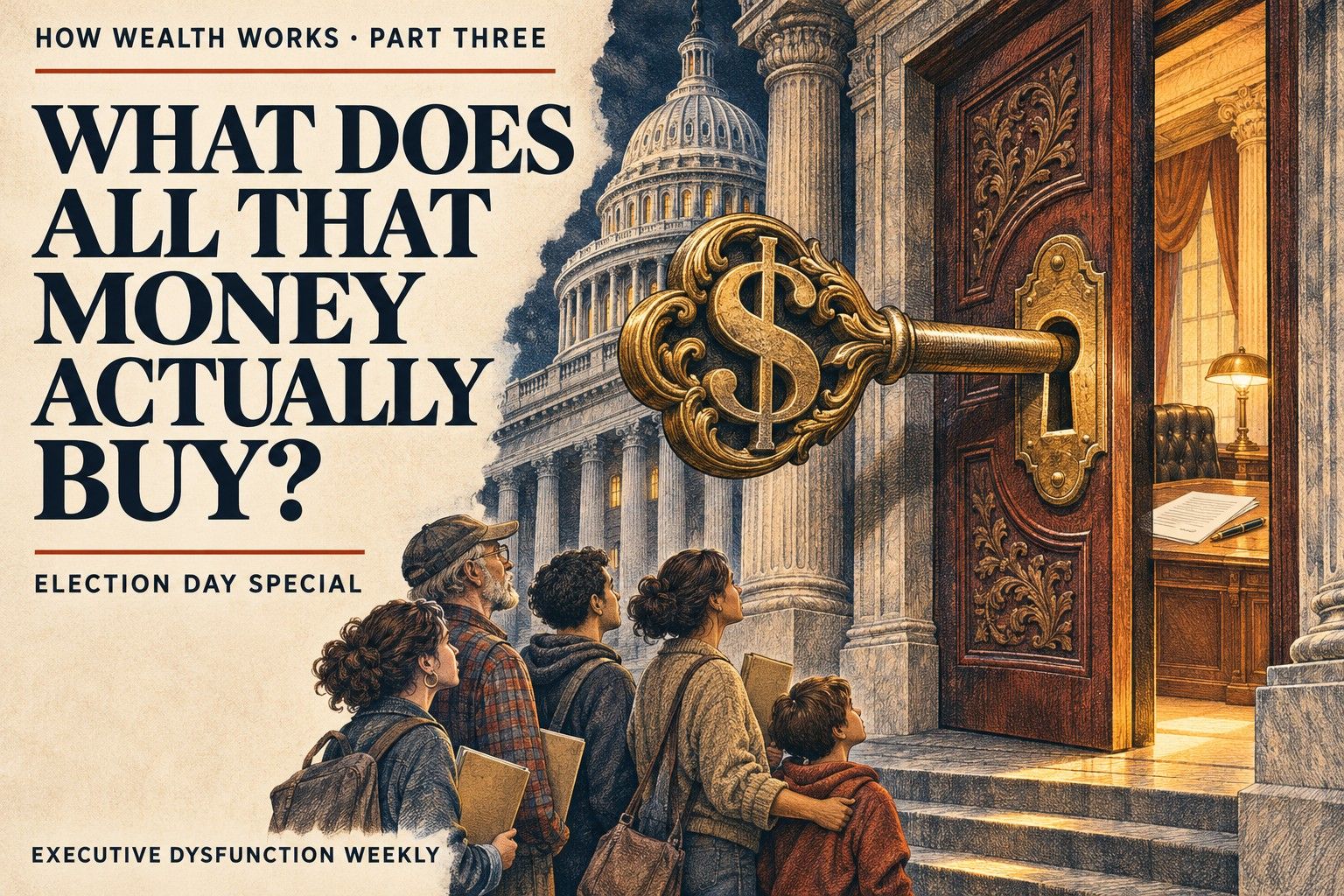
Today is Election Day in America, and I want to follow the money here.
OpenSecrets projects that this year’s congressional elections will cost about $11.9 billion. That is a projection, with the final accounting still to come. [2]
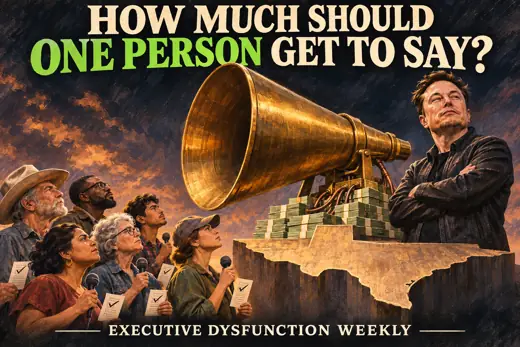
I know campaigns cost money. People need staff, transportation, offices, and a way to reach voters. But when we get into billions, I want to understand what the people providing it are getting. How much of the election can money change? Who gets heard afterward? Who helps write the laws?
Because the more I read, the less sense it makes to stop following the money when the votes are counted.
America had its own wealthy men buying their way toward power long before anybody heard of Citizens United.
William A. Clark, one of Montana’s copper kings, resigned his U.S. Senate seat in 1900 after a bribery investigation. The Senate committee unanimously concluded that he was not entitled to the seat. This was when state legislatures selected senators. [3]
The Montana legislature elected him again in 1901. This time he served, remaining in office until 1907. [3]
Imagine reading about the investigation and thinking, well, at least that put an end to his Senate career.
Congress did try to put limits on money. The Tillman Act of 1907 prohibited corporate money contributions in federal elections. Following the financial abuses surrounding the 1972 presidential campaign, Congress strengthened contribution limits and created the Federal Election Commission in 1974. [4] [5]
Then, in 1976, the Supreme Court’s Buckley v. Valeo decision drew a distinction that still shapes the system. Limits on contributions to candidates could stand. Most limits on campaign expenditures, independent spending, and candidates spending their own money could not. Spending on political expression received First Amendment protection. [6]
Giving money to a candidate and spending money to help elect that candidate became legally different things.
The 2002 McCain–Feingold law later restricted the national parties’ access to “soft money,” funds raised outside the federal contribution limits. Reform kept running into the question of which restrictions the courts would allow. [7]
Citizens United came out of a nonprofit’s 2008 film about Hillary Clinton. The case became much bigger than the film. In 2010, the Supreme Court struck down restrictions on independent political spending by corporations and unions, treating that spending as protected speech. The ban on corporate contributions directly to candidates remained. [8]
The Court’s majority reasoned that independent spending did not create the kind of corruption that would justify restricting it. We are still arguing about how much protection that independence actually provides. [8]
Another case that year, SpeechNow.org v. FEC, removed contribution limits for an organization making only independent expenditures. Those decisions, followed by FEC guidance, produced the rules under which super PACs can accept unlimited contributions. [9] [10]
Here is what that distinction looks like today. An individual can give a federal candidate $3,500 per election in the 2025–2026 cycle. The primary and general election each have a separate limit. [11]
That same person can give a super PAC $10 million. Or more. The super PAC can spend independently to support the candidate or attack an opponent. It cannot give the money directly to the candidate or make coordinated contributions to the campaign. [12]
So there is a limit on the check you hand the candidate. There is no comparable dollar limit on funding the independent group trying to get that candidate elected.
A traditional PAC pools political money and can contribute to candidates within limits. A super PAC finances independent political activity. Neither term means “the people who write legislation.” We’ll get to those people in a minute. [11] [12]
Then there is dark money. A super PAC has donor-reporting obligations, but its disclosed donor can be a nonprofit whose underlying contributors are not all publicly identified. You can see the organization’s name and still be unable to follow the money back to the people who supplied it. Disclosure rules vary by organization and activity. [13] [14]
The legal changes also continued this year. On June 30, 2026, the Supreme Court struck down federal limits on political parties’ coordinated spending with their candidates. That decision concerns party spending, a different category from super PAC activity. [15]
If you thought the rules had been settled back in 2010, they hadn’t.
I wanted a percentage. How much does money affect who wins?
Polling can tell us what people think about that. Pew found in 2023 that 80% of American adults believed major campaign donors had too much influence on decisions in Congress. That tells us how widespread the concern was. It does not measure how many votes money changed. [16]
Even comparing spending with election results gets complicated. A strong candidate may attract money because donors expect a victory. An incumbent may have money, name recognition, and a favorable district. If that person wins, how much credit belongs to the spending?
Researchers have tried to separate those effects. A study published in 2016 used differences in state campaign-finance restrictions to examine Citizens United. It estimated an increase of approximately four percentage points in Republican winning probabilities in the state House races studied. That is an estimate in that setting, not four extra points of the national vote. [17]
Other research, involving 59 randomized experiments with presidential advertisements during the 2016 campaign, found small average persuasive effects. An advertisement’s effect also tells us only part of what a campaign’s money accomplishes. [18]
Michael Bloomberg is an obvious reminder that an enormous budget cannot guarantee a nomination. FEC records show he put more than $1 billion of his own money into his 2020 presidential campaign over the full cycle. He still withdrew from the race. [19] [20]
But money can keep a campaign operating, hire people to reach voters, and give an unknown candidate a chance to become known. Losing a race doesn’t mean those advantages weren’t real.
There isn’t one honest percentage that covers all of that. I would rather understand what we can measure than repeat a number that sounds good.
Then I came across the study that really got me.
Researchers arranged meeting requests to 191 congressional offices and randomly varied whether they identified the prospective attendees as campaign donors. Senior officials attended meetings with 18.8% of the groups identified as donors, compared with 5.5% of the groups described as constituents. The prospective attendees were donors in both groups; the difference was whether the offices were told. [21]
More than three times the rate. What the actual fuck.
That finding measures access. It doesn’t tell us whose legislation passed. But that was my next question: who actually gets something done?
I’ve been to advocacy days for child care. The Republican lawmakers I was meeting with kept steering the conversation toward regulations they could cut. I came away feeling that what interested them most was information they could use against their Democratic counterparts.
I wanted to talk about what children and the people caring for them needed. Too often, I felt useful as a source of complaints about the other party. I didn’t have a Democratic legislator in my own district to turn to.
Maureen Walsh, also a Republican, was an exception, and she deserves credit. She cared about child care, and in my experience she did more to help us than anyone else I dealt with. She couldn’t fix everything. She did try.
Her public record backs up that commitment. Walsh co-chaired Washington’s 2013 Child Care Improvements for the Future task force and supported the 2015 Early Start Act, arguing for quality in programs receiving public funding. [22] [23]
My meetings were with state lawmakers. They don’t prove campaign money caused the responses I got. They do explain why I want to know what happens after somebody lets you in the door.
So who does the work after the meeting?
This is where lobbying comes in. Campaign finance helps pay for elections. Lobbying seeks to influence government decisions. A corporation or advocacy organization can have a PAC and also employ lobbyists, but those are different activities.
Congress has its own legislative staff and nonpartisan drafting counsel. Outside groups can also suggest language, propose amendments, and help develop bills. Only a member can formally introduce a House bill. Providing outside expertise is a normal part of the process; citizens and public-interest organizations can do it too. [24] [25]
The advantage comes with being able to keep paying people to do that work.
Political scientists Richard Hall and Alan Deardorff described how lobbying can work this way: organizations provide information and help with legislative work to lawmakers who already share their goals. You may not need to change a politician’s mind. You can help them get something done. [26]
That made more sense to me than picturing every bad policy beginning with a secret payoff. An organization can arrive with a proposal, people who understand the details, and the resources to keep working on it. Most of us have to get back to our jobs.
Then I read about Citigroup.
In 2013, The New York Times reported that the bank’s recommendations appeared in more than 70 lines of an 85-line House committee bill addressing financial regulation. NPR later reported on the language and interviewed Representative Dan Kildee, who said he had not known about the bank’s drafting role when he initially voted for the bill in committee. [27]
A bank helped write proposed changes to the rules governing its own business. And a member who voted for the bill said he hadn’t known about the bank’s role.
The provision concerned which derivatives activities banks could keep inside institutions eligible for federal financial assistance. Congress narrowed the rule in 2014. Citigroup argued that the change would reduce costs and risks associated with pushing those activities into separate entities; the GAO later examined both the rule’s costs and other safeguards against risk. [28] [29]
There was a policy argument to consider. The industry also had the people and the money to help turn its preferred answer into a bill.
That doesn’t prove a campaign donation bought a vote. It does show a bank helping write the rules it wanted Congress to pass. I don’t need to exaggerate that for it to bother me.
I keep coming back to the same question: who has the time, the staff, and the money to keep showing up after everybody else has gone home?
This is why I want to understand political money beyond the commercials. It can help finance a candidacy, get you a meeting, and pay people to keep working on the laws. Those advantages can reinforce each other.
I want to know which donors and organizations are behind an effort, what they are asking for, and what our representatives actually do. That applies when I like the candidate, too.
When I say we need money out of politics, I mean we need to reduce the extent to which wealth determines whose participation counts. Communicating with voters will always cost something. We can still ask how to make candidates less dependent on a small number of enormous checks.
Some alternatives already exist. Seattle’s Democracy Voucher Program lets eligible residents direct public campaign funds to participating local candidates. It is one approach to broadening who can help finance a campaign, with rules and costs worth examining. [30]
I also want clearer disclosure of the original sources of political money, enforcement that matters, and a better view of who helped draft the legislation we are being asked to support. Congress needs enough expertise of its own to evaluate what interested parties bring through the door.
Broad limits on spending that the Supreme Court has protected would require the Court to change its interpretation of the Constitution, or a constitutional amendment. Congress can’t fix that part just by passing another law. [6] [8] [15]
Today, people will vote. Some candidates with more money will win, and some will lose. The people with the resources to keep working on their priorities will still be there tomorrow.
So will the rest of us, with children who need care, jobs to get to, bills to pay, and problems we need our government to take seriously.
We shouldn’t have to become major donors to matter to the people we elect.
EDW•