I thought I had a pretty good idea of how unequal wealth was. Then I started researching this series.
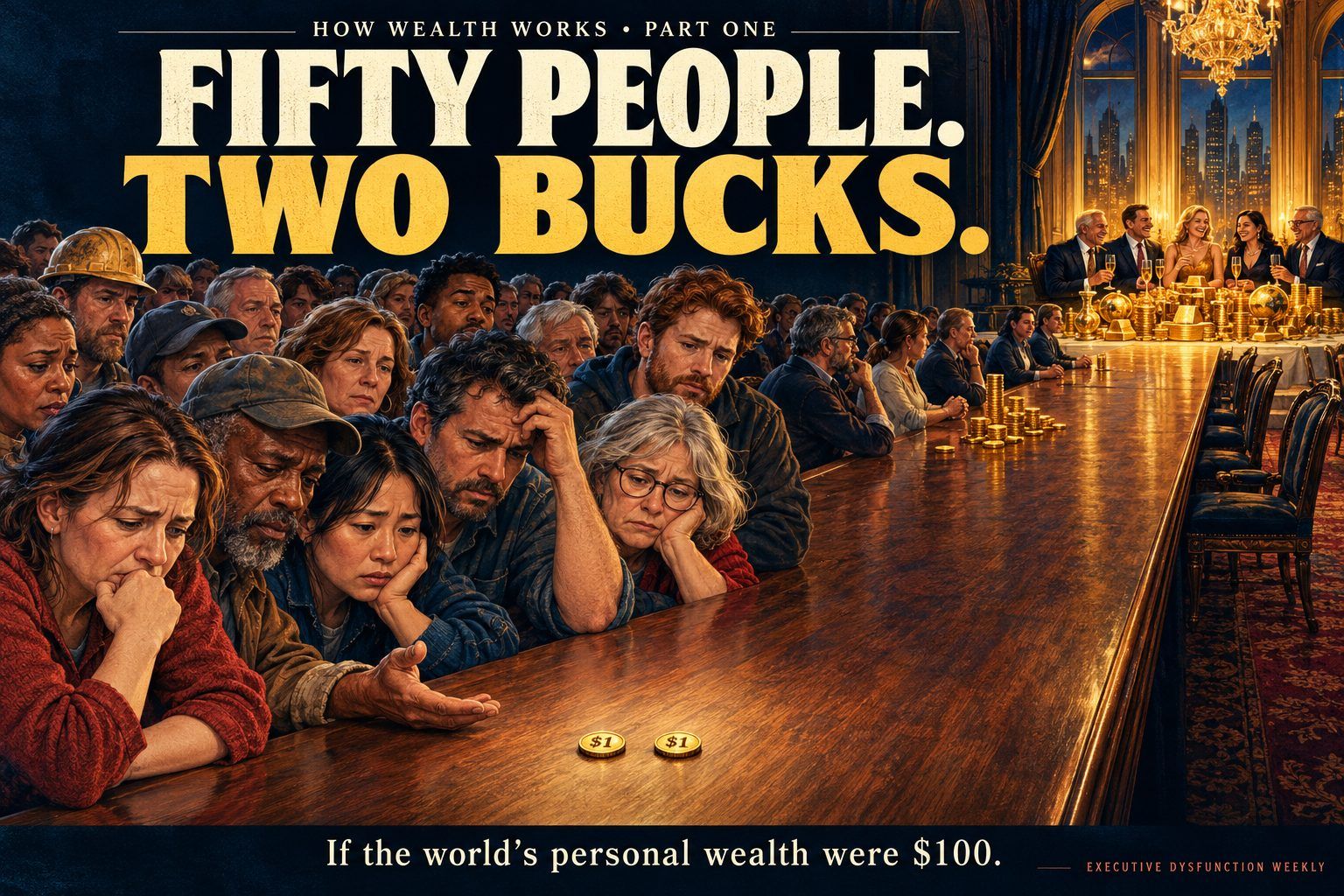
Picture a hundred people in a room. Put a hundred bucks on the table to represent the world’s personal wealth: homes, businesses, investments, and other assets, with the debts subtracted.
The wealthiest ten people have $75. The next forty share $23. The remaining fifty share $2. Those are the proportions in the World Inequality Report 2026. [3]
Fifty people are fucking sharing two bucks.
That is four cents each, on average. Meanwhile, the ten people at the other end of the room average $7.50 apiece.
I knew the gap was big. I had never pictured it like that.
Then I started learning what owning those assets allows a person to do, and the whole thing got a lot harder to stop thinking about.
A paycheck is income. Wealth is what you own after subtracting what you owe. If your house is worth $400,000 and you owe $300,000, your home equity is $100,000 before selling costs. Your retirement investments count, too. You can have wealth tied up in things you need while having very little cash available.
That distinction helps explain why somebody can earn a good salary and still feel one disaster away from trouble. It also explains how somebody else can stop working and keep getting wealthier.
Here is another number that got me. UBS estimates that U.S. wealth per adult at the end of 2025 averaged $696,277. The median was $68,998. The median is the person in the middle, with half above and half below. [4]
Nearly $700,000 on average. About $69,000 for the person in the middle.
That average is doing a hell of a lot of work.
Enormous fortunes pull it upward. They make the country look incredibly wealthy while telling you very little about what the person beside you has to fall back on.
I keep thinking about my parents’ mortgage on our house in Brick, New Jersey. We moved there in 1973. I remember a $26,000 loan, around nine percent interest, and a payment of $326 a month. Those figures work out to roughly ten years of payments.
Ten years. A family could pay off a loan like that with a lot of working life still ahead of them. The taxes and repairs would continue, but the principal and interest payment could end. That money could go toward retirement, helping a child, or starting something.
Of course, dollars and paychecks were different then. So compare home prices with what people earn. Harvard’s Joint Center for Housing Studies reports that existing home prices remain nearly five times median household income, compared with roughly three times income in the 1990s. [1]
The cost of getting into ownership has pulled farther away from the income people use to get there.
Those opportunities were never equally available. Black families were denied mortgages through discriminatory lending practices, shutting many out of the chance to build equity. Who got to buy in belongs in this story, too. [2]
I think about my daughter’s generation trying to cover housing and still have enough left to build something. Then we tell them to take a chance.
Open a business. Bet on yourself.
All right. You have a job, health insurance, and retirement contributions. Maybe a pension you’ve been working toward. You have an idea, and you think you could make it work. You also have a family that needs the money you are currently earning.
How long can you go without that paycheck? What happens if somebody gets sick? What if the customers show up six months later than you expected?
Now put somebody with the same idea in a family that can cover several years of expenses. They still have to make the business work. But they have time to figure it out, and somewhere to live if they fail.
They may even get another try.
That was the part I hadn’t given enough weight to. Being able to afford a failure is an advantage before the business even opens.
I’ve been a business owner. I know the bills keep coming after a business closes. It’s hard to be casual about “betting on yourself” when your family is depending on the same money.
Someone staying in a steady career may have every bit as much ambition as the person who leaves. They may also understand exactly what their family stands to lose.
People without much money start businesses every day. Having money behind you can change how long you can keep going, how much ownership you have to sell, and whether one failure ends your chance to try again.
Then there is what happens when the fortune gets big enough.
Suppose you have $100 million. For this example, assume it earns four percent in a year after taxes, fees, and inflation. That is $4 million. You spend $1 million and finish the year $3 million wealthier.
You spent a million bucks and still got richer.
Somebody with $100,000 earning that same return gets $4,000. Four grand helps with the bills. Most of us are still going to work.
Actual returns vary, and losses happen. But look at what the size of the fortune allows. One person can spend a million and reinvest the rest. The other is trying to leave the savings alone while paying for ordinary life.
Repeat that over years and the difference can grow. The next generation may receive help with college, a down payment, or a business long before anyone dies and leaves an inheritance. They can start acquiring assets earlier, with fewer debts.
I want to help my daughter, too. Of course I do. But there is a world of difference between helping your child with a bill and financing the years it takes them to find their way.
Some families have been building on an advantage for centuries.
The Grosvenor family’s London property fortune has a turning point in 1677. Thomas Grosvenor married Mary Davies, bringing land into the family. Later generations developed Mayfair and Belgravia and eventually expanded internationally. [5]
A marriage in 1677 belongs in the explanation of who owns valuable property today. I hadn’t understood how far back some of these stories could reach.
The owners invested in development. Meanwhile, workers built, businesses opened, public services expanded, and generations of people made London a place others wanted to live. Holding the land gave the family a claim on the value all that activity helped create.
Other records are harder to read. Britain’s 1833 abolition settlement allocated £20 million to compensate former slave-owners. UCL researchers have used those records to trace the recipients and the later influence of that wealth. [6]
The people who had owned other people got the compensation.
That is part of the history of wealth, alongside the businesses people built and the things they invented. We need to know where a fortune came from before deciding what story to tell about it.
We also need to look at the fortunes that disappeared. Barings lasted more than two centuries before concealed trading losses and failed oversight brought down the banking group in 1995. Old money can still be lost. [7]
What happens next is why I want to keep digging.
The amount of wealth in the world can grow. People build useful things, solve problems, and make businesses more productive. Asset prices can rise, too, although those gains can reverse. The hundred dollars in our example does not have to remain a hundred dollars forever.
But growth leaves us with another question: who gets the increase?
A more productive business could pay better wages, lower prices, invest in expansion, or deliver larger profits to owners. Competition, workers’ bargaining power, and the rules we make help determine how that gets divided. If the gains mostly go to people who already own the assets, the pie can get bigger while ownership becomes more concentrated.
Now bring AI into it.
If you read my AI series, you know I love what I can do with this technology. It helps me learn, work, and write. It can give a small operation capabilities it could never have afforded before. I want that opportunity for people.
The owners of the companies selling those capabilities have an opportunity, too. A 2025 IMF working paper models how AI could increase wealth inequality by raising returns to capital, even if some wage differences narrow. [8]
That is a possibility under the study’s assumptions. AI can also make mistakes, help competitors, and disrupt established businesses. It cannot guarantee that a fortune survives.
What it could do is make ownership even more rewarding while leaving people whose work gets replaced trying to figure out how to pay their bills.
I want the progress. I also want to know how the people doing the work get to share in it.
I started this research thinking about how much the wealthy have. Now I’m thinking about the chances they get to take, the mistakes they can survive, and the years they can afford to wait.
We will follow the old fortunes, the ones that disappeared, and the ways wealth is protected and passed along. We will get to taxes, hidden ownership, and the influence money buys in politics. I want to understand how we got here and what we can change.
Because we keep telling people to work hard, make good decisions, and take a chance.
I want to know how much chance we’re actually giving the fifty people sharing those two bucks.
Next: Where the fortunes began, how some survived for centuries, and what happened to the ones that didn’t.
EDW•