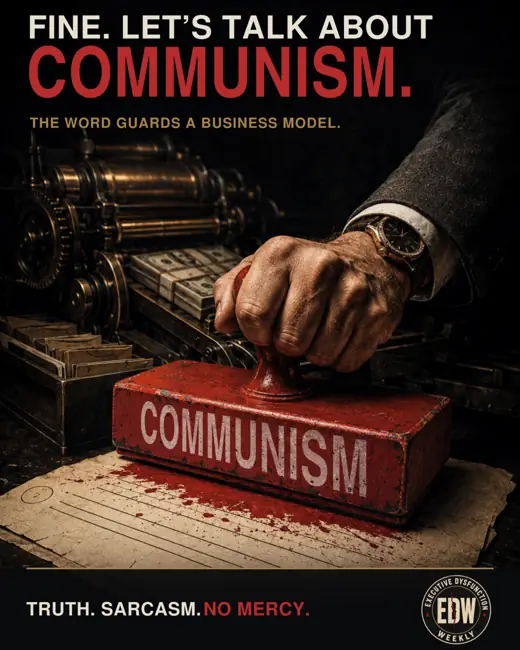
Nobody is proposing a one-party dictatorship, abolishing elections, collectivizing farms, eliminating private property, or rebuilding the Berlin Wall.
That is almost performance art.
And calling people idiots while confusing communism, socialism, social democracy, social insurance, and ordinary public investment is a hell of a way to advertise your expertise.
Universal healthcare is not a gulag. Paid family leave is not collectivized agriculture. Progressive taxation is not the Great Leap Forward. A labor union is not the Berlin Wall.
Nearly every successful modern democracy has a mixed economy: private property and competitive markets combined with public infrastructure, regulation, social insurance, and public services. America does too.
Social Security, Medicare, public schools, roads, fire departments, VA hospitals, farm supports, and government-backed mortgages did not turn America communist. They helped build America.
East Germany used walls, armed guards, and lethal force to prevent people from escaping an authoritarian one-party state. But the people escaping west were not choosing some no-government fantasy. West Germany had a capitalist social-market economy: competitive private enterprise combined with social insurance and worker protections.
Germany’s health and old age insurance traditions began under Otto von Bismarck, a deeply conservative statesman who introduced social programs partly to weaken the appeal of actual socialism.
By today’s brain-dead American definition, Bismarck would be called a communist. The lesson of the Berlin Wall is that people flee dictatorship. They do not flee affordable healthcare.
Now let’s discuss what this communist panic button has helped us avoid discussing for the last forty-five years.
I was alive when Reagan took office. I watched Reagan-era laws drive the top statutory federal income-tax rate from 70 percent to 28 percent. Later presidents raised it partway, but we never returned to the old structure.
The number mattered. The philosophy mattered more. We were taught that taxing enormous fortunes was punishment, public investment was waste, unions were an impediment, regulation was tyranny, and if we simply allowed enough money to accumulate at the top, prosperity would eventually rain down on everyone else.
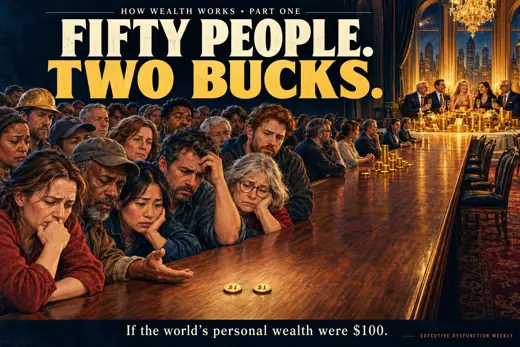
I have spent my adult life watching where it actually went. The Congressional Budget Office reports that the top one percent’s share of income after taxes and transfers doubled from 7 percent in 1979 to 14 percent in 2022. Over that same period, the share received by the middle three-fifths of Americans fell by six percentage points.
We did not become too poor to maintain the country. We changed who was allowed to keep its wealth and what we believed the public was allowed to build.
When I was a kid in the 1970s, American cities looked like the future. Our skylines were symbols of a country that could do enormous things. Our roads, bridges, universities, water systems, and public spaces reflected a nation investing in itself.
Travel around the world now. Look at the rail systems, airports, bridges, housing, and entire modern districts other countries are building while the richest country in history argues over whether replacing a water main is socialism.
Of course America still builds things. But we stopped building and maintaining the public country at the scale our wealth should make possible.
The private towers still rise. The public systems beneath them are allowed to deteriorate.
Public universities used to be genuinely public. My friends could work full-time during the summer and pay for a year at Rutgers. That wasn’t magic, and it wasn’t communism. Taxpayers understood that educating the next generation was an investment in the entire country.
Then states withdrew support, tuition rose, and we transferred the cost onto eighteen-year-olds. Now we treat beginning adult life under tens of thousands of dollars in debt as though it were a law of nature.
My parents bought a house less than a mile from the Jersey Shore in 1974 for $26,000. Their interest rate was around nine percent. Their mortgage payment was $326 a month.
Yes, dollars have changed. Nobody is pretending $26,000 in 1974 is $26,000 today.
But housing, healthcare, and higher education have outrun ordinary incomes so dramatically that young people can do everything we told them to do and still never reach the starting line their parents had.
That is not because America forgot how to create wealth. It is because too much of that wealth is being captured at the top and converted into even greater economic and political power.
I am not asking to abolish markets or wealth. I am asking the people who benefit most from this country to contribute enough to maintain the country that made their fortunes possible.
And here is the part I genuinely challenge you to examine:
Is there anything a Republican could do that would make you vote against him?
Is there anything a Democrat could do right that might earn your vote?
What evidence could change one of your political beliefs?
If the honest answer is “nothing”, if no corruption, failure, betrayal, candidate, or piece of evidence could ever move you, then you are not independently evaluating anything. A political identity is making the decision for you.
The same test applies to Democrats. If nothing your side does can cost it your vote, you are not holding power accountable. You are displaying loyalty to a brand.
Now open your Facebook feed.
How often do you encounter serious information that complicates what you already believe?
How often do you see something that makes you reconsider your own side?
And how often are you shown content that confirms your righteousness, frightens you, and makes you furious at other Americans?
If your feed never challenges you but keeps you permanently enraged, it is not informing you.
It is conditioning you.
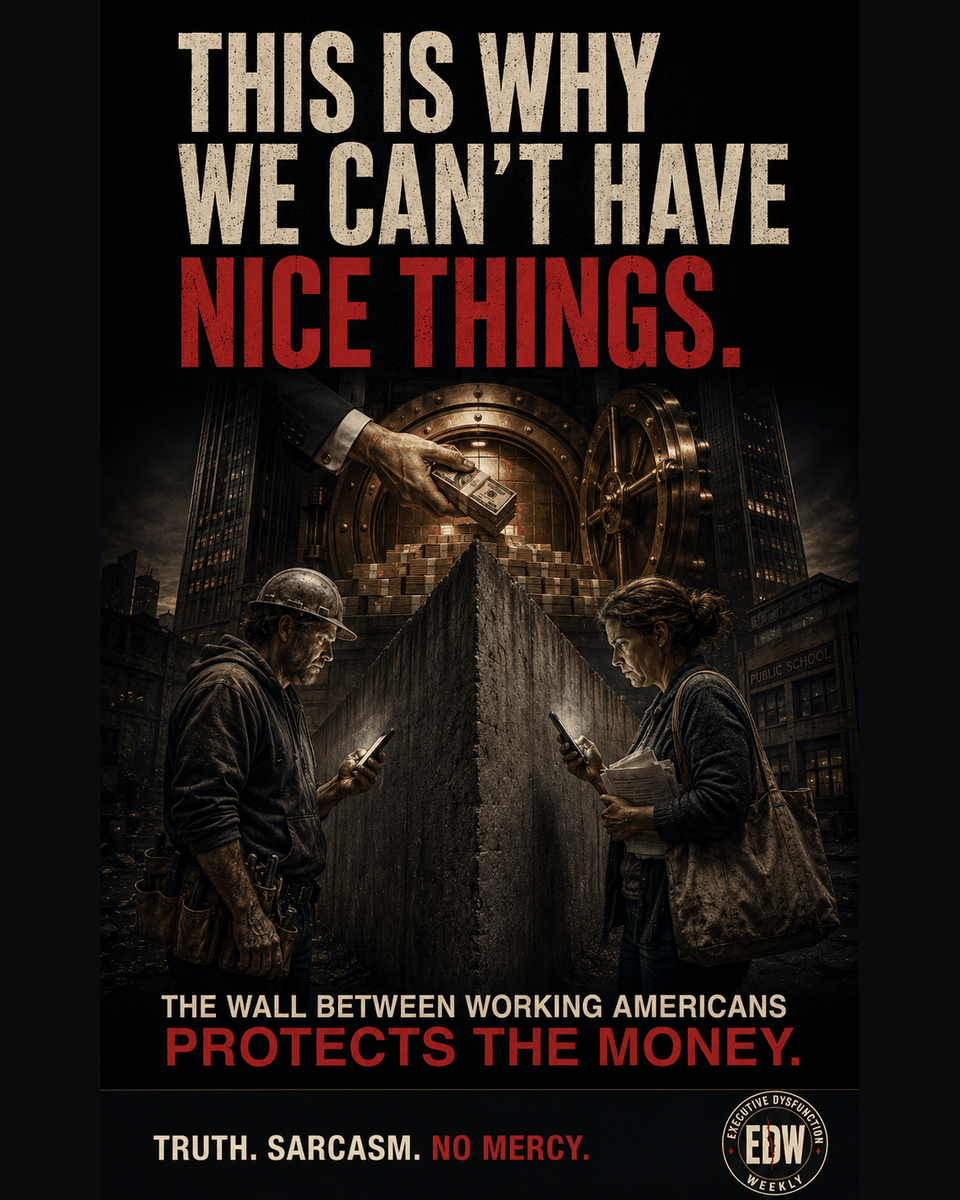
A Republican construction worker and a Democratic schoolteacher have far more economic interests in common with each other than either has with the billionaire financing the advertising that teaches them to hate one another.
That is the trick.
Keep working Americans divided into tribes. Keep them screaming “communist” and “fascist” at one another. Keep them fighting over identities while housing, education, healthcare, and political influence are auctioned to the highest bidder.
I am not asking you to become a Democrat. I am asking you to become impossible for either party to own.
Choose an actual issue. Healthcare. Taxes. Housing. Unions. Education. Paid leave. Tell us precisely which proposal you oppose, show us the evidence that it will fail, and offer a better alternative.
Then we can have an intelligent argument. But if your entire case is “Stalin existed, therefore affordable insulin leads to tyranny,” you have not made an argument.
You have pushed the panic button they installed to keep you from noticing who has been emptying the building.
The Berlin Wall fell.
The wall between working Americans is still protecting the money.
Stop volunteering to guard it.
EDW•