The claim
At his October 22 rally in Sioux City, Iowa, President Donald Trump described military strikes against drug cartels, then said: “Coming in by ocean, it's down by 97 percent.” The full transcript places that sentence at 1:00:50, immediately after he introduces the flow of drugs by ocean. This is a claim about trafficking, not simply a count of what officers confiscated.
The surrounding passage credits the administration’s strikes for the reported reduction. That adds a second claim: not only did the flow fall by a precise amount, but this policy produced the result.
Where the reasoning breaks
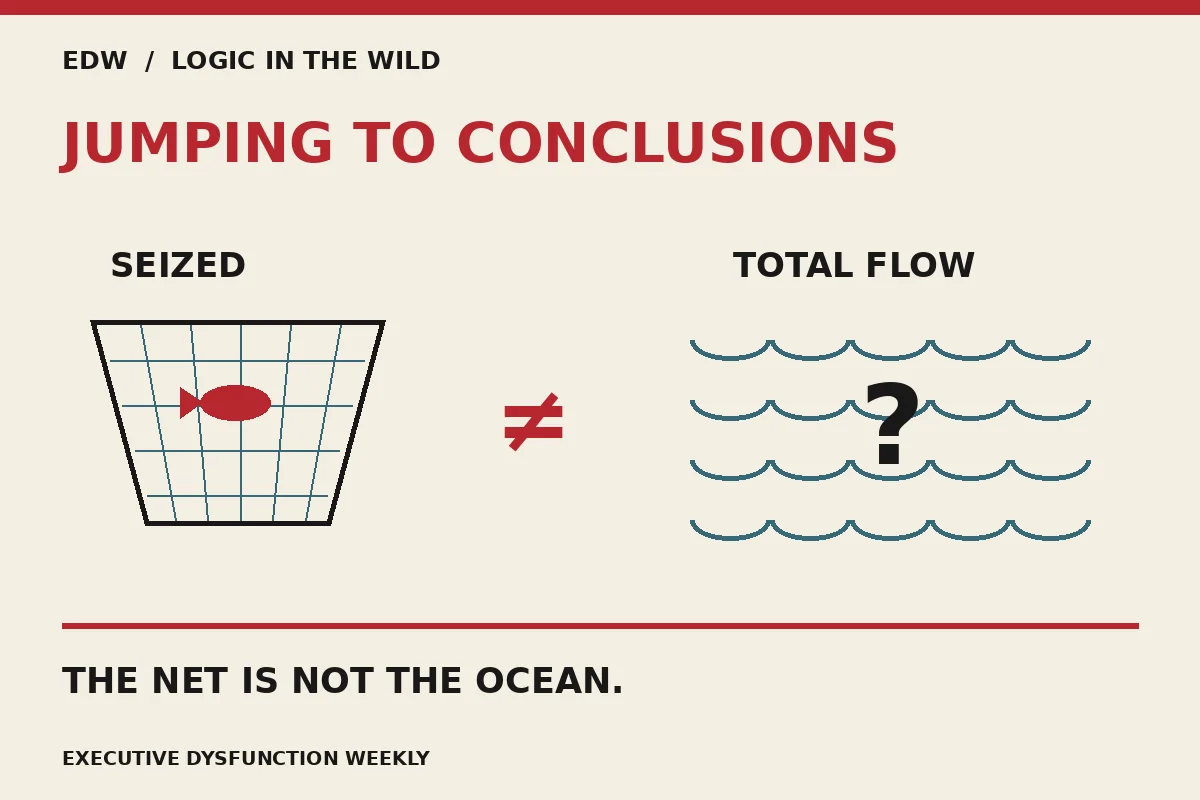
A seizure total measures drugs intercepted. It does not count every shipment attempted, or every shipment that gets through. Fewer interceptions could reflect less trafficking. They could also reflect different enforcement coverage, changing routes or a different mix of shipments. Before using the first number as a measurement of the second, we need evidence connecting them.
This is jumping to conclusions: a limited indicator is made to carry a much broader verdict. The net caught less. That is not a census of the ocean.
The documented basis has another weakness. In February, PolitiFact asked the White House about the recurring 97% claim. Officials pointed to CBP Air and Marine Operations seizures from July to November 2025. Those figures showed a roughly 98% decline in seized weight, with an unusually large July marijuana seizure total at the starting point. Selecting that high month makes the decline look especially dramatic. That is the cherry-picking problem. These are the older figures supplied to reporters, not a new October measurement disclosed at the rally.
The Congressional Research Service explains why seizure totals are an imperfect substitute for total drug flow, and why enforcement outcomes have several possible causes. Even a demonstrated decline in trafficking would not, by itself, isolate the effect of missile strikes. The causal conclusion needs its own comparison and evidence. That is the false-cause risk here, separate from the measurement problem.
The strongest fair reading
The strongest fair case is that enforcement can disrupt trafficking and deter some smugglers. Seizure data can be useful evidence when interpreted alongside intelligence, enforcement activity and other indicators. They are not worthless just because they are incomplete.
But useful clues do not automatically support a precise 97% reduction in total flow. The published evidence examined here does not substantiate that figure or establish how much of any reduction the strikes caused. This does not prove that trafficking stayed constant, rose, or failed to decline. We cannot repair an unsupported certainty by installing the opposite unsupported certainty.
Supporting tougher enforcement is a policy opinion. The 97% figure is an empirical claim; the explanation assigning the result to strikes is a causal inference. Neither is settled by enthusiasm for the policy, and this analysis makes no claim about Trump’s private motives.
Why it matters
The claim presents a near-total reduction while defending military action. That makes the missing measurement consequential, not a technical nuisance. Before applauding the percentage, ask: What exactly was counted, which dates were compared, and what would distinguish less trafficking from less detection? A percentage sign is not a lab coat.