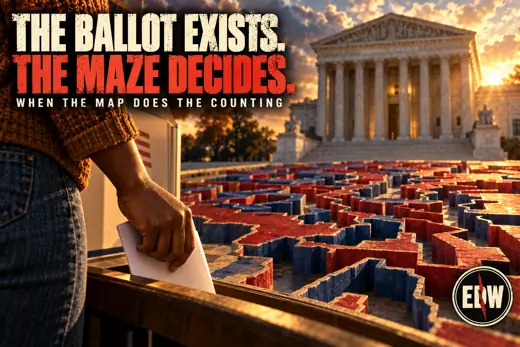
Trump is screaming that Virginia was “rigged.”
Sure. Let’s talk about the version of “rigged” that actually shows up in American politics on a regular basis: the map fight.
Virginia’s redistricting fight is now tied up in court, with the state’s high court leaving a lower-court block in place for the moment. That means the Democratic-backed constitutional amendment, approved by voters on April 21, and the congressional remap it would enable still face serious legal scrutiny, with certification of the referendum results blocked. That is a real controversy. It is also a far more honest story than the usual fantasy about mysterious ballot drops and shadowy election-night miracles.
Because this is what power usually looks like in America. It looks like process. It looks like paperwork. It looks like people in suits calling a map “fair” while quietly counting how many seats it might buy them.
And Virginia is just the latest reminder.
Redistricting itself is normal. Populations move. Districts have to change. Every ten years, after the census, states redraw lines to reflect where people actually live. That is the basic maintenance version.
Then there is the more ambitious version.
That is where politicians decide the lines should do a little extra work.
That is where the public hearing turns into a seat calculator.
That is where “communities of interest” suddenly become very creative.
That is where democracy gets introduced to graphic design.
Virginia Democrats sold this as reform. Republicans called it a power grab. The public got the usual sermon about fairness from whichever side thought the pen might help them. Then the court stepped in and said, in effect, slow down. There are real enough legal questions here that certification can wait.
That should tell people something important.
This was never some clean morality play where one side wore white hats and the other side showed up twirling a villain mustache. This was a map war. The language was nicer. The intent was familiar.
That is what makes Trump’s “rigged election” routine so ridiculous. He wants people staring at phantom fraud while the actual fight sits in plain view. Who draws the map? Under what rules? How aggressively? How cleverly? How far can a party push before a court decides the process stopped looking like law and started looking like appetite?
That is the real game.
And Virginia is hardly alone. Republicans have been doing their own redraws elsewhere. Democrats have been doing the same where they can. Florida, Texas, North Carolina, California, Virginia, and Maryland’s stalled proposal. Different accents, same hunger. One side calls it protecting representation. The other calls it cheating. Then they switch scripts depending on the zip code.
That is why this story matters.
It is easy to mock Trump’s fraud fantasies. He earns that.
It is more useful to point out the broader truth: both parties love democracy in theory and map control in practice.
That is the sharper sentence.
Because a lot of Americans still think elections begin on Election Day. Gerrymandering is one of the clearest ways powerful people try to shape them much earlier, with lawyers, software, and district lines carefully tuned to turn some voters into thunder and others into background noise.
That is the part worth seeing clearly.
A map can pass through legal channels and still carry a very obvious partisan purpose.
A referendum can win and still raise serious constitutional questions.
A party can wrap itself in the language of voting rights while reaching, quite deliberately, for more seats.
Virginia gives us all of that in one package.
So no, this episode does not prove Trump’s favorite bedtime story about stolen elections. It proves something more grounded and more embarrassing.
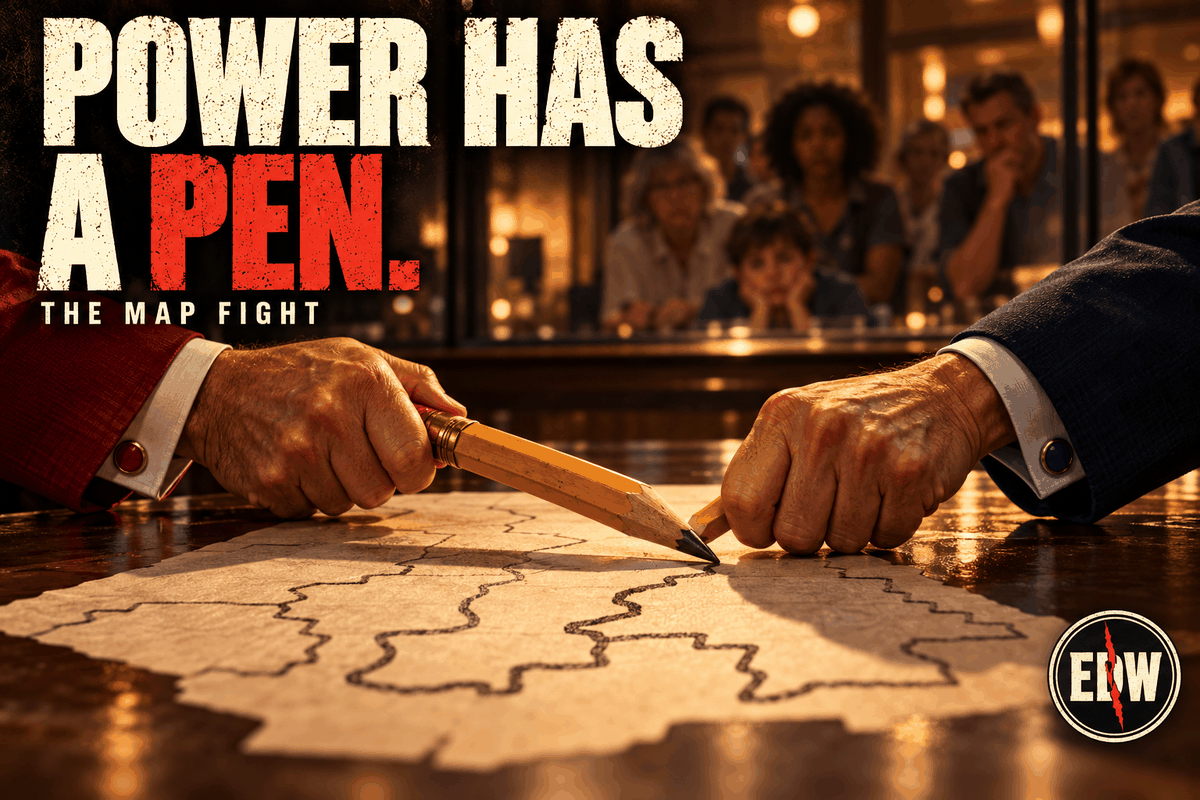
American politics rarely needs a conspiracy when it already has a pen.
If this helped sharpen the picture, share it around. Follow EDW. The word “rigged” gets tossed like confetti these days. It helps to know where the real rigging usually lives.
EDW•