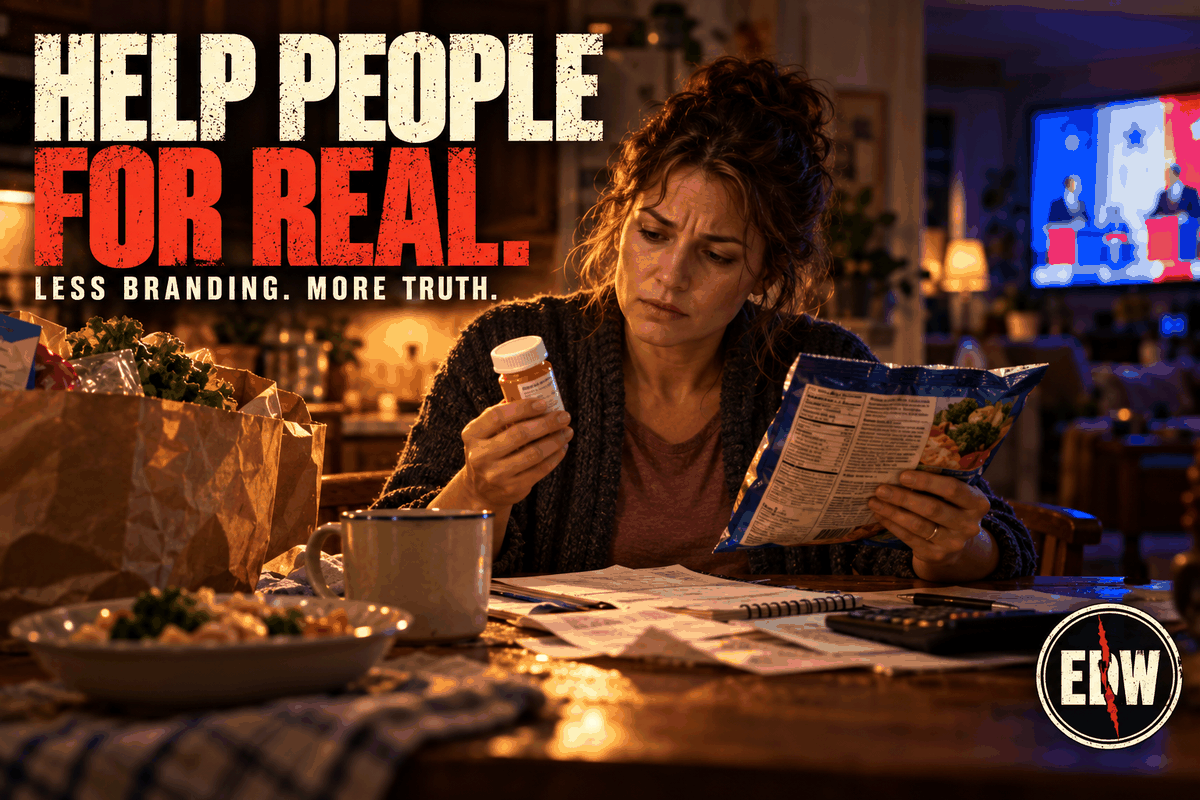
Every once in a while, Washington accidentally stumbles into an issue where the public is miles ahead of the politicians.
Prescription drugs.
Food labels.
There is no real culture-war split here. Americans do not want to pay more than other rich countries for the same damn medicine. Americans also want to know what is actually in the food they are buying. That is not socialism. That is not MAGA. That is not left or right. That is basic self-respect.
Which is exactly why this moment is so infuriating.
Trump is half-right on drug prices. That is what makes this so maddening. Reuters reports his administration now has agreements with 17 major drugmakers, with manufacturers representing about 86% of the branded-drug market, to offer some “most-favored nation” pricing and direct-to-consumer sales through TrumpRx. Regeneron, for example, agreed to cut the price of Praluent from $537 to $225 for patients purchasing through TrumpRx. That is real movement. It is more than a slogan, and it deserves to be acknowledged.
Now for the part that turns the triumphant music down.
Reuters also reports that more than 90% of prescriptions in the United States are generics. TrumpRx is largely about branded drugs. Reuters further reports the site uses GoodRx to power pricing for many of its listings and mostly routes cash-paying patients to partner platforms rather than creating a new public drug-buying system from scratch. That means the White House built a patriotic front end to a discount-shopping model Americans already had, then rolled it out like they’d discovered fire.
And then Congress started asking the obvious question: if this is such a miracle, why are some drugs still cheaper elsewhere?
At RFK Jr.’s April hearing, Sen. Elizabeth Warren pointed to Protonix at $200 on TrumpRx versus the generic equivalent, pantoprazole, at $16 at Costco. Kennedy’s answer was that she was comparing a brand-name drug to a generic, which is true as far as it goes. It also misses the larger point so completely it almost deserves a trophy. If the government wants credit for helping Americans save money, Americans are allowed to care about the cheaper medicine, not the prettier explanation.
That is the shape of the drug story right now: a real principle, a partial step, and a lot of branding trying to pass as reform.
The principle is strong. Americans should not pay more than people in Germany, Canada, or the UK for the same product. Bernie Sanders has been saying versions of this for years, including in his pressure campaigns on insulin and Ozempic pricing. Reuters reported in 2024 that Sanders wanted Ozempic priced around $155, closer to Canada, rather than its much higher U.S. price. That is not radical. That is the kind of obvious policy question that only becomes controversial in a country where pharma money has better lobbying than voters have healthcare.
And if Washington were serious, it already has the beginnings of a real bipartisan road.
The Trump team is talking “most-favored nation.”
Bernie has spent years demanding international reference pricing.
The federal government is already continuing Medicare price negotiation on expensive drugs. AP reported this year that the administration selected 15 additional drugs for Medicare negotiation, bringing the total selected across three rounds to 40. Prices from this newest round take effect in 2028.
So do something real.
Put an actual bipartisan bill on the table.
Tie U.S. prices to peer-country prices.
Expand genuine Medicare negotiation.
Force disclosure of the pharma deals instead of treating them like proprietary state secrets.
Go after launch-price abuse.
Go after the rebate maze and PBM distortions too.
There is public appetite for that in every zip code in America.
And while we are at it, let’s talk about the food-label side, because it is the same disease in a different aisle.
The federal government already knows the label the rest of us see is not enough for real accountability.
USDA’s Food and Nutrition Service says childcare centers, schools, and other child nutrition operators often need either a Child Nutrition label or a Product Formulation Statement from the manufacturer to know how a processed food actually counts toward meal requirements. A CN label is USDA-approved and provides a warranty of the product’s contribution. A PFS is a signed manufacturer document used when there is no CN label. It is not USDA-approved. USDA even says operators are responsible for checking that the calculations are accurate.
Read that again slowly.
The government itself does not just glance at the cheerful retail packaging and call it good. For federally funded child nutrition programs, it asks for deeper paperwork.
And chicken nuggets are the perfect example. USDA’s Food Buying Guide says processed items like chicken, beef, fish, or pork nuggets and patties may vary widely, may not even be listed in the guide, do not require a minimum amount of meat under FSIS labeling standards of identity, and therefore require a CN label or a manufacturer’s Product Formulation Statement to know what they really contribute.
That is an incredible sentence about the American food system.
For those processed foods, the retail label alone does not tell a childcare center how much counts toward USDA meal requirements.
That should be a scandal all by itself.
Because it means the country is already running a two-tier truth system.
One tier for institutions with compliance obligations.
One tier for the family standing in a grocery aisle with twenty dollars and a tired kid.
The childcare center gets extra meal-crediting documentation: either a USDA-approved CN label or a manufacturer statement it has to check.
The shopper gets the consumer version.
And then we all pretend to be shocked that people feel lied to.
This is where the drug story and the food story join hands.
In both cases, the public gets the simplified, market-friendly version first.
In both cases, the real details exist somewhere deeper in the paperwork.
In both cases, the people with the least time and money are the ones asked to make the biggest decisions with the least clear information.
And in both cases, Washington could do a lot more tomorrow if it wanted to.
That is what makes the whole thing so obscene. These are not impossible problems. These are not Mars-colony problems. These are not questions that divide normal people into warring civilizations. Americans want lower drug prices. Americans want clearer labels. Americans want to stop getting hustled by systems designed to be complicated enough that the public gives up and pays anyway.
So give them that.
Make drug pricing truly comparable to peer countries.
Keep Medicare negotiating and make it stronger.
Force the truth about what the discounts really are.
Require clearer front-facing food disclosure for processed products whose actual composition can vary wildly.
Stop making parents, patients, and childcare workers play detective so corporations can keep the edge.
This is the sweet spot where both parties love to campaign and almost nobody loves to legislate. Republicans get nervous about touching corporate power. Democrats get halfway there and then settle for a press conference and a pilot program. Big Pharma keeps smiling. Food manufacturers keep printing friendlier versions of the truth. Everyone tells the public help is coming. The bill and the grocery cart keep saying otherwise.
Here is the political miracle waiting in plain sight.
Trump has a real opening on drug prices.
Bernie has been right for years that the public is furious enough to support real action.
Food labeling reform is the kind of issue that should unite every parent, every caregiver, every working-class shopper, and every person who has ever stood in a pharmacy line wondering how this country got so stupid.
So stop wasting the opening.
Do something real.
Because the public does not need another patriotic coupon code or another speech about freedom while staring at a box of mystery nuggets and a $400 prescription.
It needs the truth.
And then it needs the price to come down.
If this hit the nerve, share it around. Follow EDW. America does not need better branding. It needs politicians willing to finally stop helping the companies that are bleeding people dry.
EDW•