The Supreme Court just handed America one of those decisions that arrives dressed like constitutional restraint and leaves fingerprints all over the crime scene.
In Louisiana v. Callais, the Court’s conservative majority struck down Louisiana’s second majority-Black congressional district and dramatically weakened Section 2 of the Voting Rights Act, the provision that has long allowed voters to challenge maps that dilute minority political power. Louisiana is about one-third Black and has six congressional districts. The map with two majority-Black districts was created after earlier litigation found the state likely needed another such district under the Voting Rights Act. The Court has now said, essentially: no, that remedy used race too much.
Wonderful.
A state draws one majority-Black district and gets told it may be diluting Black voting power.
A state draws two majority-Black districts and gets told it is unconstitutionally obsessed with race.
At some point, you have to admire the architecture. It is not a courthouse anymore. It is a revolving door with a velvet rope for civil rights.
Justice Samuel Alito wrote the majority opinion for the six conservatives. The Court’s official logic is that Section 2 can still justify race-conscious districting, but only when Section 2 is “properly construed.” And by “properly construed,” the Court means stripped down until it is small enough to fit inside an intent test. The opinion says Section 2 liability now requires circumstances giving rise to a strong inference that the state intentionally discriminated against minority voters because of race.
That sound you hear is Congress from 1982 banging its head against a filing cabinet.
Because Congress already dealt with this. Congress amended Section 2 of the Voting Rights Act specifically because proving racist intent is notoriously difficult. Legislatures do not usually pass a memo titled “Agenda Item Four: Make Black Voters Matter Less.” Modern discrimination tends to wear a suit, hire counsel, say “traditional districting principles,” and leave the room before the recorder turns on.
That was the whole point of the results test. You did not have to catch the state wearing a white hood in the map room. You could show that the map, in practice, left minority voters with less opportunity to elect candidates of their choice. Reuters notes that for more than four decades, Section 2 plaintiffs could win by showing discriminatory impact, even without direct proof of racist intent. The Court has now effectively turned Section 2 back toward an intent test, according to legal experts.
So the new rule is not “racism is illegal.”
The new rule is “racism is illegal if it is clumsy enough to confess.”
Progress.
The majority says plaintiffs must now clear a set of hurdles that sound technical because that is how bad things sound when lawyers launder them. Plaintiffs’ alternative maps cannot use race as a districting criterion. Those maps must also satisfy all legitimate state objectives, including political goals. Plaintiffs must control for party affiliation when showing racial bloc voting. Older discrimination and lingering effects of social discrimination get much less weight.
Translated from Supreme Court into human:
You must prove the racial harm without using race too directly.
You must show race caused the problem while separating race from party in states where race and party have been deliberately fused by decades of political strategy.
You must offer a better map without interfering with the state’s political goals, even though the political goal may be the whole trick.
You must prove present-day discrimination without leaning too much on history, even when the present-day map is standing on history’s shoulders wearing a fake mustache.
This is not judicial restraint. This is a scavenger hunt where the last clue says, “Sorry, the courthouse closed while you were reading.”
And the race-versus-party piece is the real scam.
The Supreme Court already told us in Rucho v. Common Cause that federal courts generally cannot fix partisan gerrymandering because that is a political question. Fine. Terrible, but fine. Now this ruling makes it harder to fix racial vote dilution when the state can plausibly say, “No, no, no, we were not targeting Black voters. We were targeting Democrats.”
Which is adorable, in the way a raccoon in a ski mask is adorable.
Because in much of the South, race and party are not two unrelated variables politely standing on opposite sides of the gym. They are welded together by history, policy, backlash, geography, and every election strategist who has ever looked at precinct data and whispered, “We can work with this.”
Former President Obama put the danger plainly, saying the decision frees legislatures to dilute minority voting power as long as they do it under the guise of partisanship rather than explicit racial bias.
That is the machine now.
You cannot challenge partisan gerrymandering because it is politics.
You cannot challenge racial vote dilution if it can be explained as politics.
You cannot draw a remedy because then you are using race.
And if you complain, someone in a robe will tell you the Constitution is colorblind while handing the mapmakers a brand-new box of crayons.
Justice Elena Kagan’s dissent did not miss the point. She said the majority’s “updates” eviscerate the law and render Section 2 “all but a dead letter.” She warned that states can now systematically dilute minority citizens’ voting power without legal consequence.
That is not liberal hysteria. That is reading the room after the ceiling falls in.
AP called the decision a hollowing out of a landmark civil-rights law and reported that it could open the door for Republican-led states to eliminate Black and Latino electoral districts that tend to favor Democrats. The political consequences may not fully hit until 2028 because many 2026 filing deadlines have already passed, but the invitation has been printed, embossed, and hand-delivered.
And naturally, Trump loved it. Reuters reported he praised the ruling and said Republican-led states would now want to reconfigure maps. AP reported that he welcomed the decision and said more districts should be redrawn.
There it is.
The Court says this is about equal protection.
The politicians immediately say, great, how many seats can we get?
Not exactly subtle. But subtlety died of exhaustion somewhere around the third “originalist” opinion that somehow always lands on the side of modern Republican power.
This is the part that should make every normal person furious, regardless of party. The Voting Rights Act was not some obscure procedural nicety. It was one of the great democratic repair tools of the twentieth century. It existed because America had a long, creative, shameless tradition of pretending Black citizens had the right to vote while designing systems to make that right useless.
Poll taxes.
Literacy tests.
Grandfather clauses.
White primaries.
At-large schemes.
Cracked districts.
Packed districts.
The specific tools changed. The goal stayed familiar: let people technically possess a right while making sure it cannot meaningfully threaten power.
That is why the results test mattered. It looked past the costume and asked what the system actually did. Did minority voters have less opportunity? Were their votes being diluted? Were communities being carved up so their political power disappeared into someone else’s safe district?
The Court’s new answer is: maybe, but did you catch the legislature saying the racism word?
No?
Then please enjoy this complimentary copy of “Partisan Advantage for Dummies.”
And this is where the majority’s colorblind language becomes obscene. Colorblindness can be a moral principle when used to stop discrimination. It becomes a con when used to stop remedies while leaving the discrimination’s architecture intact.
You cannot claim neutrality by ignoring the thing the map was built to exploit.
You cannot call a system fair because the newest version of unfairness learned to use cleaner fonts.
You cannot erase race from the legal analysis in a country where power spent centuries drawing race into the map, the schools, the neighborhoods, the tax base, the ballot box, the police district, the zoning code, and the congressional lines.
That is not colorblindness.
That is closing your eyes and calling it jurisprudence.
The most insulting part is how antiseptic the language is. The opinion talks about baselines, permissible districting criteria, party affiliation, illustrative maps, compelling interests, and strict scrutiny. It sounds like a zoning dispute between accountants.
But underneath all the sterile language is a very simple political reality:
Black voters in Louisiana already had two districts where they could elect candidates of their choice.
Now the Court says the second one went too far.
And the states watching at home just learned how to make more districts disappear.
The Court did not technically repeal Section 2. That would be too honest. It did something more elegant and more useful. It left the sign on the door, gutted the room behind it, and told everyone the building is still open.
That is how rights die in modern America. Not always with a dramatic ban. Sometimes with a footnote. Sometimes with a test. Sometimes with a burden-shifting framework. Sometimes with six justices explaining that the law still exists, provided the people who need it can satisfy a standard designed by people who clearly do not want it used.
So let’s stop pretending this is complicated.
The Supreme Court just made it easier for states to dilute minority voting power as long as they are smart enough to call it partisanship.
It made remedies more legally dangerous than the injuries they are supposed to fix.
It took a law built to confront real-world discrimination and told plaintiffs to come back with proof pure enough for a fantasy country.
And then everyone who benefits from the ruling immediately started measuring the curtains for new congressional districts.
Here is the civics lesson.
A democracy does not only die when people are barred from the polls. It also dies when their votes are carved into decorative confetti, scattered across districts where they cannot matter, and then described as “equal protection” by people with lifetime appointments.
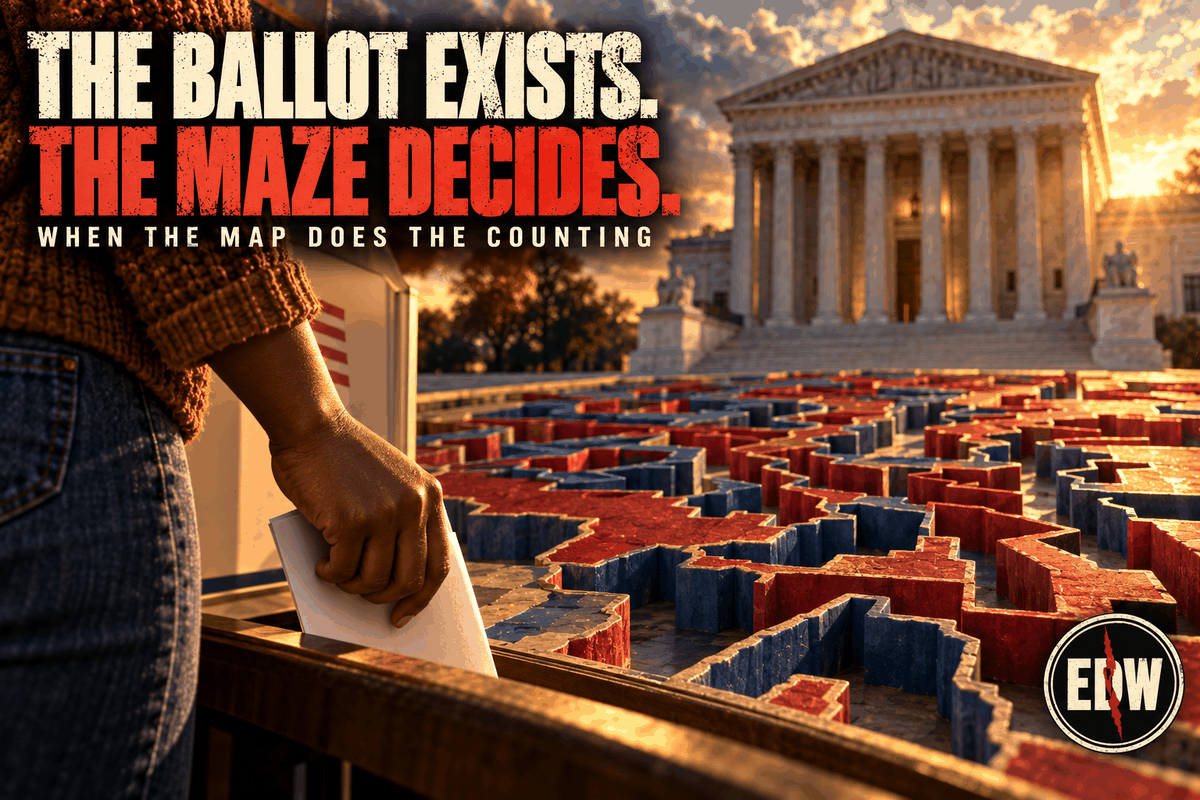
The ballot still exists.
The line still forms.
The sticker still says “I Voted.”
But the map has already done the counting before anyone walks in.
That is the trick.
That is the theft.
And now the Supreme Court just made the instruction manual easier to read.
Share this around. Follow EDW. The Voting Rights Act was not killed in one blow today. It was placed in a legal maze, handed a blindfold, and told the Court remains deeply committed to its survival.
EDW•