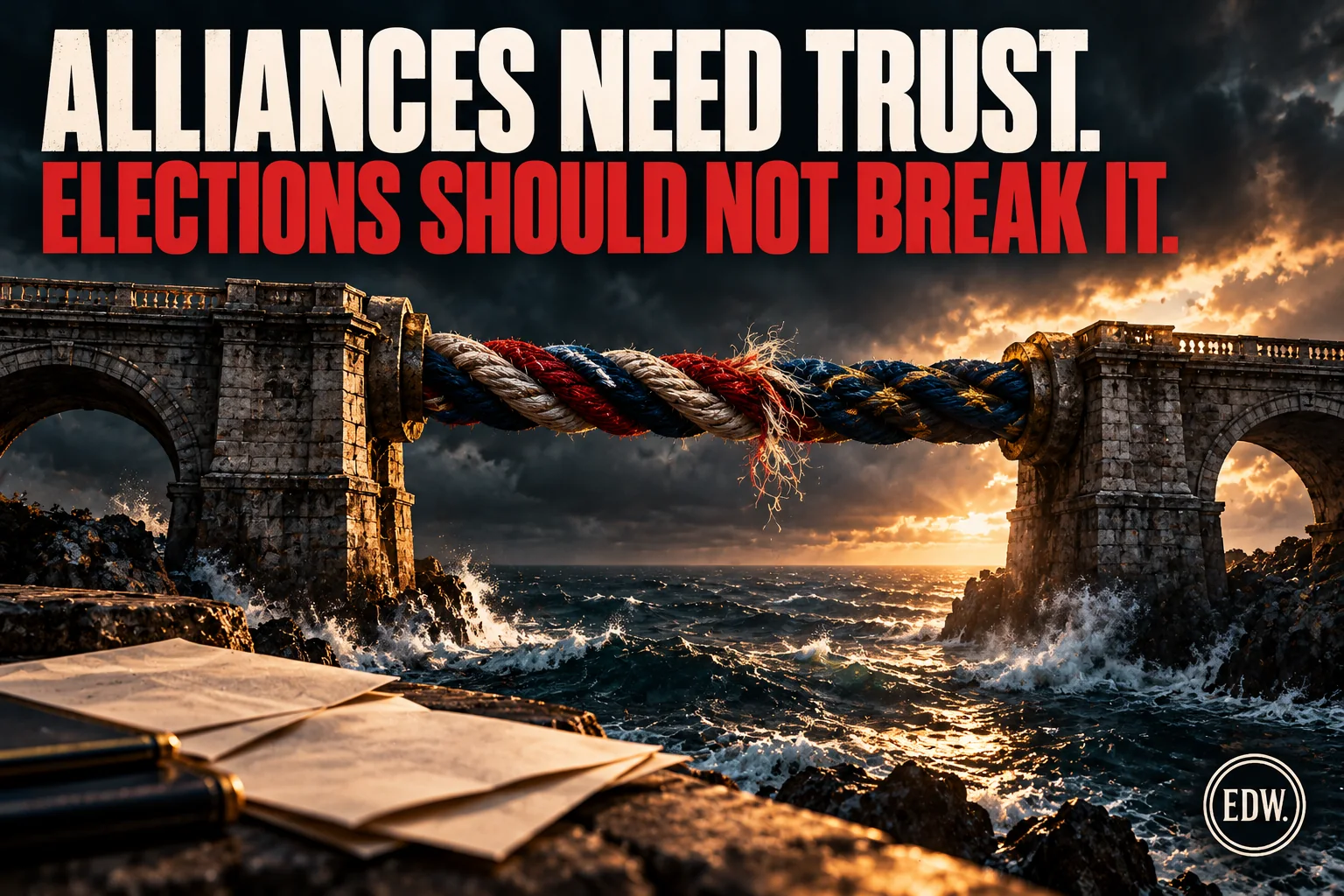
If your national‑security doctrine reads like a comment‑section fever dream (“civilizational erasure,” “patriotic parties,” warnings that “certain NATO members will become majority non‑European”), you’re not leading the alliance; you’re lighting it on fire. The White House’s new National Security Strategy really does use that language, and major outlets reported it exactly that way. This isn’t an off‑the‑cuff rally line; it’s official doctrine.
The postwar alliance was built around rebuilding economies through the Marshall Plan and locking in shared defense through NATO. Its strength depends on commitments that outlast elections. But the United States has not consistently kept its hands out of allied politics: declassified records document covert support for Italian political parties and labor organizations from 1948 through 1968.
Noninterference is the standard we should defend, not a spotless record we can claim.
This new posture makes the problem explicit. It calls for “cultivating resistance to Europe’s current trajectory” within European nations and frames Europe’s challenge as demographic doom rather than an autocrat on its border. That crosses two bright lines at once. First, it politicizes a security community whose binding promise (NATO’s Article 5) depends on believing that the United States shows up for countries, not for parties. Second, it drags us toward ethno‑politics that the post‑’45 order was designed to keep in the past.
If you think this is just “tough talk,” look at the numbers and what they actually measure. Eurostat’s 2024 figures show 9.9% of EU residents were born outside the EU and another 4.0% in a different EU member state. Pew’s 2017 scenarios projected Muslims at 7.4% to 14% of the population of the 30 European countries studied in 2050; the high-migration scenario was 14%. Birthplace, religion, and European identity are different categories. Those figures do not establish the strategy’s claim that certain NATO members will become “majority non-European.”
Weaponizing replacement paranoia doesn’t make it true; it just makes it toxic.
If you think allies will shrug this off because “they know how Washington works,” study how trust in alliances actually breaks. Reputation is cumulative and leader‑specific; governments update their beliefs about our reliability when they see us politicize commitments or reverse course. We’ve already tested that proposition. Abrupt exits from the Paris Agreement and the Iran nuclear deal split us from Europe and damaged credibility that later administrations had to spend years rebuilding. Announcing, in a strategy paper, that we will tilt the playing field inside their politics is another reputational hit and reputation is one commodity you can’t print on demand.
There is also the law and craft of diplomacy. The Vienna Convention couldn’t be plainer: diplomats have a duty not to interfere in the internal affairs of the receiving state. NATO’s own texts stress “democracy, individual liberty, and the rule of law,” not ancestry tests. When official U.S. strategy praises Europe’s nationalist parties and promises to help change Europe’s trajectory, it invites every future European government to treat us as a faction, not a friend. That’s how you lose votes for sanctions packages, force deployments, and basing rights when you need them most.
Here’s the part that matters beyond rhetoric: alliances are promises under uncertainty. They function because partners believe our security guarantees are insulated from partisan cycles. Break that insulation and you don’t just offend sensibilities; you raise the price of cooperation tomorrow. Allies hedge. They delay. They make side deals. And when a crisis comes, they parse our words like lawyers. That caution is rational, and it is costly.
Will a different administration “fix” this?
Partially, maybe. But credibility isn’t a light switch. The last decade proved that whiplash, out of Paris, back into Paris, then announcing withdrawal again, leaves scar tissue. Europe will remember a U.S. strategy that sorted its democracies by “civilizational” categories and promised to boost one set of parties over others. Some damage can be patched; some becomes the new discount they apply to our word.
What should an American strategy say instead?
It should do the boring, grown‑up things that hold an alliance together: defend borders, not bloodlines; build deterrence with law and capability, not with slogans; keep our hands out of allied elections; and argue values with confidence precisely because we don’t have to rig the deck to win. The U.S. has more influence when we model a free system than when we try to program one.
The bottom line is not complicated. Alliances aren’t supposed to be partisan because their credibility depends on outlasting parties. Treat Europe like a set of domestic talking points and you will get exactly what you paid for: less Europe when you need more, and a weaker West when you promise strength.
Call the new line what it is, optics over order, and understand the bill it sends to the future.
EDW•