If the United States wanted to send a message that it can still project power in the Western Hemisphere, it did not need to sound like it was annexing a country’s revenue stream.
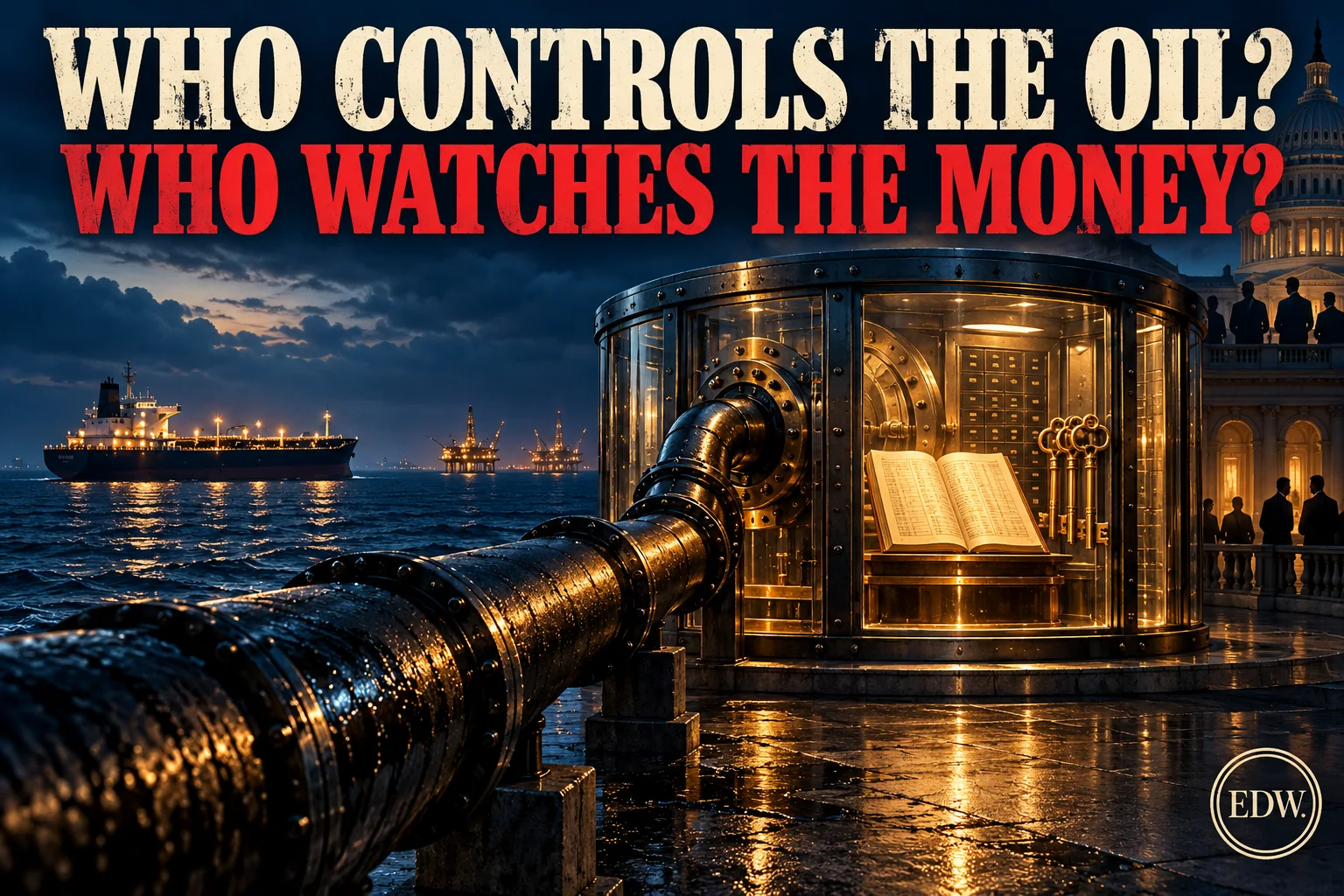
But that is what the administration’s language now implies: President Donald Trump publicly stated that Venezuela will “turn over” 30–50 million barrels of sanctioned oil to the United States and that the money from selling it “will be controlled by me, as President of the United States of America.”
Hours later, Energy Secretary Chris Wright said the U.S. would control Venezuela’s oil sales and revenues “indefinitely,” with proceeds deposited into accounts controlled by the U.S. government. And the Department of Energy published a fact sheet that goes further: proceeds would “first settle in U.S. controlled accounts at globally recognized banks,” then be disbursed “at the discretion of the U.S. government,” and the sales would “continue indefinitely.”
Regardless of how the White House intends to justify this (humanitarian claims, anti-corruption claims, compensation for past expropriations), the world will not interpret it as benevolent trusteeship. It will interpret it as an admission that the United States is willing to treat sovereignty, transparency, and the rule of law as optional when money is on the table.
America’s allies will have to decide: are they partners of a rules-based superpower, or subcontractors to a resource-seizure operation?
1) What is actually being proposed, and what is still unclear
Meticulous analysis begins with separating three categories: declared policy, operational mechanism, and accountability structure.
Declared policy
The administration’s public stance is straightforward:
• The U.S. will control Venezuelan oil sales and the associated revenue for an open-ended period.
• The U.S. is already “marketing” Venezuelan crude, engaging major commodity marketers and banks to execute sales.
• The President frames the proceeds as under his control as President, ostensibly to ensure they are used “to benefit” both Venezuelans and Americans.
Those statements are not ambiguous. The ambiguity begins when we ask: how.
Operational mechanism
The DOE fact sheet specifies that proceeds will settle in “U.S. controlled accounts at globally recognized banks,” with the specific account structure not identified in that fact sheet. PBS reported on January 7 that officials told Congress the proceeds would go to private banks rather than the U.S. Treasury. Reuters likewise reported the “U.S.-controlled accounts” at “globally recognized banks.”
That operational choice matters because it is precisely the kind of arrangement that, without ironclad governance, reads internationally as a slush-fund architecture even if it is not intended to be one.
Accountability structure
This is the part that is conspicuously thin.
Reporting indicates the administration has not fully clarified where, exactly, these funds will sit and how the routing will interact with the Treasury and congressional oversight. When governments ask other governments to accept extraordinary arrangements, details are not a clerical matter; they are the legitimacy.
In geopolitics, the absence of governance details does not create neutrality. It creates suspicion.
2) How allies and partners will interpret this, even before they say it out loud
Allies judge American actions through two lenses simultaneously:
1. What the U.S. is doing.
2. What the U.S. is becoming.
The second lens is where reputations fracture.
The early allied reactions already show the fault line: legality and “appropriation”
A Reuters roundup of international reactions to the U.S. intervention in Venezuela includes mainstream democratic partners emphasizing international law and the UN Charter, including Canada, the European Commission President, and Norway’s foreign minister.
Separately, a joint statement by Spain, Brazil, Chile, Colombia, Mexico and Uruguay explicitly warned against exploitation/appropriation of Venezuela’s natural resources and argued the operation violated core principles of international law and the UN Charter.
Even where governments are pleased to see Maduro gone or favor a democratic transition, a large share of partners are sending the same signal: transition, yes; resource seizure and unilateral impunity, no.
The EU’s posture is revealing: support democracy, insist on law, refuse annexation language
European Commission spokesperson Paula Pinho framed Maduro’s removal as an “opportunity” for a Venezuelan-led democratic transition while stressing the need to abide by international law and the UN Charter.
That is diplomatic code for: we want the outcome, but we do not want your method, or your precedent.
The UK’s approach is the ally playbook when it distrusts the U.S. but depends on it
The UK Parliament’s own research briefing notes legal concerns raised by scholars and politicians, and summarizes UK officials pressing the U.S. to set out the legal basis for its actions and urging compliance with international law.
This is what “special relationship” caution looks like: British support for the separate January 7 tanker interception, paired with demands for a legal explanation of the capture operation.
Adversaries will weaponize the optics instantly, and they already are
China’s foreign ministry has condemned the U.S. intervention as bullying and a breach of sovereignty, explicitly invoking permanent sovereignty over natural resources. Reuters has also reported that China confronted the U.S. at the UN and framed the seizure of Maduro as a dangerous precedent.
This matters because allies care about strategic competition. When Washington hands Beijing a clean narrative (“the U.S. takes what it wants and calls it law”), America loses coalition capacity in places where it desperately needs it.
3) Why the “bank accounts outside Treasury” issue is a reputational accelerant
The oil-grab optics are already severe. The financial plumbing makes it worse.
Allies and partners will ask (and private-sector institutions will ask even more sharply):
• Whose accounts are these?
• Which banks? Which jurisdictions?
• Who has signatory authority?
• What audit regime exists?
• What legal authority governs disbursement?
• What prevents political (or personal) use?
The DOE fact sheet says disbursement is at the discretion of the U.S. government. The President says the money will be “controlled by me” as President. Even if intended as shorthand, internationally it reads as: personalized executive control over foreign resource proceeds.
In a post-2010 world, allies have spent years arguing for:
• anti–money laundering standards,
• beneficial ownership transparency,
• constraining kleptocracy, and
• limiting sovereign abuses of offshore finance.
When the U.S. appears to build its own discretionary, bank-account-based revenue channel outside normal public-finance systems, it doesn’t merely “look bad.” It undercuts the moral authority behind every anticorruption and sanctions argument Washington has made for decades.
It also invites the simplest, most corrosive question in diplomacy:
If the U.S. is doing this, why should anyone believe America’s lectures about governance?
4) The decisive point allies will focus on: precedent, not Venezuela
Many partners will admit, quietly, that Maduro’s regime was brutal, corrupt, illegitimate, and destabilizing. Some will even welcome his fall.
But allies will still fear the precedent because the precedent is not “regime change.” It is this:
A U.S. president asserts indefinite control over another country’s primary export and places revenue in U.S.-controlled bank accounts, to be disbursed at U.S. discretion.
That is a blueprint. And allies ask: what stops a future American administration from using similar logic elsewhere?
For smaller states, the implicit message is chilling: sovereignty exists until U.S. interests decide it does not.
For larger allies, the concern is different but just as serious: it suggests the U.S. is slipping from state behavior into personalized regime behavior, where institutions become instruments of the leader.
That is not how stable alliances function.
5) “But we’re doing it for the Venezuelan people.” The strongest defense, and why it fails abroad
The administration’s stated defense is predictable: control the money to prevent corruption and channel it toward stabilization and reconstruction, possibly including repayment of U.S. companies for past nationalizations.
A methodical response requires acknowledging that this defense has a plausible policy logic: countries emerging from authoritarianism and state capture often do need guarded revenue channels.
But here is the critical distinction allies will draw:
Legitimate guarded channels are typically multilateral, rules-bound, and independently audited
When revenue control has been used in post-conflict settings, it has often been placed under explicit, internationally visible oversight structures. For example:
• The UN Oil-for-Food program routed Iraqi oil revenues into UN-controlled escrow accounts (whatever its flaws).
• After 2003, UN Security Council Resolution 1483 recognized the establishment of the Development Fund for Iraq and provided for independent auditing and international monitoring.
Those models are controversial and imperfect, but they were not framed as “the President controls the money,” and they were not marketed as indefinite unilateral dominion. They were built, at least on paper, as rule-governed and auditable.
By contrast, what is being described now is unilateral and personalized
The rhetoric (“controlled by me” and “at the discretion of the U.S. government”) collides with a foundational norm recognized in international instruments: the principle of permanent sovereignty over natural resources.
Even allies who want democracy in Venezuela will not want to endorse a doctrine that sounds like: we can seize the resource stream and decide how it’s used.
Because once you validate that doctrine, you validate it everywhere.
6) What the world will conclude about the United States if this continues
If this policy is executed as described (indefinite control, discretionary disbursement, bank-account routing outside ordinary public-finance channels), then America’s reputation with allies will degrade in five predictable ways:
1) The U.S. stops being the “rules-based” anchor and becomes the “power-first” disruptor
Allies can tolerate hard power. They cannot build long-term strategy on a partner that treats law as optional.
The EU’s repeated invocations of the UN Charter are not procedural nitpicking; they are a warning flare.
2) Alliance cooperation becomes transactional and conditional
Partners will still work with the U.S. when their interests align, but they will hedge harder: more “Europe-first” defense planning, more independent sanctions architecture, more distance from U.S.-led operations.
You do not need a formal break to lose strategic cohesion. Distrust is enough.
3) U.S. financial leadership loses legitimacy
The dollar system, correspondent banking, sanctions enforcement, anti-kleptocracy initiatives: these rely on trust that the U.S. uses financial power within predictable legal constraints.
Routing sovereign commodity proceeds into executive-controlled bank accounts invites exactly the “gangster finance” narrative America has historically used against oligarchs and autocrats.
4) Private-sector allies will be dragged into reputational risk
The DOE explicitly references engaging major commodity marketers and banks.
If those include non-U.S. institutions, allied governments will face parliamentary pressure: Are our banks facilitating a resource appropriation scheme? Under what legal framework? With what audit?
5) America hands strategic rivals a durable propaganda weapon
China has already framed the U.S. action as bullying and a sovereignty violation.
The more the U.S. emphasizes “we control your oil indefinitely,” the more it validates rival narratives that the U.S. is not a defender of sovereignty but a selective predator.
7) What “crushing” this action should mean in a democracy
If the objective is to stop this behavior, without adopting the lawlessness it represents, then the response must be institutional, legal, and alliance-aware.
Here is what a methodical opposition strategy looks like:
A) Force transparency immediately
Demand publication of:
• the legal authority for holding proceeds in non-Treasury accounts,
• the identity and jurisdiction of the banks,
• signatory authority and internal controls,
• an independent audit regime,
• a public disbursement framework.
The lack of these details is itself the scandal vector.
B) Reassert constitutional and statutory guardrails
The “power of the purse” is not decorative. If revenues are being controlled outside ordinary Treasury channels, Congress has a duty to clarify whether that is lawful and, if necessary, prohibit it through appropriations and oversight.
Even reporting sympathetic to the administration’s economic goals has raised the unresolved question of where revenue will be held and how it bypasses Treasury systems.
C) Push allies to condition cooperation on lawful, audited structures
Allies should not be asked to “trust us.” They should demand a structure consistent with their own legal and political constraints.
If the administration insists this is for Venezuelans, then it should welcome:
• independent auditing,
• transparent escrow/trust governance,
• and meaningful Venezuelan participation in oversight.
Otherwise, it is not trusteeship; it is control.
D) Make the alternative explicit: democracy support without resource appropriation
The U.S. and its partners can support a Venezuelan-led democratic transition (humanitarian relief, technical election support, anti-corruption assistance, targeted sanctions) without claiming indefinite control over oil revenues.
The existence of past revenue-escrow mechanisms (UN-administered, however imperfect) shows that if the goal were truly integrity and humanitarian benefit, there are governance models that do not require “the President controls the money.”
Conclusion: This is how countries lose allies, by demanding complicity in what cannot be defended
The most damaging thing about this episode is not merely the policy substance; it is the posture.
When the President says foreign oil money will be “controlled by me,” and when the government says it will sit in U.S.-controlled bank accounts and be disbursed at U.S. discretion indefinitely, the world hears something louder than energy policy.
It hears a superpower announcing that it is willing to act like the kind of regime it once opposed.
Allies will not instantly abandon the United States. But they will recalibrate, quietly, persistently, and structurally, because they cannot afford to be chained to a partner that treats law and transparency as negotiable.
If we want to keep allies, we need to stop behaving in ways that force them to choose between America and the principles America claims to represent.
EDW•