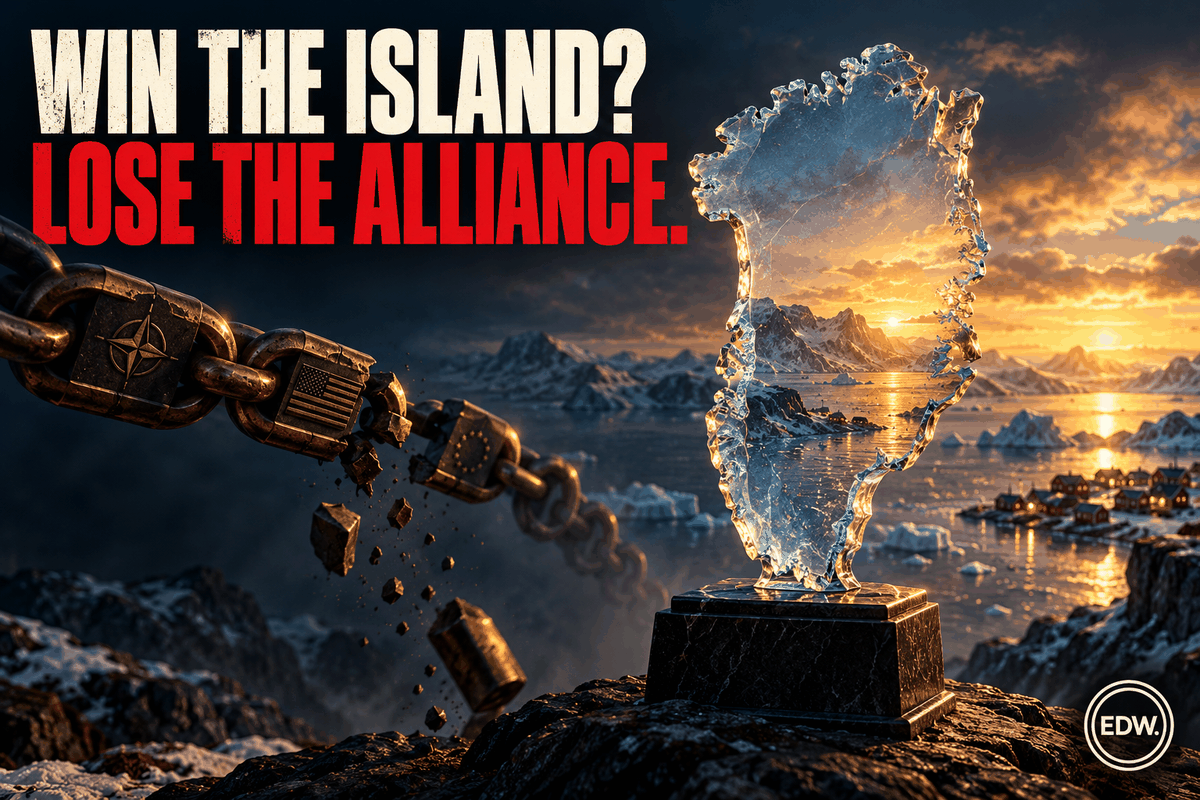
America can argue about almost anything. Border policy. Spending. Culture wars. Even what “strength” looks like.
But here is a national-security proposition that should not be partisan: the United States is safer when it leads alliances than when it intimidates them.
That’s why the Greenland standoff matters, not as a viral headline, but as a stress test of the very architecture that has protected the U.S. for decades.
This week, President Trump tied his renewed push to take control of Greenland to his frustration over not receiving the Nobel Peace Prize. In a written message reported by Reuters, Trump said he no longer felt an “obligation to think purely of Peace,” adding “although it will always be predominant,” and in the same message insisted that “The World is not secure unless we have Complete and Total Control of Greenland.” (Reuters, Jan 19, 2026)
At the same time, the pressure campaign has not been subtle. Reuters reported Trump threatened tariffs on eight European countries, including Norway unless the U.S. is allowed to purchase Greenland. (Reuters, Jan 19, 2026) And earlier this month, Reuters reported the White House said “utilizing U.S. military is always an option” while internal discussions examined paths to acquisition. (Reuters, Jan 6, 2026)
Those are the facts on the table. Now here is the strategic question:
What do we gain by coercing a NATO ally over Greenland that we do not already have through law, basing rights, and alliance cooperation, and what do we lose if we turn an ally into a coerced party?
Start with the part that gets lost in most shouting matches: the United States already has robust legal access to Greenland for defense purposes.
The 1951 “Defense of Greenland” agreement between the U.S. and Denmark explicitly authorizes U.S. use of defense areas and the construction of facilities tied to the defense of Greenland and the North Atlantic Treaty area. (U.S.–Denmark agreement text, Apr 27, 1951) The U.S. Space Force publicly describes the agreement as establishing the Thule Defense Area and notes the base (today Pituffik Space Base) was built under Operation Blue Jay. (U.S. Space Force fact sheet)
The legal framework has been updated: the 2004 agreement amends and supplements the 1951 arrangement. It identifies Thule as the sole defense area and requires consultation with Denmark, including Greenland’s government, before significant changes to U.S. military operations or facilities. That is a cooperation framework, not unlimited unilateral authority everywhere in Greenland. (U.S. Department of State, Aug 6, 2004)
This matters for a simple reason: if the core justification is security, Arctic positioning, radar, space and missile warning, there is already an operational pathway that does not require territorial seizure.
Now look at the costs.
NATO is not a vibe; it is a deterrence system. Its foundational idea is collective defense, codified as Article 5, which NATO explains as treating an armed attack on one member as an attack on all. (NATO, Article 5 explainer, updated Nov 12, 2025)
You cannot credibly lead a mutual-defense alliance while threatening military action against a member of that alliance.
That is not a moral statement. It is a functional one.
Senior European officials have said as much. Reuters reported the EU’s Defence and Space Commissioner warned that a U.S. military takeover of Greenland would be the end of NATO. (Reuters, Jan 12, 2026) The Associated Press summarized how NATO works under this kind of internal crisis, noting the alliance includes 32 members and that the dynamics of collective defense become fundamentally strained when the dispute is among members. (AP, Jan 13, 2026)
Even if you ignore legal technicalities about whether NATO can “expel” anyone (the treaty text addresses withdrawal but does not lay out expulsion), my strategic concern is straightforward: if allies no longer trust U.S. commitments, deterrence can weaken badly. (NATO treaty, Article 13)
Then there’s the economic and political spillover, also evidence-based, not speculative. European institutions are already framing tariff threats as coercion and discussing response options. The European Council President’s statement explicitly references readiness to defend against coercion and warns that tariffs would undermine transatlantic relations. (European Council/Consilium, Jan 18, 2026) Reuters reported EU leaders would discuss options at an emergency summit, including retaliatory tariffs and use of the EU’s Anti‑Coercion Instrument. (Reuters, Jan 19, 2026)
So the tradeoff looks like this:
• Marginal security gain from sovereignty transfer is unclear, because existing agreements already enable basing and defense operations.
• Alliance cost is immediate and measurable: retaliatory economic planning, official EU statements on coercion, and open warnings that NATO’s unity could not survive a forced takeover.
This is the “more danger” argument in plain terms:
America’s biggest strategic asset is not a single island. It is the network of allies, basing access, interoperability, and credibility that makes adversaries hesitate.
If we trade that for coercive acquisition, we risk spending the next decade trying to buy back what we threw away: trust, access, and unified deterrence.
If the administration wants more Arctic security, there is a path that does not set fire to America’s alliance structure:
1. Use the existing U.S.–Denmark Greenland defense framework to negotiate expanded capabilities and basing cooperation.
2. Work through NATO, the collective-defense alliance, through which allies can coordinate Arctic security.
3. Stop treating allies as targets of coercion, because coercion is the opposite of deterrence credibility.
You can be tough on adversaries without becoming unpredictable to allies.
And if we genuinely care about American safety, we should be honest about what makes us safe: not the ability to take territory, but the ability to keep partners.
EDW•