The claim
At his October 28 rally in Chillicothe, Ohio, President Donald Trump urged voters to elect Republican Vivek Ramaswamy as governor. Of Democratic opponent Amy Acton, he said “she wants to double your taxes.” That is a claim about her intended policy, not just a warning that her promises might be expensive.
The broader accusation has a published rationale. A website paid for by the Ramaswamy/McColley campaign puts Acton’s additional spending above $21 billion and says funding it would require more than doubling state income tax. Trump’s October 28 wording says taxes generally; the campaign website specifies state income tax. Those formulations should not be silently treated as identical.
Where the reasoning breaks
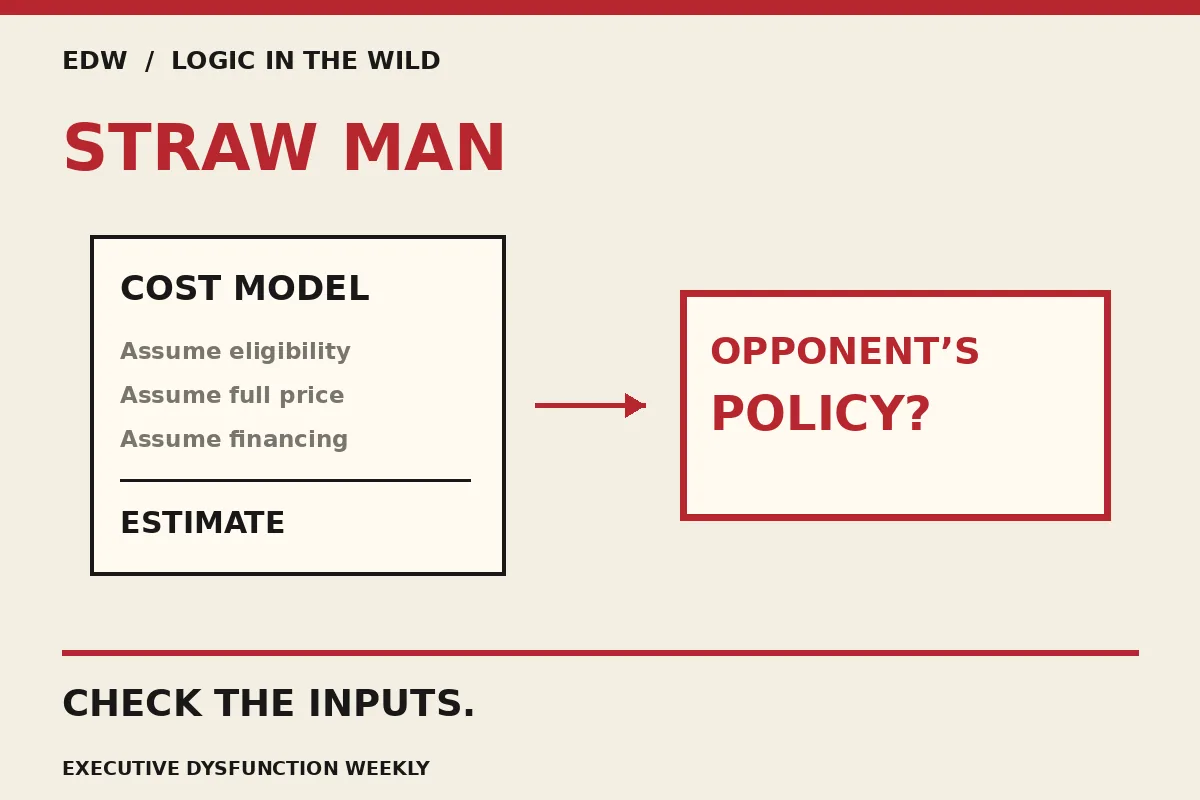
Look at the medical-debt item. The rival campaign multiplies an estimated 810,000 Ohioans with medical debt by a national average debt amount of $18,660, producing roughly $15.1 billion. That calculates an estimated face value of debt. It does not establish the state’s purchase price for debt relief.
Acton’s own affordability agenda proposes following Ohio city programs that acquired and relieved debt at steep discounts. Her August 4 campaign release also described discounted debt relief, well before this rally. Whatever the eventual program costs, pricing that approach as payment of the entire estimated debt balance changes the proposal being evaluated. The calculator can multiply perfectly while answering the wrong question.
There is a second gap: even a sound spending estimate would not, by itself, establish a decision to double a particular tax. That conclusion needs a financing argument, including the alternatives and constraints. An assumption about a possible consequence cannot simply become evidence of what a candidate wants.
This is a straw man: replacing the opponent’s position with a different, more attackable version. Here the replacement is assembled from cost assumptions, then presented as the opponent’s tax agenda. A spreadsheet is useful evidence when its inputs match the policy. It is less useful when it starts writing the policy.
PolitiFact’s October 27 examination of the earlier, explicitly state-income-tax accusation traced the White House’s supporting referral through the Republican National Committee to this campaign website. It found unsupported assumptions and no evidence of a doubling proposal. That reporting establishes the published rationale for the earlier claim, not what Trump privately consulted before his October 28 remarks.
The strongest fair reading
The strongest fair criticism is that Acton owes voters a credible account of costs and funding. PolitiFact reports that her campaign denied plans to raise state income tax but had not supplied a comprehensive financing explanation. A promise of tax relief does not make other spending free. Critics can reasonably test whether a platform adds up.
But an incomplete budget is not a blank form opponents get to fill in and attribute to the candidate. The cost estimate is disputed; the doubling claim is an unsupported factual characterization of her agenda. Whether her priorities are sensible is a political judgment. Whether they could create future pressure for higher taxes is a prediction requiring evidence and explicit assumptions. None of this proves her program is fully funded or guarantees that taxes could never rise.
The reasoning problem is visible without guessing anyone’s private motive: a contested model has been promoted into an announced intention.
Why it matters
When someone tells you what an opponent’s plan costs, ask for the plan and the assumptions separately. Then ask how a possible funding problem became a specific tax proposal. Keep those documents in different folders. Campaign spreadsheets already have enough authority issues.