The claim
At his October 25 rally in Port Huron, Michigan, President Donald Trump called Democratic Senate candidate Abdul El-Sayed “a jihadist Muslim Brotherhood member.” Later in the speech, he invoked a letter El-Sayed had signed supporting Egypt’s Mohamed Morsi and described it as support for the Muslim Brotherhood. This analysis examines that offered connection, not every allegation in the speech.
There is a real document to examine. Al-Ahram’s November 25, 2012 reproduction lists El-Sayed among the signatories of a statement supporting Morsi’s recent decisions. It calls for purging the media and police. It also expresses concern about concentrated presidential power and asks that the expanded powers end when constitution-writing is complete. None of that should be edited out to make the letter more comfortable.
Where the reasoning breaks
The leap is from endorsing decisions by a president affiliated with the Brotherhood to belonging to the organization, and then to advocating violent extremism. Those are different propositions. A signature can establish support for the statement signed. It cannot automatically establish organizational membership, every belief associated with that organization, or a present commitment to violence.
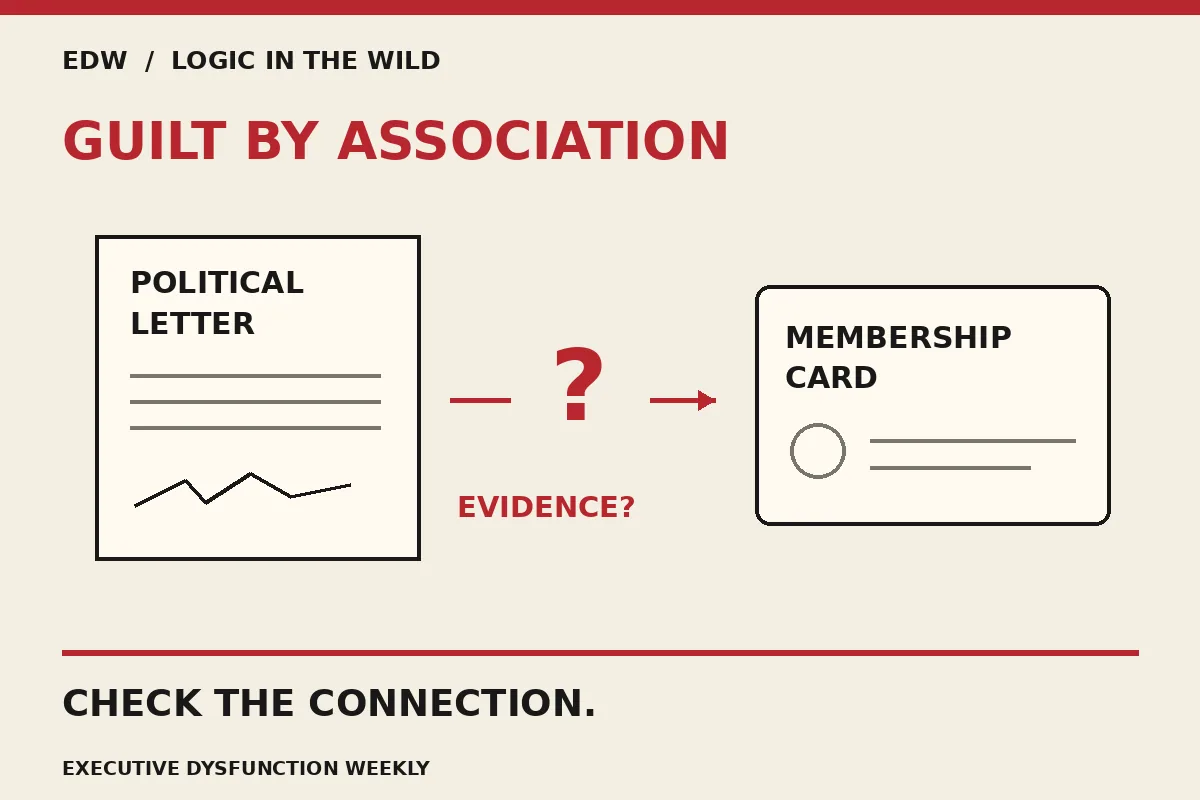
This is guilt by association: using a connection to transfer a group’s alleged identity or wrongdoing to an individual without establishing the necessary link. Here, the disputed political endorsement gets promoted into a membership credential. The admissions office apparently accepts inference instead of an application.
The letter’s language deserves scrutiny on its own terms. But even accepting its most troubling passages does not make the later labels follow. Membership requires evidence of membership. A claim of violent extremism requires evidence supporting that claim. Disapproval of an old statement cannot fill both gaps.
PolitiFact’s October 27 examination found no basis for the jihadist or membership labels. El-Sayed’s disavowal of the Brotherhood is also recorded in CNN’s October 18 broadcast transcript. That response belongs in the record, though a denial alone is not the whole proof. The central point is that Trump’s cited association does not establish the allegations.
The strongest fair reading
The strongest fair criticism is about judgment. Voters can ask why El-Sayed supported Morsi’s extraordinary powers and the statement’s language about the media and police, what he meant then, and what he believes now. Past political commitments can be relevant to public office. Calling every uncomfortable question an ad hominem would be another shortcut.
But relevance is not equivalence. A critic can argue that the endorsement was reckless without asserting an organizational affiliation or violent ideology that the document does not establish. The 2012 endorsement is a documented fact; how voters weigh it is a judgment. The membership and extremist labels are factual allegations, not merely opinions. Treating the former as proof of the latter is the invalid inference.
We do not need to guess Trump’s private motive to identify that gap. Nor do we need to approve of the letter to reject the unsupported conclusion.
Why it matters
When a political argument introduces an association, ask what it actually proves. Is there evidence of a shared decision, formal membership, coordinated action, or only a connection the audience is invited to complete? Keep the criticism attached to the documented conduct. A signature should not acquire extra beliefs on its way to the podium.