The claim
In a campaign video posted by Team Talarico on October 24, Texas Democratic Senate candidate James Talarico says: “Crystal was sentenced to five years in prison because of Ken Paxton’s crackdown on voters of color.”
The ad features Crystal Mason, whose provisional ballot in 2016 was never counted. She was convicted of illegal voting in 2018. An appeals court acquitted her in March 2024, finding insufficient evidence that she knew she was ineligible. The state’s highest criminal court let that acquittal stand in September 2026. Her ordeal is real. The question here is the ad’s explanation of who caused it.
Where the reasoning breaks
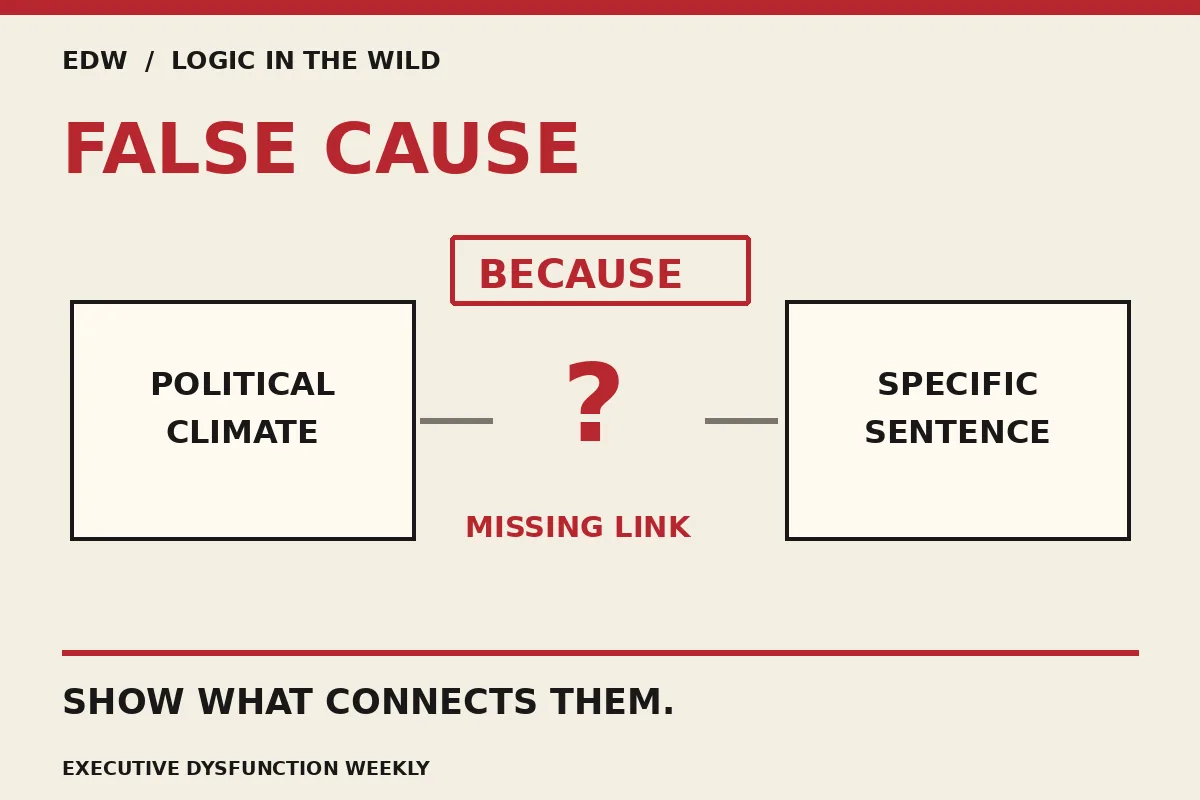
The statement moves from a broader political climate to a specific causal conclusion. Paxton promoted election-fraud enforcement. But Mason’s case was brought by the Tarrant County district attorney, not his attorney general’s office. The earlier court record describes a local election judge reporting her ballot to the county prosecutor, followed by an indictment and a bench trial.
FactCheck.org reports that local prosecutors sought a sentence intended to deter illegal voting and that the trial judge did not explain his five-year decision. It also reports that Talarico’s campaign defended the ad with coverage connecting the case to the broader crackdown. That establishes relevant context, not the missing link between Paxton’s enforcement drive and this particular sentence.
This is the false-cause problem: treating an association or surrounding circumstance as sufficient proof of causation. The ad’s certainty outruns the evidence presented for it. To establish the link, we would need evidence showing how Paxton’s actions influenced the prosecution or sentencing, rather than assuming the connection from the shared subject. “Because” is a small word with a very large evidence bill.
The strongest fair reading
The strongest fair interpretation is that Talarico means political responsibility, not that Paxton personally prosecuted Mason. Public officials can encourage an enforcement climate without signing every charging document. Mason’s lawyer had attributed the sentence to that broader rhetoric, according to the contemporaneous reporting cited by FactCheck.org. That possibility deserves consideration.
But possible indirect influence is not an established explanation of a particular judge’s sentence. Conversely, a local prosecution does not prove that Paxton had no influence whatsoever. Either categorical conclusion would jump past the evidence. A more defensible argument would identify the documented enforcement rhetoric, explain the suspected connection and label that connection as an inference.
The conviction, sentence and later acquittal are facts. Whether the episode illustrates a harmful enforcement culture is an interpretive judgment. The specific causal attribution is disputed and insufficiently established by the evidence offered. This critique concerns the campaign’s causal claim, not Mason’s account of what she endured.
Why it matters
Political accountability gets weaker when it skips the step that connects an official to an outcome. Ask who made the decision, what evidence explains it and whether the speaker has shown influence or merely named a nearby politician. Apply that test even when you agree with the criticism. A campaign narrator does not get to testify for the missing evidence.