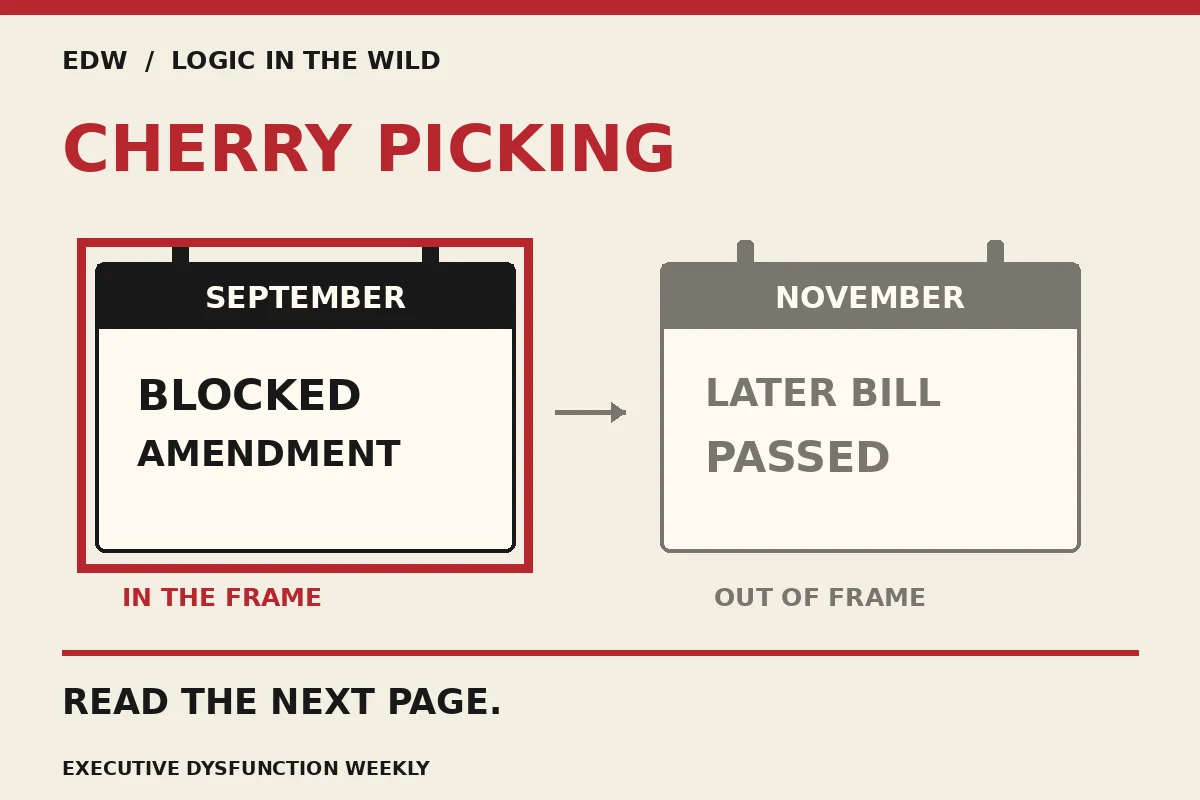
The claim
An October advertisement from New Deal for All attacks Florida Republican Sen. Ashley Moody over the Epstein files. In the original upload’s transcript, a survivor identified as Marina says Moody "cast a deciding vote to protect the man who abused me." The ad’s on-screen claim, reproduced in independent reporting, describes her as the deciding vote blocking release of the files.
There is a real vote underneath this. On September 10, 2025, Moody voted to table a Schumer amendment requiring release of Epstein investigative records. The Senate’s roll call lists her among the 51 senators who supported tabling it, against 49 opposed. Tabling stopped that amendment. Criticism of her participation has a factual basis.
Where the reasoning breaks
The problem is the cropped timeline. In November 2025, the Senate agreed without objection to advance a separate Epstein disclosure bill. Its formal passage followed under that order, and it became law. That later action belongs in an October 2026 account of the disclosure fight, too. It does not erase September. It prevents September from doing the work of the entire record.
That is cherry picking: selecting a genuine piece of evidence while leaving out relevant evidence that changes the impression. Citing an earlier vote cannot make the omitted next chapter irrelevant.
The word deciding also needs care. Changing Moody’s vote alone would turn 51–49 into 50–50. The same is true of every other senator on the winning side. Her vote mattered, but the tally does not make her uniquely responsible. Nor would defeating the tabling motion, by itself, have enacted the amendment or released the files. Further legislative steps would still matter.
A recorded vote establishes an action. It does not, by itself, establish the voter’s private purpose. Protecting Epstein is the ad’s interpretation of the action, not a motive written into the Senate roll call. We can examine the effect without pretending we found a confession in the vote totals.
The strongest fair reading
The strongest case for the ad is straightforward: Moody helped block a disclosure effort when it came before her. Voters can consider that important, even after a different measure later passed without objection. A later reversal or agreement is not a refund for an earlier vote.
An advertiser also cannot recite an entire legislative history in thirty seconds. But this is not an obscure footnote. The later measure addressed the very disclosure at issue. A fair criticism could say she helped block the September amendment and later did not object to the separate bill, then ask why. That question survives the fuller record.
The earlier tally is fact. How heavily voters should weigh it is a judgment. The ad does not explicitly claim to give her complete record; the concern is the broader impression its selective account invites. Assigning a protective motive is an inference requiring additional evidence. This analysis concerns the PAC’s presentation of that record, not the survivor’s account of abuse.
Why it matters
The issue deserves more accountability than a selectively edited scorecard. When a campaign shows you a vote, ask what the motion actually did, what would have happened if it failed, and what happened next. Check your own side’s ads, too. A calendar should not need a party registration.