The claim
At his October 22 rally in Sioux City, Iowa, President Donald Trump said: “But they voted against voter ID because they want to cheat.” He immediately made the same accusation about opposition to proof of citizenship. The passage follows criticism of Democrats on taxes and leads into criticism of their border policies.
The relevant transcript segments run from 1:09:48 to 1:10:45. The claim under examination is the reason assigned to the opposition: a vote becomes evidence of a desire to commit election fraud.
Where the reasoning breaks
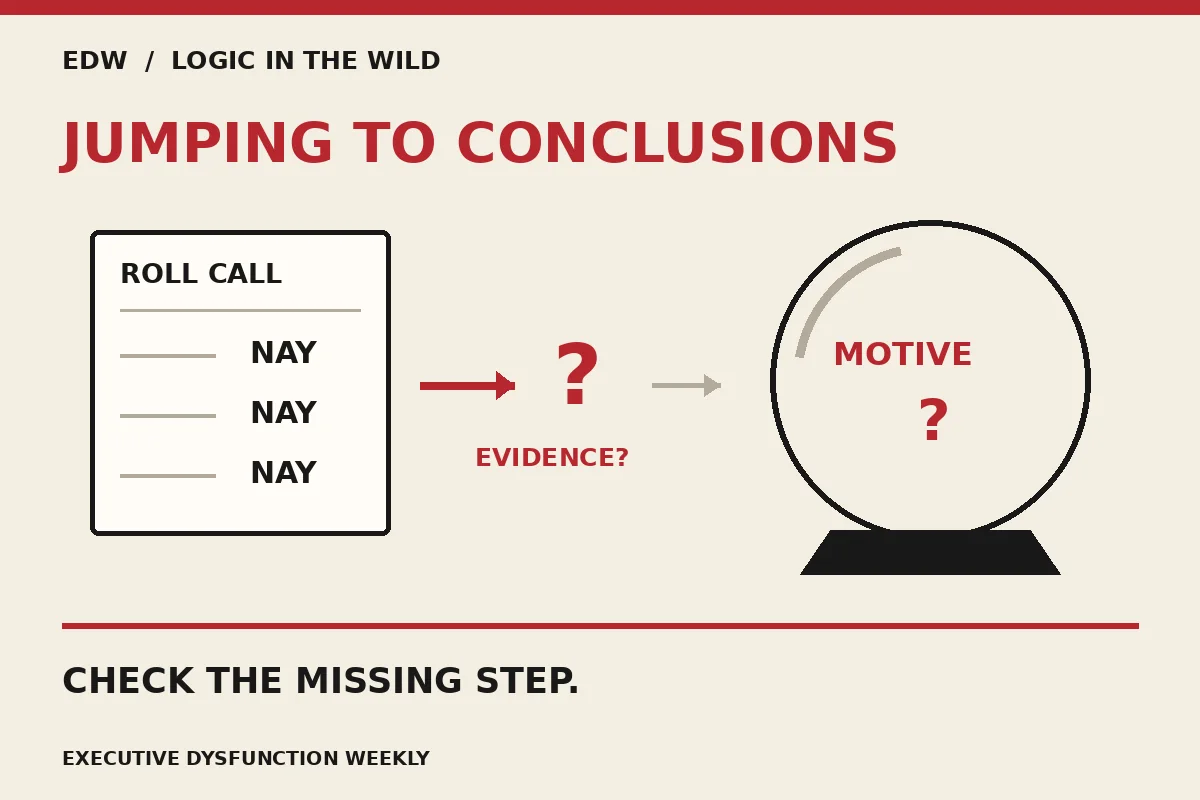
A roll call can establish how a legislator voted. It cannot, by itself, establish why. The missing evidence is what distinguishes a desire to cheat from other possible reasons for opposing these requirements. Trump does not supply that distinction in this passage.
There are competing explanations in the public record. In a March 18 press conference, Democratic Senator Patty Murray argued that the SAVE America Act would impose document costs and practical obstacles on eligible citizens. That is her stated rationale. It is not independent proof that every prediction she made was correct, or that every opponent shares her reasoning. It does establish that there is an actual policy objection to examine instead of skipping straight to a verdict about intent.
The reasoning pattern is jumping to conclusions: the evidence offered cannot carry the certainty of the motive accusation. We also read an implied false-dichotomy frame: support the proposed requirements, or want to cheat. That is our reconstruction of the framing, not an explicit either/or quotation. A person could support secure elections while disputing the burden, design or effectiveness of a particular bill.
This is an unsupported inference about motive, not merely an opinion that voter ID is good policy. Nor does finding the gap prove that no politician could ever have a dishonest motive. It means the vote alone does not settle the question. The crystal ball needs to submit its evidence like everybody else.
The strongest fair reading
The strongest fair version of the argument is that identity and citizenship checks can help prevent ineligible voting and increase confidence in elections, and that opposing a useful safeguard deserves scrutiny. A supporter can argue that the benefits outweigh compliance burdens and challenge opponents to propose an equally effective alternative.
Those are arguments about policy design and likely consequences. Even if a critic establishes that an opponent’s preferred rules increase a risk, that still does not establish that the opponent desires that outcome. Rejection of a safeguard, disagreement about its usefulness and an intention to cheat are different claims. Our analysis does not settle which version of voter-ID policy is best, and it does not assign Trump a private strategic motive.
Why it matters
The president made this accusation while campaigning before the November 3 midterms. Voters can debate election security without treating disagreement as a confession. Ask two separate questions: What does this proposal change, and what evidence supports the accusation about intent? If the answer to the second question is just the first question repeated louder, the missing step is still missing.