The claim
At his October 19 rally in Park City, Kansas, Donald Trump described France as being “burned to the ground by migrants, jihadists and communists who hate Christianity.” The passage appears at 04:19–05:23 in the full-event transcript. He connected the violence to immigration policy and subsequently urged France to close its borders.
His original October 19 Truth Social post makes the same causal attribution. Our focus is that diagnosis of the French unrest, not every claim in the speech or post.
Where the reasoning breaks
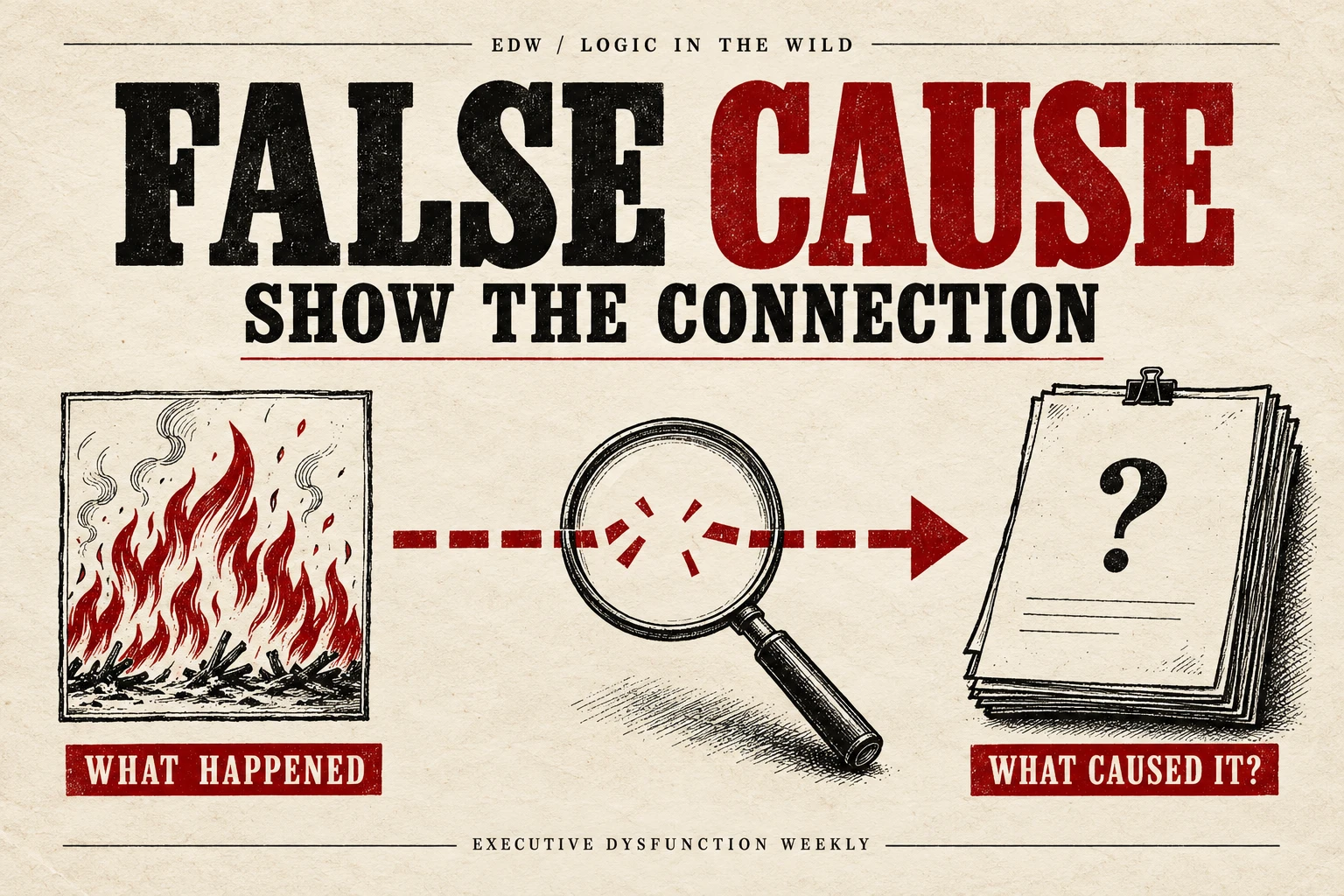
The reasoning pattern is false cause, more precisely an unsupported causal attribution. Destruction is visible. The proposed explanation is not established merely by pointing at the destruction. A fire is not a cause-of-fire report, even when the person narrating it has a microphone.
Several questions have been compressed into one confident answer. Who committed which acts? What evidence establishes their motives? Which immigration or integration policy contributed, through what mechanism? Would the proposed border response address that mechanism? The statement treats those steps as already completed.
AP reported on October 20 that authorities had not linked immigrants to the French rioting and that the participants’ precise sociological makeup remained uncertain. That is a significant limit on the evidence. It is not proof that no immigrant participated. AP also reported radical-left involvement in some violence, so it would be wrong to describe every component of Trump’s account as wholly invented.
Reuters’ October 18 reporting described school-related protests joining broader discontent over living costs and public services. It distinguished peaceful marchers from violent fringe groups. Those reported grievances help explain the mobilization. They do not establish every rioter’s motive, either.
Even verified participation by some immigrants would not, by itself, demonstrate that immigration caused the unrest. Turning individual involvement into a verdict on a whole population adds a generalization problem to the causal one. The evidence has several jobs here. A dramatic video cannot quietly work all of them.
The strongest fair reading
The strongest fair interpretation is a concern about social cohesion: immigration and integration policies might affect how a society handles conflict, and governments should investigate whether specific failures contributed to violence. Concern about violence is not a fallacy. Asking that question is legitimate.
But a possible contributing factor is not an established explanation. A serious case would identify evidence about participants, mechanisms and relevant alternatives, and would distinguish the peaceful protest movement from those who committed violence. It would also explain why the proposed remedy fits the identified cause.
We are not concluding that immigration had no role. We are concluding that the confident causal diagnosis outruns the evidence presented and independently verified. That distinction is the lesson, not an inconvenient footnote.
Why it matters
Keep the categories separate. The occurrence of violence is a factual matter. The composition and motives of the people involved require evidence. Immigration’s causal role is an empirical claim, not just an opinion. Whether a country should change its immigration policy is a policy judgment that needs its own argument.
This is an informal reasoning failure, not a demonstration that every conclusion in the speech is false. It is also not specifically a post hoc argument: the problem here is assigning a cause without establishing the connection, rather than merely saying one event followed another.
Ask: What establishes the cause, rather than just the crisis? What competing explanations have been considered? What would change the diagnosis?
The flames may be real. The arrow drawn from them to a preferred explanation still needs an inspection.