The claim
An October 15 White House release responded to Newsweek’s coverage of American socialism by invoking atrocities under socialist and communist regimes. It then declared: “That same ideology is now being sold to Americans”. The next targets were the Democratic Socialists of America and the Democratic Party’s left wing.
The release also named policies, including Medicare for All and the Green New Deal, and cited a Council of Economic Advisers economic report. Our focus is the historical association, not a verdict on that report. ThePrint independently reported the statement and its Newsweek context on October 16.
Where the reasoning breaks
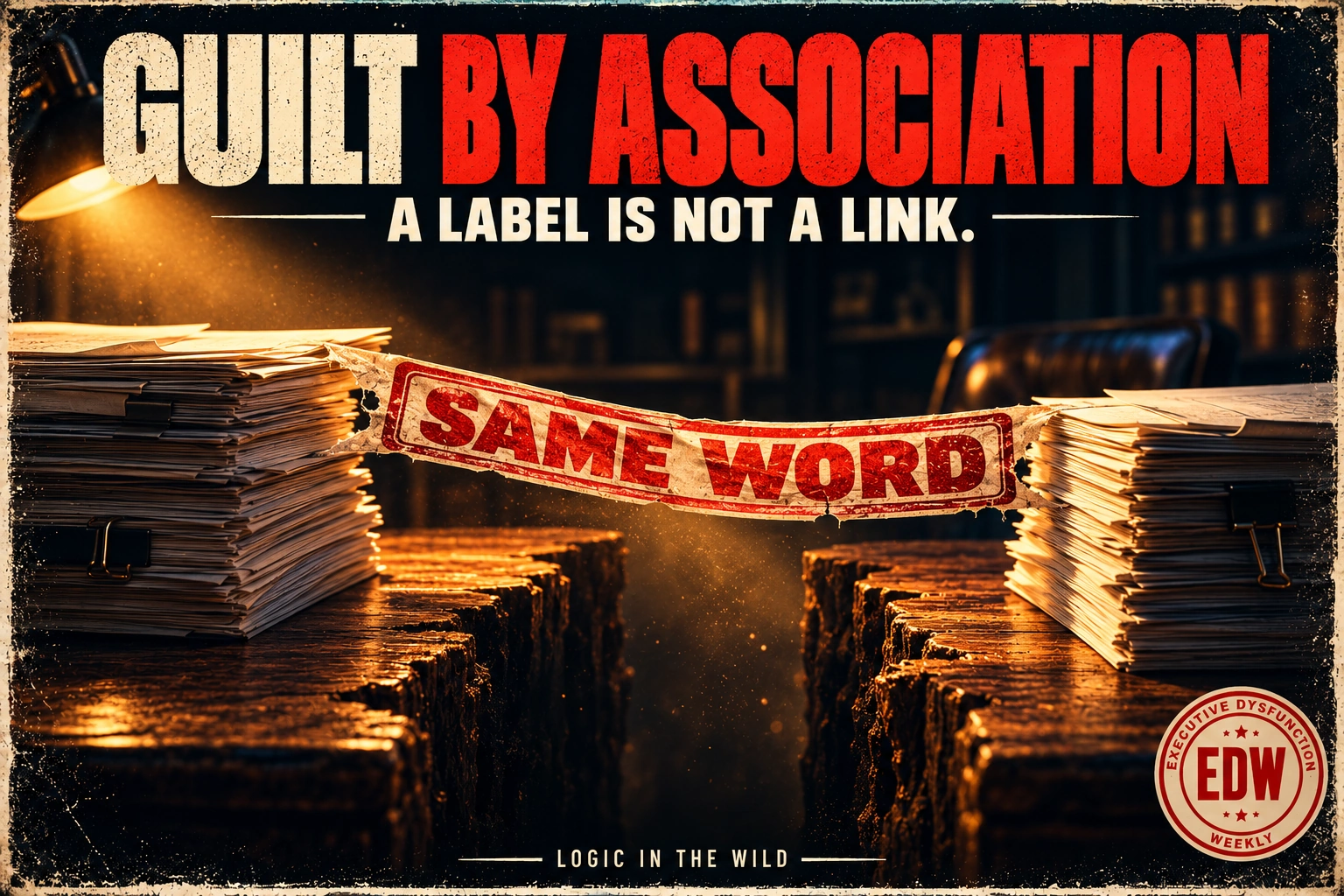
The shortcut is guilt by association: attach a present proposal to a horrifying historical example through a shared label, then let the horror carry the conclusion. The related problem is an insufficient historical analogy. A resemblance has been announced; its relevance still needs to be established.
To make that connection persuasive, identify the mechanism. Does the proposal eliminate competitive elections? Suppress dissent? Concentrate coercive power without effective checks? Which provision does that, and how? A label cannot answer those questions for us.
This is not an argument that history is irrelevant. It is an argument that history deserves more than a name tag. Two policies sharing a word does not establish that they share the institutions, methods or consequences that matter.
DSA’s own explanation advocates collective ownership of key economic sectors while rejecting authoritarian socialist models. That is its stated position, not independent proof of every member’s behavior or a guarantee about future outcomes. It nevertheless identifies a difference an equivalence argument should address. DSA and the entire Democratic Party are not interchangeable subjects, either.
The label has arrived wearing a historian’s jacket. We should still ask whether it brought any history.
The strongest fair reading
The strongest fair interpretation is a warning about concentrated state power. Historical comparisons can illuminate genuine dangers, and critics are entitled to argue that particular economic arrangements create those dangers. They can also challenge whether promised democratic safeguards would hold.
That case needs relevant similarities, a causal explanation and attention to important differences. It cannot be completed merely by pointing to an awful regime that used the same broad political vocabulary.
The release’s separate economic claims deserve separate examination. A weak historical association does not prove the proposed policies affordable, wise or harmless. Nor does identifying this reasoning gap settle a contested historical death toll. We are not adjudicating those questions here.
Why it matters
Keep the categories straight. What an organization says it supports is a checkable statement about its published position. Whether a proposal would work is a substantive policy question. Whether two systems share the mechanisms that produced a particular outcome is an argument requiring evidence. Condemnation by shared label skips that work.
Ask: Which specific proposal? Which historical mechanism? What evidence connects them? What differences might change the outcome?
A useful historical warning gives us something to examine. A guilt-by-association shortcut gives us something to recoil from. Before we mistake the second for the first, check the bridge. A matching name tag is not load-bearing.