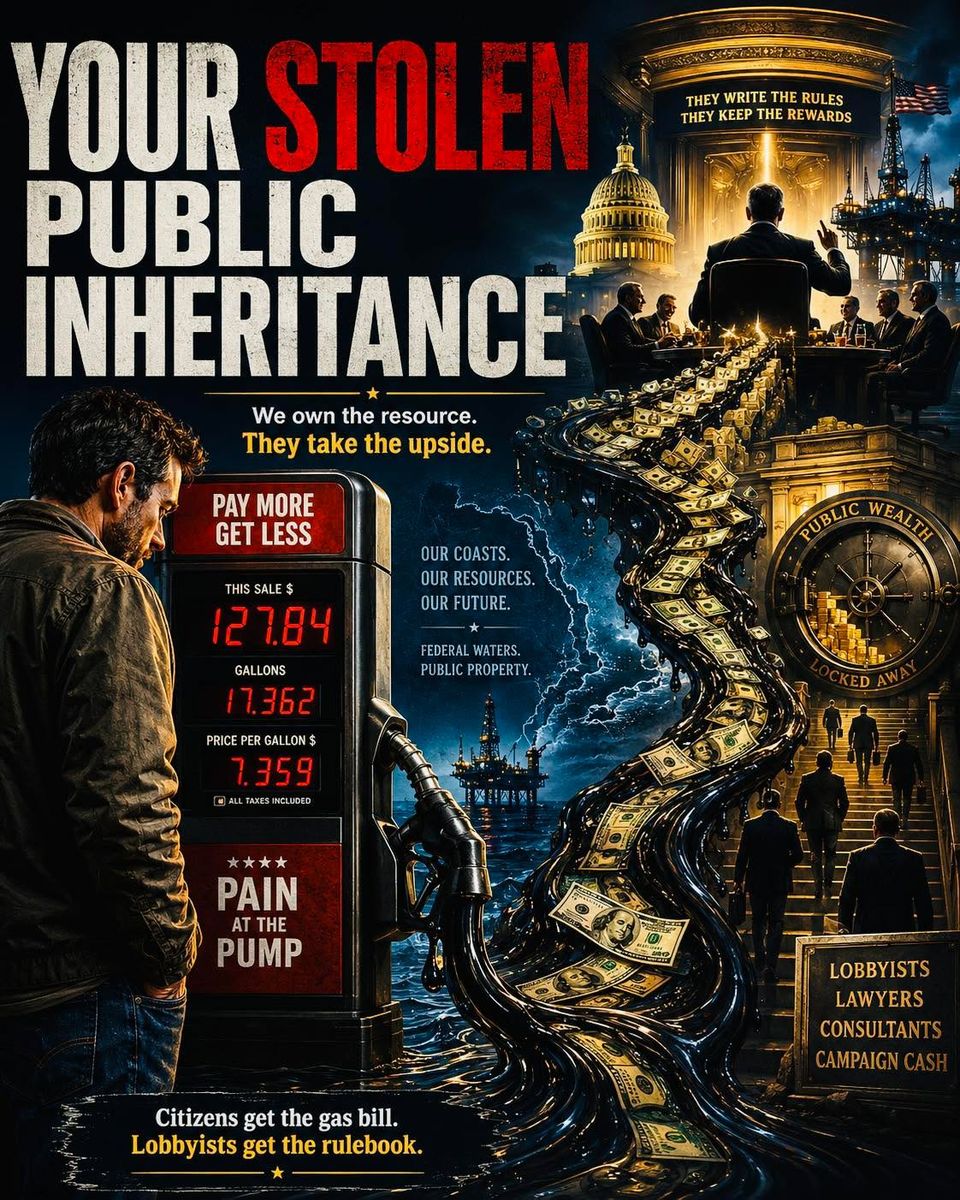
America is rich in public resources. Citizens get the gas bill while lobbyists get the rulebook.
Gas prices are where most Americans first feel the insult.
You stand there at the pump watching the numbers spin like a slot machine built by lobbyists and blessed by a Senate committee, while someone on television tells you America just needs to “produce more energy.”
Cute.
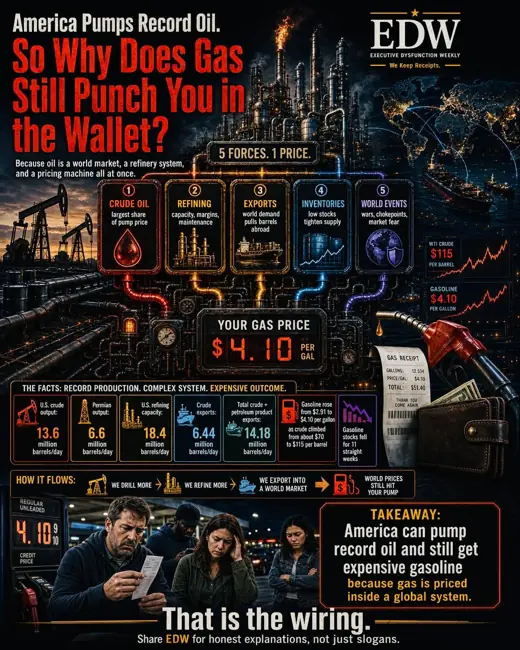
The United States already produces an enormous amount of energy. In 2025, total U.S. energy production reached a record 107 quadrillion British thermal units. Crude oil production also hit a record 13.6 million barrels per day, and the United States remained the world’s largest crude oil producer. America has plenty of oil muscle.
The deeper fight is ownership.
Who owns the resource? Who gets the upside? Who writes the rules? Who gets the dividend? Who gets the pollution, volatility, infrastructure cost, refinery bottleneck, campaign ad, and gas bill?
You know the answer.
Here is the part Washington would prefer you skim past while admiring a stock photo of a worker in a hard hat. Some of this resource wealth already belongs to the American people. BOEM says resources on the Outer Continental Shelf in U.S. waters belong to all U.S. citizens. Those resources generate money from lease sales, rental fees, royalties, and operating fees. The largest portion goes into the General Fund of the U.S. Treasury.
In FY 2024, oil and gas activity on the Outer Continental Shelf generated $7.0 billion in direct government revenue. Offshore oil and gas activity also supported about 250,000 jobs, $18.3 billion in labor income, $30.8 billion in value added, and $59.5 billion in economic output. That is real money. Real work. Real value.
Now look at the architecture.
The public owns the resource. Private firms lease the right to extract it. The public gets a slice. The industry captures the production upside. Then the same industry spends heavily lobbying the government that sets the next round of rules.
OpenSecrets reported that the oil and gas industry spent $72 million on federal lobbying in the first six months of 2024. American Fuel and Petrochemical Manufacturers led the sector with $8.1 million in federal lobbying during that period.
That is a serious investment in rule writing.
The tax system joins the party wearing its best “nothing to see here” face. Federal law still gives oil and gas special treatment. Section 263 allows taxpayers to deduct intangible drilling and development costs for oil and gas wells. Section 613A preserves percentage depletion for independent producers and royalty owners under specific rules.
Treasury has explained the basic problem with percentage depletion clearly. The deduction can rise as oil prices rise, lowering the effective tax rate when commodity prices are high. In regular human language, the system can get friendlier to producers when the product gets more valuable. Lovely little arrangement. Very normal. Definitely designed by people who expect you to stop reading after paragraph three.
The scandal here is simple.
Private companies can make money extracting oil and gas. Build the rig. Hire the workers. Take the risk. Make a profit. Nobody is asking a drill bit to volunteer at the soup kitchen.
The scandal is that public resources keep turning into private leverage while citizens get treated like a tip jar.
We own the resource in theory. Companies extract it in practice. Politicians route the money through the usual federal plumbing. Lobbyists show up with dump trucks full of “deep concern.” Tax preferences survive like cockroaches in a marble kitchen. Citizens receive a pump price, a lecture, and the comforting knowledge that somewhere, in some federal budget line, a sliver of their own wealth technically helped pay for something.
This is public ownership in theory and private advantage in practice.
This system has bipartisan fingerprints all over the glass. Politicians love yelling about energy independence because it sounds muscular and costs them nothing. The ownership question costs more, which explains why they avoid it like a subpoena.
If the public owns the resource, the public deserves a larger long term claim on the upside.
Other places figured this out without collapsing into a fainting couch sponsored by Exxon.
Norway looked at petroleum and built a national wealth machine. Its petroleum tax system maintains a combined marginal tax rate of 78 percent, and government petroleum revenues flow into the Government Pension Fund Global. The fund exists so oil wealth benefits current and future generations. At the end of 2025, the fund’s value was 21,268 billion kroner.
Alaska gives America a domestic proof of concept. The Alaska Permanent Fund Dividend lets residents share in state resource wealth. The 2025 dividend amount was $1,000, and Alaska’s summary of dividend applications and payments lists more than $619 million disbursed for that dividend year.
Norway and Alaska are imperfect comparisons. Congratulations to the objection machine for discovering that countries and states are different. Very advanced. Someone get a whiteboard.
The point is much simpler.
Public resource wealth can become public wealth.
That is a choice.
America made a different choice. We built a system where public resources become private leverage, lobbyists help sculpt the rules, politicians collect the applause, and citizens mostly get the pump price, the asthma, the cleanup cost, and a lecture about how asking for a dividend from our own inheritance sounds too radical.
It sounds radical only because the people taking the inheritance got used to calling themselves job creators.
Americans are already in the largest union most of us will ever join. It is called the United States. We pool risk. We build roads. We defend coastlines. We insure deposits. We subsidize industries. We rescue markets. We absorb pollution, volatility, infrastructure costs, and geopolitical blowback together.
Time to act like members of a country instead of customers trapped at the checkout line of our own inheritance.
Create an American Public Resource Fund.
Start with federal revenue from publicly owned offshore energy resources. Expand it to federal mineral royalties, renewable energy leases, geothermal leases, and future critical mineral revenue where Congress can create a real public return instead of handing extraction rights around like party favors at a donor retreat.
Protect the principal.
Invest it for long term growth.
Pay every citizen an equal dividend from a portion of the returns.
Use another portion for national resilience: grid modernization, disaster hardening, rural energy infrastructure, public transit, transition support, and the communities that actually live with extraction instead of posing near it in campaign ads.
Keep existing conservation commitments whole. Leave state revenue sharing intact. Protect the Land and Water Conservation Fund. Real reform builds public wealth. Washington shell games just move the same twenty dollar bill between pockets and ask citizens to clap.
The fund should grow.
A real fund.
A permanent fund.
A citizens’ ownership fund.
Public resource in. Public wealth out.
This will not lower gas prices tomorrow. Good. Say that out loud before some cable news possum with a lapel pin pretends the whole argument is a coupon scheme.
The point is bigger than tomorrow’s pump price.
Gas prices move because oil is a global commodity. Refineries matter. Supply chains matter. Wars matter. OPEC matters. Export markets matter. Record U.S. production does not magically turn every gas station into a patriotic charity kiosk.
The real question is larger.
Why did a country this rich in public resources build a system where citizens feel the downside while private players hold so much of the upside?
That is the theft.
The boring kind.
The legal kind.
The committee hearing kind.
The “stakeholder input” kind.
The “energy dominance” kind.
The “we are proud to announce a bipartisan framework” kind.
The kind where everyone involved owns a suit, nobody calls it looting, and the public is told to be mature while its inheritance becomes someone else’s leverage.
When something under public land or public water belongs to the American people, the American people deserve more than a royalty check, a budget line, and a higher gas bill.
We can understand the scam without hating oil companies.
We only need to remember who owned the resource before the lobbyists arrived.
It was ours.
If this country still has enough spine to act like a country, rather than a private equity brochure with a flag pin, it should be ours in a way citizens can actually feel.
If this hit home, help it move. Like it, share it, and leave a comment so more people start asking the ownership question Washington keeps dodging: if the resource is ours, why does the upside keep flowing away from us?
EDW•