Because oil is a world market, a refinery system, and a logistics business all at once. Too many politicians hand people one piece of that picture and call it the whole machine.
It isn’t.
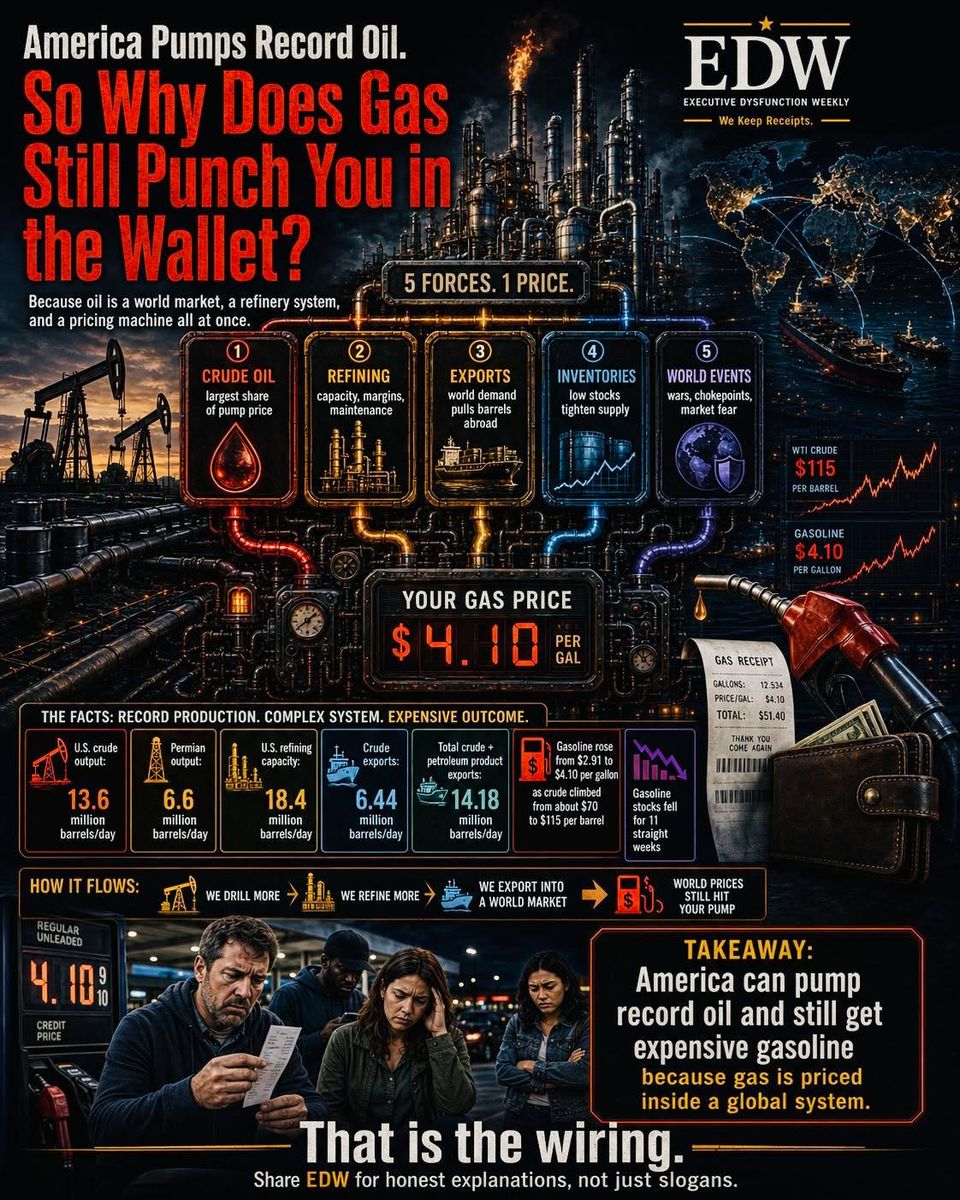
The United States produced a record 13.6 million barrels of crude oil a day in 2025. The Permian alone supplied 6.6 million barrels a day, almost half of total U.S. production. America also has a giant refining system, with 18.4 million barrels per calendar day of operable refining capacity at the start of 2025. That is real production. That is real industrial capacity. That is real muscle.
Gasoline prices come out of a chain. The biggest piece is still crude oil itself. After that comes refining, then distribution and marketing, then taxes. The Energy Information Administration says crude is usually the largest part of the pump price, while refining costs and profits can swing hard depending on season, region, fuel mix, and refinery conditions.
That is where the slogan falls apart.
America produces a lot of oil. Good. That matters. Crude still lives inside a global market. When the world gets nervous, oil prices move. When crude moves, gasoline usually follows. When refineries get tight, exports rise, or inventories shrink, the squeeze gets worse. Markets price all of that fast.
That is exactly what is happening now. Reuters reported that the United States became a net crude exporter on a weekly basis for the first time since World War II, with crude exports hitting a record 6.44 million barrels per day and total crude and petroleum product exports reaching an all time high of 14.18 million barrels per day. In the same report, gasoline stocks fell for the 11th straight week. America is producing at record levels while also exporting heavily into a tight global market with thinner inventories at home.
Refining adds another layer. Reuters reported that Phillips 66 and Marathon benefited from stronger refining margins as disruptions tied to the Iran war tightened global fuel supply and boosted demand for U.S. fuel exports. Marathon’s refining and marketing margin rose to $17.74 per barrel, up more than 32% from a year earlier. That is a direct signal that refiners are making more money in a tighter market, and tighter markets show up quickly at the pump.
Inventories matter too. Reuters reported that Morgan Stanley expects U.S. gasoline inventories to fall to around 198 million barrels by the end of August, which would be the lowest level for that point in the season in modern records. The same report said refiners are leaning harder toward diesel and jet fuel where margins are stronger, while gasoline imports have been weak and exports remain elevated. That means less cushion in the system right as summer demand arrives.
Here is the real story.
America pumps a lot of oil.
America refines a lot of oil.
America exports a lot of oil and fuel when the world wants it.
Drivers still buy gasoline in a market shaped by global crude prices, refinery margins, export demand, and inventory levels.
That is the wiring.
Once you see the wiring, the political line starts sounding awfully small. “We produce all this oil” is one fact. It is a true fact. It is also one fact inside a much bigger machine. It leaves out exports. It leaves out refinery economics. It leaves out inventories. It leaves out the way a shock in the Middle East or a squeeze in shipping can make Europe and Asia pull harder on American supply, tightening conditions here and lifting prices for everybody.
That is why the public keeps feeling played. People hear “record production” and reasonably expect relief. What they get instead is a civics lesson in markets they were never given. Oil is global. Fuel is tradable. Refiners chase margins. Inventories matter. Fear gets priced in quickly. Drivers pay at the end of the chain.
Production still matters. The Energy Information Administration says higher U.S. oil production has helped slow the rise of oil and gasoline prices over time. That is real. It just operates inside a system larger than any campaign line. Politicians who pretend one production number settles the price question are offering comfort, not understanding.
The honest version sounds like this:
Record oil production is real.
High gas prices are real.
Those two facts fit together perfectly in a country that produces heavily, refines inside a profit system, exports into a world market, and buys gasoline at prices shaped by all of it.
That is what is going on.
A one line answer will never do this story justice. All it does is give people one more reason to feel lied to when the receipt says otherwise.
If this said what you were thinking but cleaner, share it around. Follow EDW. The country gets plenty of speeches about oil. It could use a few more honest explanations.
EDW•