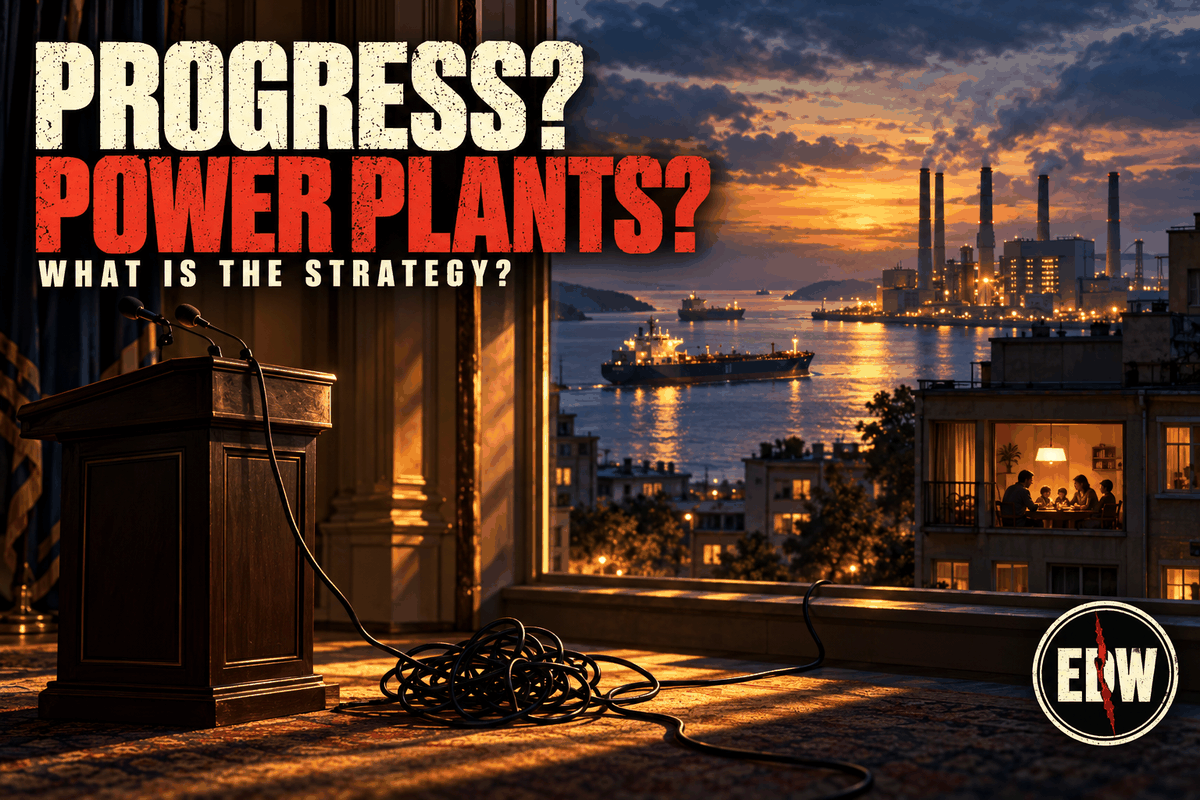
A few days ago, the White House was selling momentum.
Karoline Leavitt said the Iran discussions were “productive and ongoing.” Trump was still talking like the endgame was close enough to taste. The public mood they wanted was obvious: pressure is working, the deal is forming, history is bending nicely in our direction.
On April 16, Pete Hegseth was back on the podium saying U.S. forces are “locked and loaded” on Iran’s remaining power generation and energy industry.
That swing is the story.
A government whose pressure campaign is landing starts talking about terms, sequencing, verification, and what happens next. A government that circles back to power plants is telling you something else. It is telling you the first theory of leverage did not get the job done.
That is the tell.
And the blockade is telling on them too.
The opening headline was built for cable. CENTCOM said six ships turned around and none passed its blockade in the first 24 hours. Nice, crisp, cinematic. Reuters later reported that sanctioned supertankers Alicia and RHN entered the Gulf. But Alicia was heading to Iraq, and RHN’s destination was unclear. The blockade targeted Iranian ports, so those transits alone did not prove it had been breached. Meanwhile, AP and Reuters reported fresh ship attacks and seizures in Hormuz as diplomacy remained stuck. Suddenly the picture looked less like “we control the board” and more like “welcome to a chokepoint crisis, where every rule has an exception and every exception gets expensive.”
That matters because this administration keeps trying to tell a battlefield story in a shipping-and-economics crisis.
Battlefield stories are easy. They come with targets, maps, speeches, and dramatic verbs. Chokepoint crises come with insurers, freight risk, shipping routes, underwriters, oil traders, and governments staring at the price of panic.
One makes great television.
The other rewrites the gas bill.
Which brings us to the timeline, and holy hell, the timeline.
April 15: the White House says talks are “productive and ongoing” and hints another round may happen in Pakistan.
April 16: Hegseth says U.S. forces are “locked and loaded” on Iran’s remaining power generation and energy infrastructure.
April 17: Trump says the Strait is “completely open” and that most of the points are already negotiated, while AP makes clear the reopening is conditional and still tied to Iranian control and U.S. pressure.
April 19: Trump threatens every bridge and every power plant in Iran if Tehran does not take the deal.
April 21: Trump announces an indefinite ceasefire extension while keeping the blockade in place. Another round of talks remains uncertain, and an Iranian official tells Reuters Tehran rejects negotiations under pressure aimed at surrender.
April 22: Reuters and AP report attacks on three ships in Hormuz, two seizures by Iran, and diplomacy still stalled.
That is not a tidy strategy unfolding. That is a government lurching from “progress” to “power plants,” from “the Strait is open” to “ships are being seized,” from “deal soon” to “we’re extending the deadline again.”
And every time those threats come back, Tehran gets something for free.
This kind of regime feeds on siege language. It knows exactly what to do with American apocalyptic rhetoric. “Look what they want to destroy now.” “Look what they call peace.” “Look what they threaten when they do not get their way.” Every recycled U.S. threat helps hardliners convert pressure into patriotism. You do not have to like the regime to understand the political gift being handed to it.
And there is another audience learning from all this too.
Allies learn that U.S. messaging whipsaws.
Markets learn that “open” does not mean open.
Adversaries learn that deadlines move.
The world learns that social-media diplomacy produces a lot of noise and not much closure.
That is the deeper credibility problem.
America is powerful. Iran’s regime is brutal. Those two things can both be true while this administration still makes the United States look less credible, not more. Spectacle is not strategy. Posting is not negotiating. Volume is not leverage.
A superpower should not negotiate like a comment section.
That is the line.
Because once diplomacy starts sounding like a live feed, every missed deadline gets louder, every recycled threat gets cheaper, and every declaration of “progress” ages in public. The words start working against the speaker. That is where this White House is now. The administration keeps trying to use public drama to create private concessions. The result keeps looking like overpromise, escalation, extension, repeat.
So ask the question that matters.
If the pressure campaign is working, why are power plants back on the podium?
That one question does more work than the whole press shop.
It gets to the gap between the White House’s confidence and its outcomes. It gets to the gap between promises of rapid progress and threats against energy infrastructure. It gets to the gap between the fantasy of control and the reality of a conflict that keeps slipping sideways into shipping, oil, and global nerves.
The threats returning are the tell.
Not the boast.
Not the body count.
Not the swagger.
The recycled threat.
Because recycled threats are what governments reach for when the first round of pressure did not close the deal.
That should worry Americans, because a White House that keeps swinging from “progress” to “power plants” is telling the world it still has not figured out what kind of conflict it is actually in.
If this said what you were seeing but sharper, share it around. Follow EDW. The timeline is doing half the writing now.
EDW•