An open challenge to all of us to pursue truth with courage
I have a sentence tattooed prominently on my body:
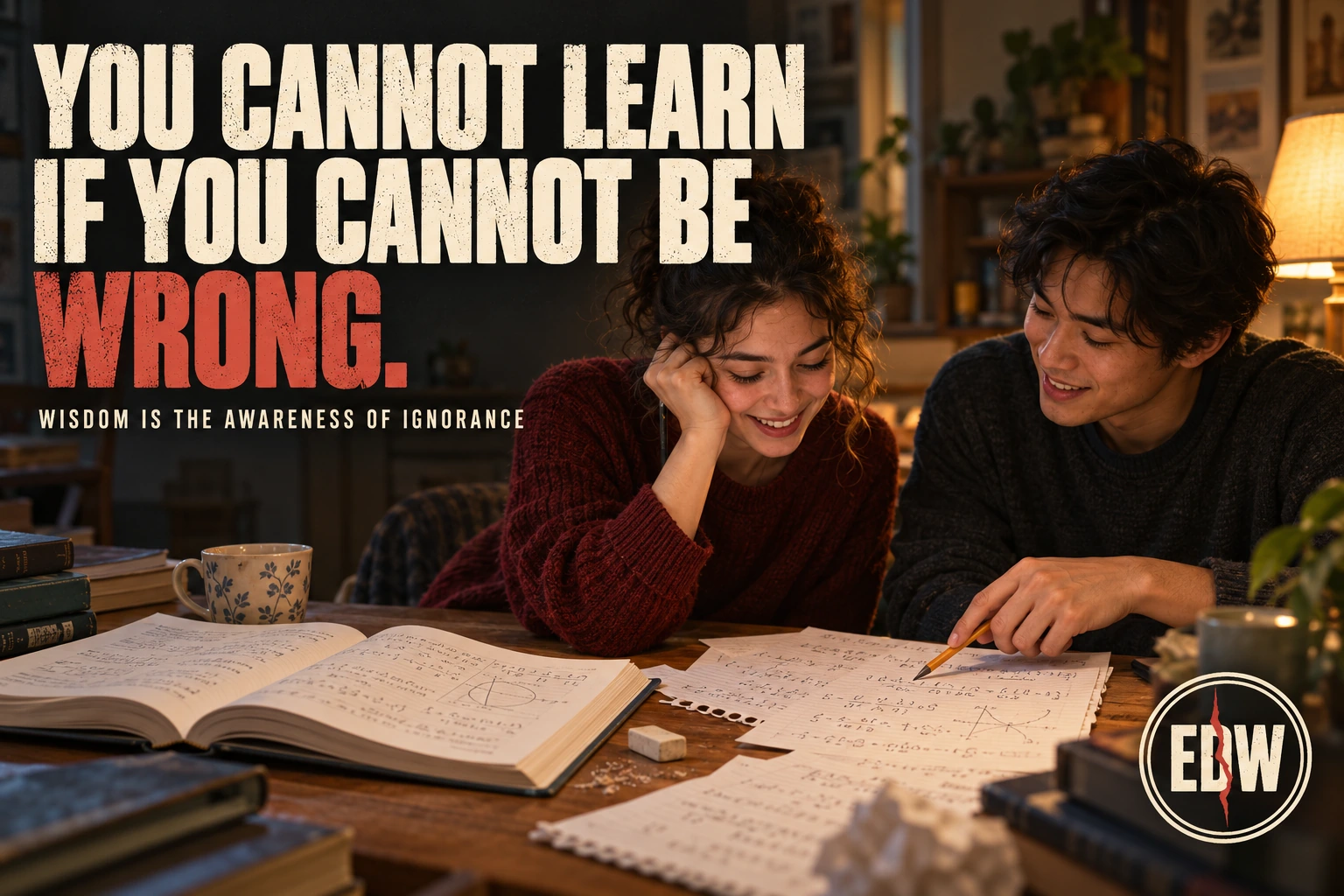
Wisdom is the awareness of ignorance.
People sometimes assume it’s a flex, like I’m claiming to be wise. It isn’t. It’s the opposite. It’s a reminder, carved into skin, that the moment I start feeling most certain is the moment I should slow down and ask: What am I missing? What don’t I know? What am I afraid to admit?
Because the crisis we’re living through isn’t just political. It’s cognitive. It’s cultural. It’s personal. And it’s wrecking us.
Somewhere along the line, being wrong became shameful, as if a wrong answer is evidence of a bad character instead of a normal step in learning. We trained ourselves to believe that to be wrong is to be weak, and to admit you were wrong is to lose status. And that single belief has quietly poisoned everything: school, relationships, social media, and the way we argue about our country’s future.
If we want to heal anything, anything at all, we have to start here:
You cannot learn if you cannot be wrong.
The country we’re building when we punish people for learning
Think about how we talk now. “Flip-flopper” is an insult. “Changed your mind” is treated like betrayal. We reward the person who delivers the cleanest dunk, not the person who asks the uncomfortable question. And we’ve created a social environment where it’s often safer to double down on something false than to update your beliefs publicly.
That’s not strength. That’s fear with better branding.
And it leads to something even worse: people stop trying. They stop reading. They stop asking. They stop raising their hand. They stop listening. They stop learning. Not because they’re incapable, because they’re protecting themselves from embarrassment.
I watched this start early.
I’ve had people on my friends list that I met in grammar school, high school, college, every phase of life. And I remember, vividly, sitting next to kids who didn’t want to learn. Not because they weren’t smart. Because somewhere, someone taught them that getting something wrong means you’re stupid.
I was different in one strange way: I had no fear of being wrong.
I wasn’t fearless because I thought I was always right. I was fearless because I wanted the truth more than I wanted to look smart. If I asked the teacher a question and I was wrong, good. That meant the fog cleared a little. That meant we were moving.
But what I watched around me was people shutting down. Some would get frustrated when I kept engaging the teacher. Some would pull away from the lesson. Some would say things like, “I’m never going to use this anyway,” and just turn their minds off. I used to wonder, was that coming from home? Did someone teach them that school is a performance, not a process? That questions are weakness? That confusion is humiliation?
And then that pattern follows you into adulthood.
In college, I used to teach people calculus at my dining room table before finals, when I didn’t even need to study, because I loved the moment when someone who’d been ashamed finally realized: Oh. I’m not broken. I just didn’t understand yet.
That word, yet, is the difference between a learner and a prisoner.
We don’t need more certainty. We need more courage.
Here’s the truth nobody wants to say out loud: it takes more courage to be wrong than to be loud.
It takes courage to say:
• “I don’t know.”
• “I might be missing something.”
• “I was wrong, and here’s what changed my mind.”
• “Teach me.”
In a healthy society, those sentences are a sign of strength. They’re proof you’re awake. They’re evidence you’re capable of growth.
In our society, those sentences often get punished.
And that punishment isn’t just a “social media problem.” It’s a national security problem. It’s a public health problem. It’s an education problem. It’s a democracy problem. Because a country that cannot update its beliefs cannot adapt. It cannot self-correct. It cannot govern itself responsibly.
We keep saying we want truth, but we keep rewarding performance.
The Rorschach test we’re living inside
You’ve seen it: two people watch the same video and walk away with entirely different conclusions. Two people read the same headline and hear opposite stories. Two people hear the same sentence and interpret it like it was written for them personally.
We are living inside a national Rorschach test, an inkblot where our assumptions, fears, and loyalties fill in the meaning.
That doesn’t mean “there is no truth.” It means our minds are filters. And when those filters are fueled by humiliation, tribal identity, and fear of being wrong, we stop seeing clearly.
So the question becomes: How do we reclaim clear sight?
Not by shaming people harder. Not by yelling “educate yourself” like it’s a spell. Not by treating our neighbors like enemies.
We reclaim it by building a culture where truth matters more than ego.
The discipline of the tattoo: practicing wisdom in public
“Wisdom is the awareness of ignorance” isn’t just a pretty sentence. It’s a discipline. It’s a daily practice. And it demands something from all of us, regardless of politics:
If you want to be a truth-seeker, you have to be willing to be embarrassed.
That’s the price. You don’t get a functioning mind without it.
So here is my challenge, yes, to you, and to me, and to everyone reading:
1) Ask yourself one brutal question:
What evidence would actually change my mind?
If the answer is “nothing,” then you’re not holding a belief. You’re holding an identity.
Write down what would change your mind. Be specific. “A credible source,” “a primary document,” “a court record,” “a clear video from another angle,” “a dataset,” “a witness statement under oath.” Whatever it is, name it.
Then do the hard thing: go look for it.
2) Practice the sentence that saves relationships:
“I could be wrong.”
Not as weakness. As respect. As openness. As a signal to the other person: I’m not here to win; I’m here to understand.
This one sentence has the power to lower the temperature of an entire conversation.
3) Reward mind-changing like it’s leadership
When someone says, “I used to think X, but I learned something and now I think Y,” don’t punish them. Don’t call them a traitor. Don’t call them a flip-flopper.
Say: “That took courage.”
Because it does.
4) Separate people from positions
You can be wrong and still be a good person. You can vote differently and still be worth loving. You can hold a mistaken view and still deserve dignity. If we forget that, we will never persuade anyone; we will only recruit for our own side.
This isn’t about one side. It’s about what kind of humans we decide to be.
I love people across the political spectrum. I have Trump-supporting family and chosen family that I would protect with my life. I’m not interested in dividing them into “good” and “bad” because the internet demands purity tests.
But loving people doesn’t mean abandoning truth. It means telling the truth with enough humility that we stay human.
The pursuit of truth is not a team sport. It’s a moral obligation.
And being wrong, admitting you were wrong, updating publicly, choosing growth over pride, is not a failure. It is the mechanism of learning. It is the engine of civilization.
So here’s what I want to normalize again:
Raise your hand. Risk the mistake. Start the conversation. Learn out loud.
Let’s stop treating ignorance like a sin and start treating it like the beginning of wisdom.
Because the future of this country won’t be decided by who is the loudest.
It will be decided by who is brave enough to say:
“I was wrong. Now I know better. And I’m going to do better.”