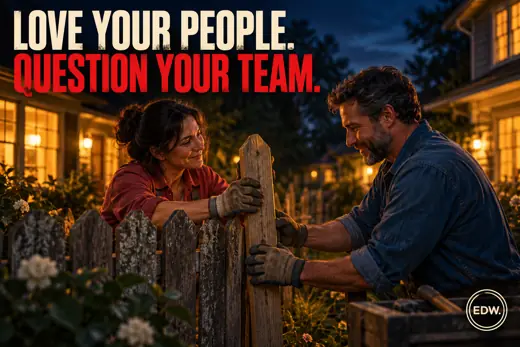
I see you. I understand the instinct. The stakes feel existential. You think compromise equals surrender. You’ve watched your side get mocked, lied about, ignored, and you decided: “Never again.” So when someone tries to lower the temperature, it can feel like betrayal.
But here’s my honest question:
If your political identity requires you to be in 100% lockstep with every talking point your “team” produces, if you can’t name even ONE thing your side gets wrong, how can you possibly be confident you’re thinking independently?
That isn’t strength. That’s a dependency.
And it’s not happening only on the right or only on the left. It’s happening everywhere. I’ve watched people I respect, smart, normally thoughtful people, completely lose their ability to reason the moment a conversation threatens their tribe. When I start using basic logic, asking for evidence, or pointing out that two things can be true at once, some people don’t debate the point. They attack the person. They call names. They try to excommunicate anyone who refuses to hate the other team.
That reaction is the tell.
Because when your beliefs are grounded in truth, you don’t need intimidation to defend them. You can handle questions. You can handle nuance. You can handle the possibility of being wrong.
And that brings me to something I live by (literally):
“Wisdom is the awareness of ignorance.”
Not because ignorance is good. Because awareness of what we DON’T know is the beginning of learning. It’s the doorway to truth. And it’s the antidote to manipulation.
So let me say this as clearly as I can:
If “come together” makes you furious, it may not be because unity is bad.
It may be because conflict has become your coping mechanism.
And I’m not saying that to shame you. I’m saying it because I want my country back.
Here’s what I believe is true, and I think most Americans quietly agree:
1) You can want law enforcement respected AND still demand accountability.
2) You can want illegal immigration reduced AND still insist enforcement be lawful and transparent.
3) You can dislike what “the other side” is doing AND still admit your side sometimes gets things wrong.
4) You can love your family, friends, and neighbors across politics without “selling out.”
What’s tearing us apart is not disagreement. It’s the growing belief that disagreement makes someone evil.
That belief is a gift, to the worst politicians and the worst media voices, because it turns citizens into fans and neighbors into enemies. It keeps us fighting each other while they raise money, chase clicks, and avoid real accountability.
So I’m making a request, again, to BOTH sides:
Stop treating politics like a purity contest.
Start treating it like a truth contest.
And if you want to test whether you’re still capable of independent thought, try this exercise (it’s uncomfortable on purpose):
• Name ONE position where you disagree with your party or your “side.”
(If you can’t name one, that’s not loyalty. That’s captivity.)
• Name ONE legitimate concern the other side has.
(Not a strawman. A real concern. The kind you’d admit if you were trying to solve a problem.)
• Name ONE thing you would want as a safeguard if the other party held total power.
Then ask yourself: why wouldn’t you demand that safeguard now?
If you can do those three things, you’re not weak.
You’re a citizen.
Now, for the people who are tempted to respond with insults, here are my boundaries:
If you can’t speak without name-calling, I’m not engaging.
If you can’t argue without assuming motives (“you only think that because…”) I’m not engaging.
If you need to declare everyone outside your tribe “evil,” I’m not engaging.
Not because I’m fragile, because I’m done feeding the outrage machine.
If you want to actually talk like adults, here are the rules I’ll follow and invite you to follow too:
1) Quote the specific claim you disagree with.
2) Separate facts from interpretations.
3) Use evidence when possible.
4) Admit uncertainty when it exists.
5) Steelman before you criticize (repeat the other person’s point in a way they’d recognize).
6) If you realize you were wrong, update out loud. That’s leadership.
This isn’t about being “nice.” It’s about being effective.
Because a society that cannot correct itself cannot survive.
And here’s the part people forget: The person you’re dehumanizing is someone else’s spouse, parent, sibling, friend, coworker. They are part of the same country you’re trying to “save.”
So yes, I’m going to keep saying it, even if both extremes attack me for it:
There is middle ground.
There is shared reality.
There is a way to disagree without contempt.
And we are not giving up on each other.
If you want to build that with me, comment ONE thing you’ve questioned on your own side, or ONE belief you updated based on new information. Normalize growth. Normalize humility. Normalize truth.
Because if we can’t do that, then the loudest, angriest voices win.
And I’m not willing to hand them my country.
EDW•