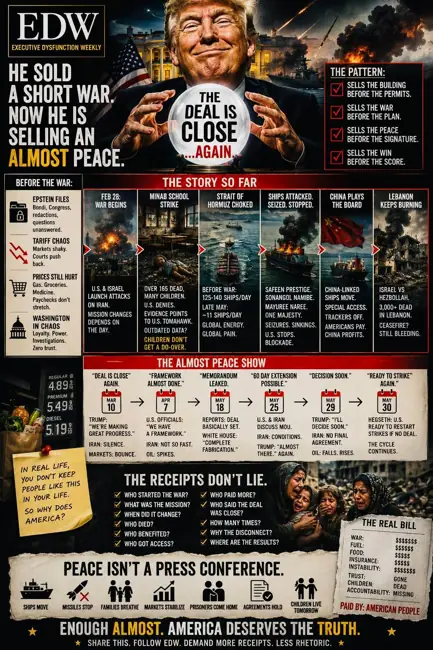
Most Americans hear “cost of war” and picture the obvious things.
Missiles.
Jets.
Fuel.
Troops deployed right now.
The giant flaming receipts we can see on television.
That is the kindergarten version of war accounting.
The adult version is uglier, slower, and vastly more expensive.
That is why Linda Bilmes is worth paying attention to.
Bilmes is not some random pundit doing doom math on a podcast. She is the Daniel Patrick Moynihan Senior Lecturer in Public Policy at Harvard Kennedy School, a public-finance specialist, and a former CFO of the U.S. Department of Commerce. She has spent years studying the real long-term costs of war, including major work on Iraq with Joseph Stiglitz. In a public Harvard Kennedy School interview published April 7, she said the Iran war was costing the United States about $2 billion a day in short-term upfront costs and that she was “certain” the total would reach $1 trillion.
A lot of people hear that and think, That sounds insane.
It only sounds insane if you think war ends when the explosions stop.
Bilmes’ argument is simple, and it is devastating. War costs come in layers.
The first layer is the one everybody sees. The daily burn. Missiles fired. Aircraft flown. Ships deployed. Troops extended past their rotations. Equipment damaged or lost. Harvard’s interview says Bilmes puts that short-term cost at about $2 billion a day, and CSIS reported that the Pentagon had already told Congress the war cost $11.3 billion in the first six days, with CSIS estimating $16.5 billion by day 12 once additional operating and damage assumptions were added.
That is the flashy part.
It is also the easy part.
Then comes the reset bill, and this is where most people lose the plot.
You do not just fire expensive weapons and move on with your life. You replace them. You repair damaged bases and ships. You replenish inventories. You restart and expand production lines. You sign giant contracts for the systems you burned through faster than peacetime planners ever expected. Bilmes points to exactly that gap in the Harvard interview, arguing that the Pentagon’s opening number misses repair, maintenance, and replacement costs, and that the Pentagon’s proposed emergency funding package reflects those hidden bills finally showing up on the ledger.
That part matters because governments love announcing the cheap-looking number first.
Nobody gets on TV and says, “Good evening, America, tonight we begin a war and also a decade of procurement distortion.”
They say the first week cost X.
They leave out the years.
And then comes the long tail, which is where war turns from a crisis into a mortgage.
This is the part almost nobody talks about honestly. Veterans’ care. Disability payments. Higher baseline defense budgets. Interest on the debt used to finance the whole thing. Bilmes has been making this argument for years. Her Iraq work with Stiglitz made the same point back in 2006: the true cost of war explodes once you include lifetime healthcare and disability payments for veterans, hardware replenishment, recruitment costs, and broader economic effects. Even conservative assumptions pushed Iraq above $1 trillion and potentially far beyond it.
That is why her Iran-war warning deserves respect.
She is using the same lens she used on Iraq. The real price of war is not just what you spend to fight it. It is what you commit yourself to afterward.
That includes the debt.
And the debt is where this starts to get obscene. War spending lands on top of an already massive federal debt. Borrowing to finance it adds interest costs that can continue long after the fighting stops. One generation gets the macho press conference. Another gets the interest payment.
That is the scam.
The Pentagon’s reported six-day cost works out to about $1.88 billion a day during the expensive opening phase. But that does not establish a continuing daily rate: CSIS’s March 13 analysis estimated $16.5 billion through day 12 and projected roughly $500 million a day afterward, absent a significant change in operations. Bilmes’s $2 billion figure is a higher estimate with different assumptions.
So yes, the sticker shock is real.
The argument among serious people is not whether war is expensive.
The argument is how much bigger the bill becomes once the tail arrives.
And the tail always arrives.
Take the USS Gerald R. Ford. During an extended deployment, it suffered a non-combat laundry fire on March 12 that damaged living spaces and required repairs. By April 2, the Navy said scheduled repairs were completed and the carrier remained available for full mission tasking. The episode still illustrates the maintenance costs and strain that deployment can bring.
That is why “How do you get from $2 billion a day to $1 trillion overall?” is the right question.
You get there by counting like an adult.
You count the munitions.
You count the repairs.
You count the replacements.
You count the production surge.
You count the veterans’ care.
You count the disability obligations.
You count the debt service.
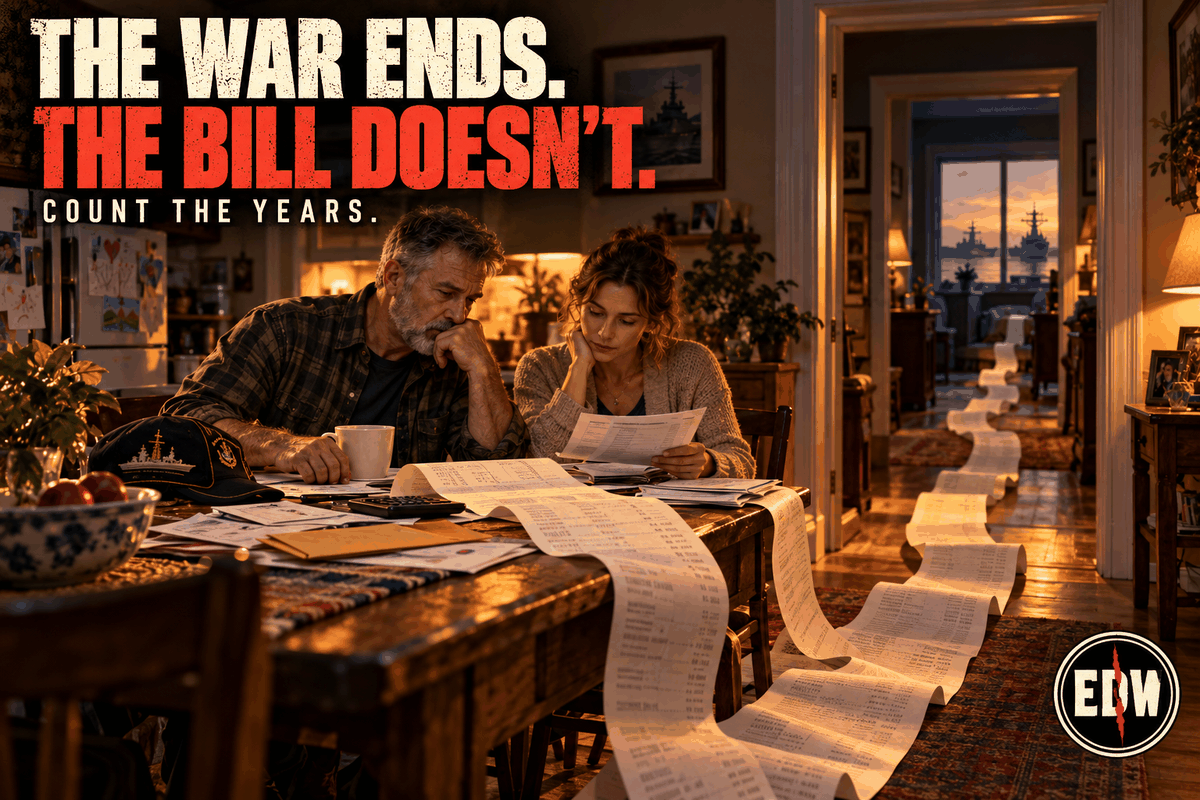
You count the years.
And once you count the years, the war stops looking like a headline and starts looking like a generational bill.
One more thing matters here. Bilmes is not building her argument on fantasy incidents. She cites real losses, and some of those are publicly corroborated. CENTCOM said three U.S. F-15E Strike Eagles were brought down in a friendly-fire incident involving Kuwaiti air defenses, with all aircrew recovering safely. That kind of loss carries real replacement and readiness costs whether or not it becomes the focus of public attention.
So what should people take from all this?
War does not become expensive when the Treasury writes the first check.
War becomes expensive when the country pretends the first check is the whole bill.
That is the lesson.
If you only count what burns, you miss what lingers.
If you only count what explodes, you miss what accumulates.
If you only count the first month, you miss the next twenty years.
And this is where the politics gets poisonous. Leaders get to enjoy the language of decisiveness. “We acted.” “We struck.” “We prevailed.” The public gets the opening invoice. The next administration gets the supplemental. The next Congress gets the veterans’ obligations. The next generation gets the interest.
Strong work, everyone.
That is why Bilmes matters. She is one of the people in public life still insisting on the full ledger. She did it on Iraq. She is doing it on Iran. You do not have to agree with every decimal point in her forecast to understand the value of the warning.
Wars cost much more than the explosions.
They cost in resets.
They cost in tails.
They cost in obligations that keep compounding long after the speechwriters have moved on.
A lot of the country still thinks war is an event.
It is usually a bill.
If this helped connect the dots, share it around. Follow EDW. The public deserves the full ledger before the next politician starts selling war like it ends when the camera cuts.
EDW•