Because “transparency” that re‑exposes victims is not transparency. It’s re‑victimization with a government seal.
Here’s what we can verify right now:
The Department of Justice has created a “DOJ Disclosures” portal for Epstein-related materials under what they call the Epstein Files Transparency Act (EFTA), with multiple “data sets” (documents, audio, and video). The DOJ says it applied redactions to protect victim names and other personally identifying information, and that audio redactions are replaced with a steady tone. They also specifically ask the public to report any accidentally released identifying information so it can be addressed.
That’s the official posture.
Now here’s the question that should be non-negotiable, especially for women, and especially for anyone who claims they care about “law and order”:
If any release shows victims’ faces or identifying details while shielding the identities of powerful men, what are we even doing?
Even if that happens only once, through carelessness, haste, or incompetence, it’s catastrophic. Because it tells every survivor/victim:
“You will pay the price of ‘transparency’ again.”
And it tells every predator with power:
“The system will still try to protect you.”
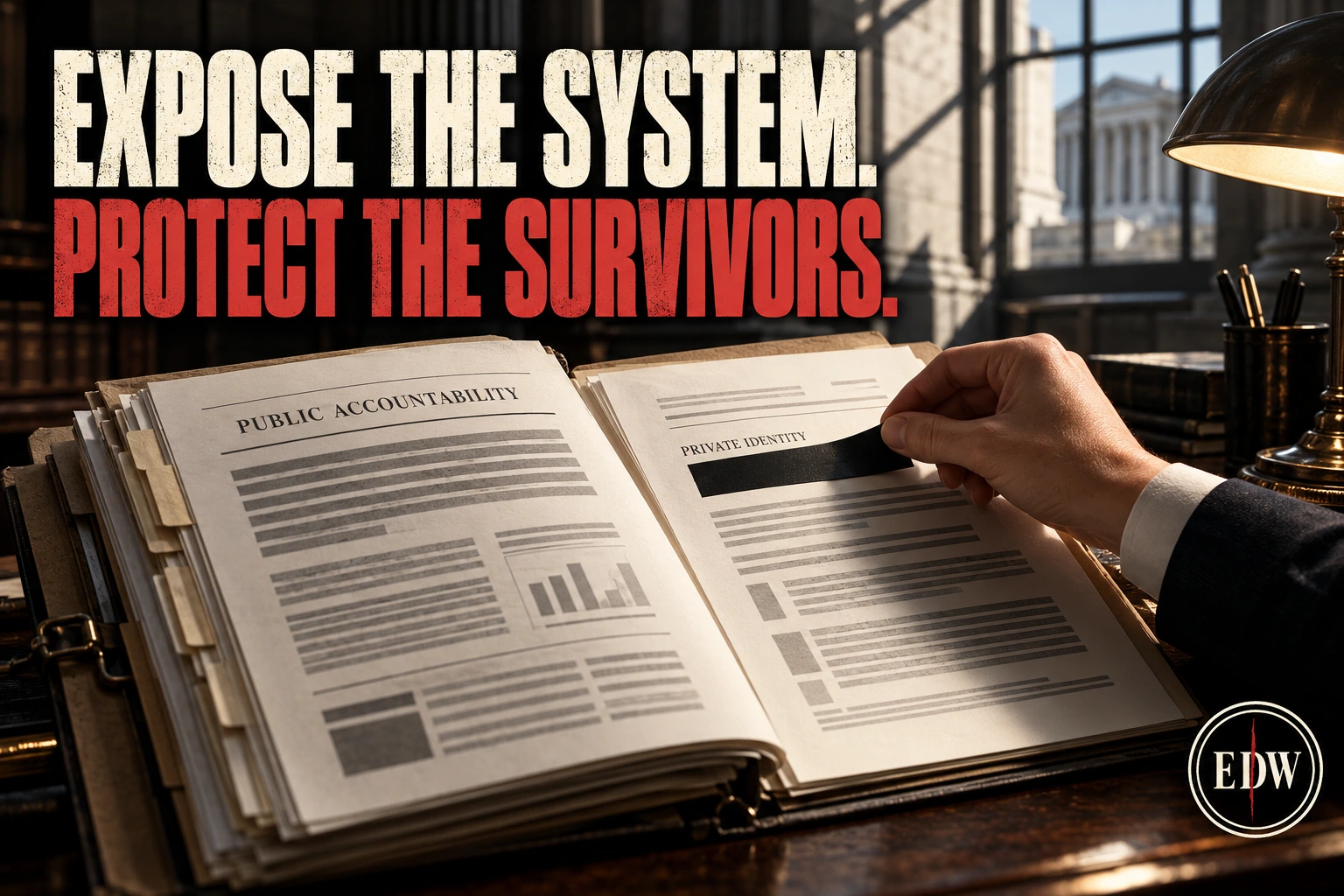
There is no “public interest” argument strong enough to justify broadcasting identifiable victims of sexual exploitation. Full stop. We can demand accountability without turning victims into evidence displays for the internet.
And to be fair: being named in released material is not proof of wrongdoing. But the law does not permit redactions merely to prevent embarrassment, reputational harm, or political sensitivity. Any withholding needs a lawful basis. That makes the DOJ’s job harder, not easier:
• Victims’ privacy should be absolute.
• Redaction standards should be transparent and consistent.
• The DOJ should not dump raw material in a way that requires victims to relive the worst thing that happened to them just to see whether the government protected them.
The deeper problem: the pattern Americans have learned
Here’s why this is exploding online: people have watched for years as institutions “manage” scandals by controlling what the public can see.
So when the DOJ says “we redacted identifying details,” but the public believes the redaction choices protect powerful men more than victims, it doesn’t just create outrage, it destroys trust.
When people suspect the rules are different for the connected, they assume the worst, because history keeps teaching them that assumption is often safer than optimism.
What EDW is demanding, right now
This is what a victim-centered, rule-of-law approach looks like:
1. Immediate independent review of releases
Before any future data drop, an outside victim- advocate panel (with legal authority and trauma expertise) reviews for identifying info. Not after. Before.
2. A clear redaction rubric published publicly
Not vague reassurances. A written standard: what gets redacted, why, and under what authority.
3. A rapid-response correction process
If identifying victim info slipped through, pull it fast, fix it fast, and say so publicly. The DOJ itself asks for reports of inadvertent victim-identifying information, people should use that channel.
4. Stop confusing spectacle with justice
“Dumping files” is not accountability. Accountability is prosecutions where warranted, consequences for enablers, and institutional reforms that prevent the next Epstein.
This isn’t about left vs right. This is about whether any of us want to live in a country where the cost of truth is paid, again and again, by the victims, while the powerful negotiate their privacy behind closed doors.
If you want more EDW posts that stay evidence-first, victim-centered, and non-tribal: please share this and follow Executive Dysfunction Weekly.
EDW•