There’s a reason so many independents have stopped watching the news.
It isn’t apathy. It’s self-preservation.
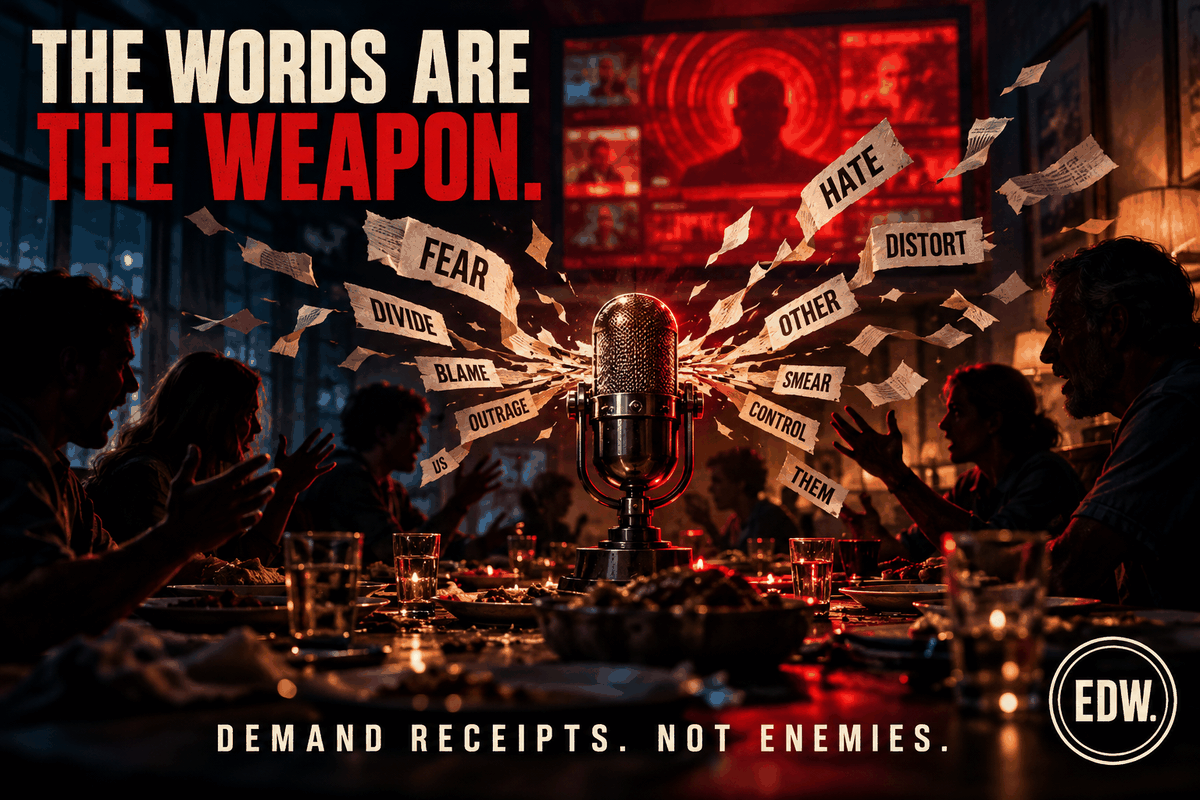
Turn on the TV or open your feed and you don’t just get information. You get identity branding. You get a steady drip of labels designed to make you feel morally obligated to despise your neighbors before you’ve even heard their argument: “radical,” “traitor,” “terrorist,” “fascist,” “dictator.” These aren’t descriptions anymore. They’re triggers, coded shortcuts meant to bypass thought and go straight to adrenaline.
The most dangerous part is how normal it’s become.
On the right, this language has become a governance style. When President Trump announces a “domestic terrorism” crackdown but frames it around the “radical left,” names liberal donors as alleged backers of violence without evidence, and builds an entire narrative architecture that points anger in one direction, that’s not “tough talk.” That’s political sorting by accusation, turning disagreement into suspicion and suspicion into permission.
On the left, we’ve often answered fire with fire, reaching for the most radioactive words available because the stakes feel existential. A prominent example: then-Vice President Kamala Harris publicly saying she believes Trump is a “fascist.” You can argue about whether that label fits. But step back and notice what happens next: the other side doesn’t hear a warning about democratic norms. They hear a justification to stop listening entirely. The word becomes a barrier, not a bridge.
Now add Congress, the arena where language is increasingly built for clips, not clarity. Rep. Jim Jordan chaired the Select Subcommittee on the Weaponization of the Federal Government during the 118th Congress (2023–2024), and even the name was a rhetorical weapon. It pre-loads the conclusion before evidence is weighed. Hearings become content; content becomes fundraising; fundraising becomes the reward signal that teaches everyone to keep escalating.
This isn’t accidental. It’s a business model.
Political advertising alone is projected to reach an eye-watering level in the 2026 midterms, AdImpact forecasts about $10.8 billion, a record-setting midterm cycle. That is not the budget of a calm republic. That is the budget of a permanent, monetized emergency, where the incentive is to keep voters afraid, furious, and endlessly engaged.
It isn’t just ads. The donor ecosystem has become its own gravitational field. A Washington Post investigation found the very richest Americans poured extraordinary sums into federal elections, with the 100 wealthiest Americans contributing more than $1 billion in 2024, roughly 7.5% of total federal election spending, while benefiting from a system that keeps concentrating wealth. When politics becomes an investment portfolio, outrage becomes an asset class.
This is the feedback loop that is eating us alive:
A politician uses maximalist language to hold attention.
Media amplifies it because conflict outperforms nuance.
Fundraising follows because fear opens wallets.
Then the next politician learns the lesson: the way to win is not to persuade, it’s to polarize.
The casualty isn’t just your friendships. It’s the rule-bound architecture that keeps a republic from turning into a personality contest over power.
Watch what happens when leaders normalize contempt for independent institutions, courts, prosecutors, inspectors general, civil servants, journalists. Reuters has reported on moments where Trump and allies describe judges and legal constraints in delegitimizing terms, framing lawful checks as political sabotage rather than constitutional design. That kind of rhetoric doesn’t just criticize decisions, it trains the public to see accountability itself as illegitimate.
Once a society is trained to believe that “the other side” is not merely wrong but evil, once we accept that our opponents are criminals-in-waiting, then every tool becomes justifiable. Surveillance. Purges. Retaliation. “Emergency” measures. Not because Americans are inherently tyrannical, but because a frightened public will accept almost anything if they’re convinced the alternative is annihilation.
This is why we’re writing this. Not to lecture. Not to scold. To name the mechanism.
If you’re in the middle, you’re not crazy for feeling disgusted. You’re detecting something real: our leaders are using language that makes governing together impossible, and they are being rewarded for it.
So here’s EDW’s ask, to every side:
Demand receipts. Demand definitions. When someone says “terrorist,” ask what statute, what evidence, what due process. When someone says “fascist,” ask what behavior, what institutional pattern, what falsifiable claim. Refuse to let labels replace arguments.
Because the quickest way to get played is to let powerful people sell you a villain instead of showing you a solution.
If you want more evidence-first posts that call out bad-faith rhetoric no matter who uses it, share this and follow Executive Dysfunction Weekly (EDW). We’re building a corner of the internet for people who still want to argue like grown-ups and protect the republic while we do it.
EDW•