You can practically hear the group texts go silent, then restart in all caps. Not because they’re shocked by the depravity, Washington is not a city that shocks easily, but because they recognize the specific kind of disaster that can’t be contained.
This was one of those moments.
Late Thursday night, the President’s Truth Social account boosted a minute-long meme video that recycled the familiar sludge of 2020 election-fraud conspiracy claims. Near the end, where people stop watching because the point has already been made, it swerved into something older and nastier: a racist depiction of Barack and Michelle Obama as apes. It stayed up into Friday, long enough to be captured, amplified, defended, condemned, and finally pulled down after bipartisan blowback.
And then came the part that matters most for the midterms: the response. Not the removal. The response.
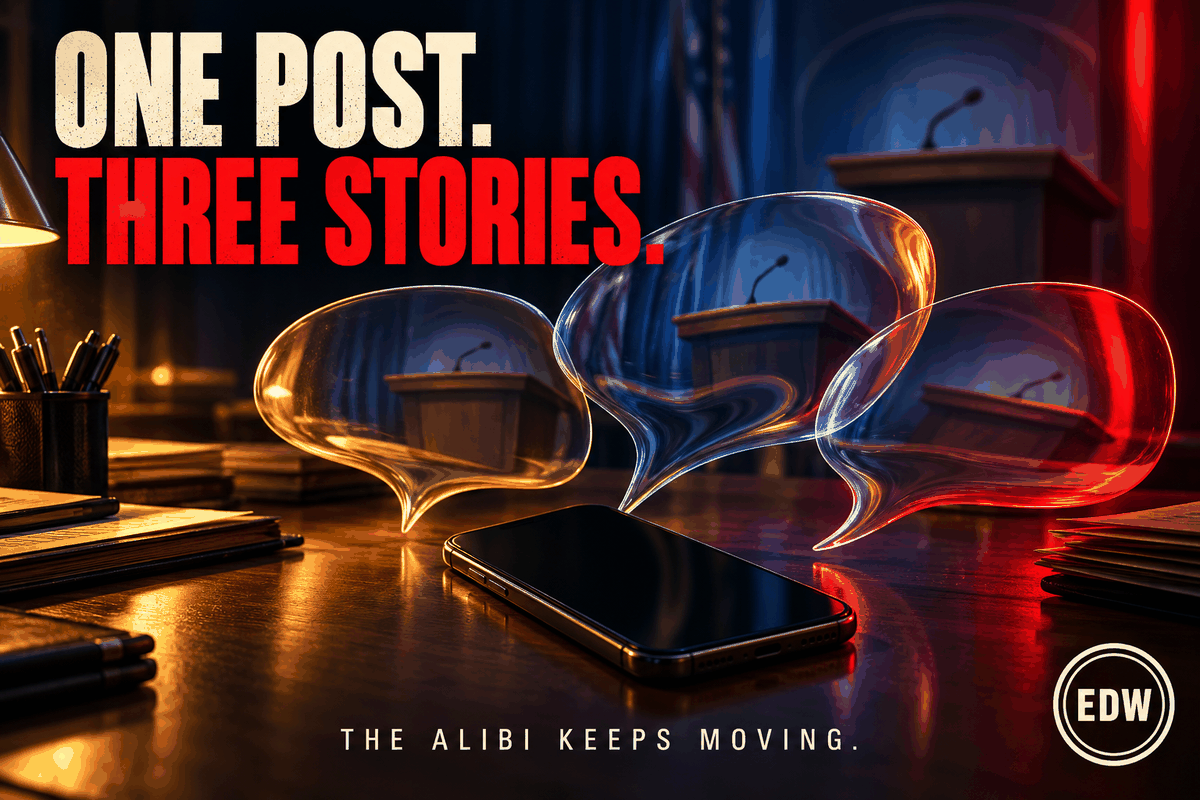
First, the White House tried to muscle the public into silence, “fake outrage,” an “internet meme,” a “Lion King” style parody. Then, when the backlash didn’t play dead, the story pivoted to “a staffer posted it erroneously.” And then the President, instead of landing the plane, lit the runway on fire: he refused to apologize and said he hadn’t watched the whole thing.
That sequence is not crisis management. It’s crisis multiplication. It tells the country three different things in one day: we meant it, you’re wrong to care, and actually nobody meant it, oops. Down-ballot Republicans can handle a controversy. They cannot handle a controversy with a shapeshifting alibi, because a moving story is the universal signal of either incompetence or dishonesty. Often both.
Now you’re asking the question everybody asks when something is this self-defeating: what the hell is going on? Is this sabotage? Is it distraction? Is it the Epstein files? Is it all of it at once?
Let’s talk about Epstein, because the timing is not happening in a vacuum.
This week, the Justice Department has been under intense scrutiny around a massive release of Epstein-related materials, described in reporting as millions of pages plus thousands of videos and a huge volume of images, released on a rolling basis with redactions. The DOJ has also arranged for members of Congress to review unredacted versions on DOJ systems under strict conditions. Coverage around these releases has repeatedly emphasized two uncomfortable truths at the same time: the public wants accountability, and the documents are messy, redactions, privacy concerns for victims, and names of powerful people in communications that are not, by themselves, proof of wrongdoing.
So what’s “in” the Epstein files? A lot. Too much. Enough to generate headlines for weeks. Enough to keep partisans digging for scalp-ready narratives. Enough that anyone with power has a motive to shape what the public is staring at on any given day.
But here’s the trap: “Distraction” is always plausible and almost never provable. It’s a fog machine theory, and fog machines are politically useful precisely because you can’t grab them. You can only cough.
So let’s say the quiet part plainly: whether or not the Obama post was meant as a distraction, it functions like one. It floods the zone. It forces everyone, especially Republicans in swing districts, to stop talking about what they want to talk about and start answering for what they didn’t do.
And that’s why it’s catastrophic for midterms.
Because midterms are not won on cable-news dominance or meme virality. Midterms are won in the thin, stubborn middle: voters who don’t want to be recruited into a cult of personality, who want to be left alone, who would love a reason to vote Republican on the economy and a reason to vote Democratic on basic decency, and who, crucially, treat midterms as the one time they can write “NO” in red pen on the national mood.
This story is a gift-wrapped “NO.”
It’s also, strategically, an own-goal against the exact coalition Republicans have been trying, sometimes sincerely, sometimes opportunistically, to expand. And it’s happening while the right is already picking fights in the culture war that have meaning well beyond football.
The reporting around Bad Bunny headlining the 2026 Super Bowl halftime show has become a proxy fight about language, identity, representation, and belonging, with clear polarization in Republican opinion. If you’re a party trying to make inroads with Latino voters, starting a national tantrum about one of the biggest Puerto Rican stars on Earth is not “messaging.” It’s self-harm. It tells millions of people, in plain English, that their culture is something to be tolerated at best and mocked at worst.
Now layer the Obama video on top of that and ask yourself what the composite picture looks like to a persuadable voter of color. Not to activists. Not to hardcore partisans. To the person who just wants to work, pay rent, watch the game, and not be reminded that American politics can still slip, without shame, into the oldest dehumanizing imagery in our history.
And then there’s the apology problem.
In normal political gravity, this was easy. You come out fast. You condemn it without throat-clearing. You don’t call it “fake outrage.” You don’t hide behind “meme” as if racism becomes inert when it’s rendered in AI. You say you’re taking it down because it’s wrong. If it truly was posted by a staffer “erroneously,” you treat it like an actual operational failure: you explain how the hell presidential comms can post something the President didn’t watch, you tighten process, and yes, if accountability is real, you name consequences.
Instead, they did the opposite. They defended it, dismissed the criticism, and then retreated into a staffer story that instantly collapses under the President’s own posture: he “owns” his social media until it becomes toxic, and then suddenly the cockpit is full of invisible hands.
That is where the sabotage feeling comes from. It’s not just the initial post. It’s the insistence on making the aftermath worse, even when the clean exit is right there.
And here’s the brutal political truth: timing matters because narrative hardens. If you don’t apologize quickly, you’re not just refusing to say sorry, you’re telling the public you’re proud enough to stand there and let everyone else twist in the wind. When you wait, any apology becomes less an act of contrition and more an act of triage, and voters can smell the difference. “Sorry” said late is heard as “sorry I’m being punished.”
So what the fuck is going on?
Some of it is likely just what it looks like: a White House that treats the presidential feed like an algorithmic slot machine, yanking levers for attention and outrage, assuming it can always pivot to a new headline tomorrow. Some of it is a base strategy: keep the faithful emotionally mobilized, because anger is a turnout machine. Some of it may be opportunistic distraction in a week when Epstein headlines and cultural fights are swirling, because chaos is the easiest form of narrative control, if nothing is stable, nothing can be pinned down.
But whether it’s malice, incompetence, or calculated fog, the midterm consequence is the same: Republicans running for Congress inherit a national brand that looks impulsive, cruel, and structurally incapable of owning its own actions without spinning a new version of reality every few hours.
That is not how you persuade the middle. That is how you mobilize the opposition.
And if Republicans lose ground in 2026, it won’t be because one post changed every mind. It will be because one post made something unavoidable: you can’t ask voters to trust you with power while you demand they pretend not to see what you do with it.
EDW•