I ran a medical clinic for 11 years. I watched ordinary people walk in terrified they were losing their independence, because when your vision goes, your world shrinks fast. And I watched something that still feels like science fiction: patients with macular degeneration getting real hope from modern treatment.
This is what makes the pharmaceutical story in America so morally complicated, and so morally urgent.
Because we can hold two truths at once:
We need these drugs.
And the way we pay for them is increasingly a rigged system.
The macular degeneration example is the clearest case study I know.
A drug originally used in cancer care, Avastin, became widely used (often through carefully prepared small-dose compounding) to treat retinal disease, helping preserve, and sometimes improve, vision. Then the “next generation” branded drugs, Lucentis and later Eylea, arrived, designed specifically for the eye. Some patients did better. Some did similarly. But what everyone noticed was the pricing: the branded injections routinely cost orders of magnitude more than the older, repurposed option, often thousands per dose, repeated every month or two for years.
And here’s where the story stops being “just” about a patient’s copay.
Because for a huge share of these patients, the American taxpayer is the payer.
Medicare Part B covers most physician-administered drugs, including the eye injections that keep seniors from going blind. In 2022, fee-for-service Medicare and its beneficiaries spent $46.9 billion on separately paid Part B drugs, including beneficiary cost sharing.
In that same year, Eylea accounted for about $3.5 billion in combined Medicare program payments and beneficiary cost sharing. The corresponding totals were about $0.8 billion for Lucentis and its biosimilars and $0.7 billion for Avastin and its biosimilars. The Avastin figure includes cancer treatment as well as eye care.
Read that again: one drug, in one category of care, in one year, $3.5 billion.
That is not “free market.” That is a publicly financed revenue stream.
So here’s the question every independent voter should be asking, and every elected official should be forced to answer:
If taxpayers are the backstop, if Medicare is effectively guaranteeing the market, why do we have so little leverage over price?
Now we get to the second half of the story: influence.
The pharmaceutical industry does not just sell medicine. It also buys policy, legally, lavishly, and relentlessly.
In 2023, the broader pharmaceutical and health-products industry spent about $383 million on federal lobbying, according to OpenSecrets data. That’s not a typo. That’s the cost of making sure Congress hears “innovation” and “access” while quietly writing rules that preserve pricing power, extend exclusivity, and blunt any serious attempt at negotiation.
And when policy debates heat up, the spending spikes. For example, one Wall Street Journal analysis describes drugmakers pouring tens of millions into the fight over pharmacy benefit managers (PBMs), including $31 million in 2024 and $13 million in the first quarter of 2025 alone.
This isn’t a partisan point. Both parties take this money ecosystem seriously, because it works.
Campaign financing is complicated, PACs, industry trade groups, “issue advocacy,” dark-money nonprofits, and individual executive donations flow through different channels. But the real-world result is simple: the industries most dependent on government reimbursement become the industries most invested in shaping government.
Even at the state level, we see striking examples of massive political giving. The Associated Press reported Pfizer gave $1 million to a Kentucky GOP building fund in late 2022. That’s not “grassroots civic engagement.” That’s institutional power protecting institutional profit.
So yes, this is why so many Americans feel like nothing changes no matter who wins.
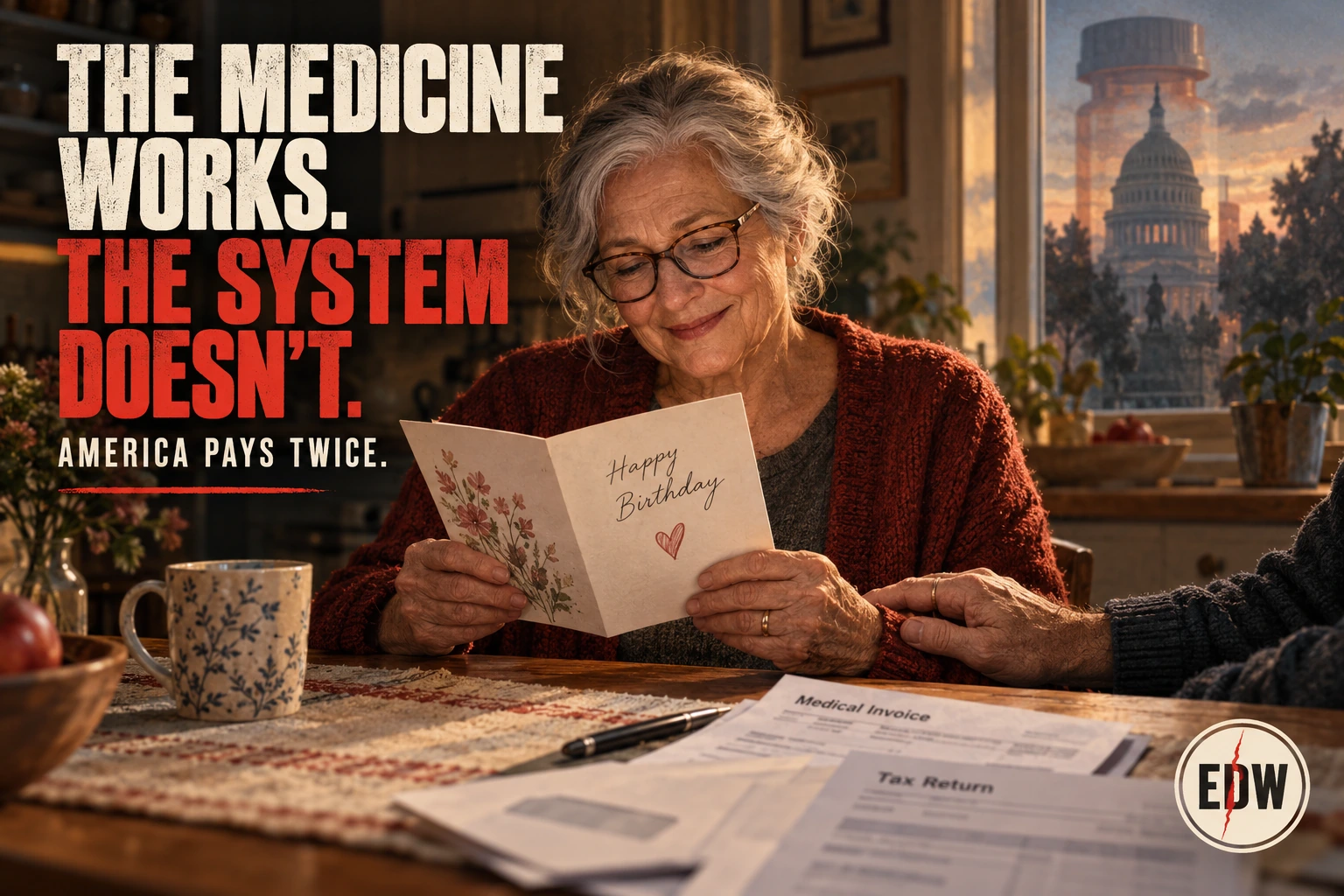
Because we’re paying twice:
We pay as patients and families.
We pay again as taxpayers.
And then we watch the same companies spend astronomical sums to influence the rules of the game that determine what we pay.
That is how cynicism is manufactured. And it is how a country with breathtaking medical capability becomes a country where people skip prescriptions, delay care, go blind slowly, or ration insulin.
Let me be very clear about what this is not saying:
This is not anti-science.
This is not “punish innovation.”
This is not “every pharma employee is the enemy.”
This is saying that any system that can produce Eylea-at-$3.5-billion-in-one-year-of-Medicare-spending and produce about $383 million in annual lobbying across the broader pharmaceutical and health-products industry is not a system optimized for patients. It’s optimized for extraction.
What should we demand?
We should demand real price negotiation power for the programs that taxpayers fund.
We should demand that “new” versions of old drugs prove meaningful clinical advantage, not just patent advantage, before they’re rewarded with premium pricing.
We should demand faster competition (generics and biosimilars) and fewer legal games that delay it.
We should demand radical transparency: what the U.S. pays, what peer nations pay, and who is profiting at each layer.
And yes, we should have the courage to say out loud that if Medicare for All (or any single-payer-style leverage) is on the table, the entire point is negotiating power: one buyer, one standard, no hostage pricing.
This is not left vs. right. This is public money vs. private capture.
If you’re an independent voter, you are the only bloc big enough to force both parties to stop pretending this is unsolvable. It is solvable. But not while we keep treating Big Pharma’s influence machine as “normal politics.”
If this gave you language for what you’ve been feeling, please share it. And if you want more evidence-first, non-tribal breakdowns like this, follow Executive Dysfunction Weekly (EDW).
EDW•